>Interview – Max Goodman, Uproar Art

>Never mind the nightlife and the skyscrapers, one of the most exciting things about New York is the commitment of the many artists and educators who serve their community through not-for-profit work. Over the coming weeks, Books and Adventures will be speaking to some of these American heroes striving to provide the best possible start for their city’s children.

Today we speak with Max Goodman. Max is a young artist and educator who, in 2009, founded Uproar Art, a Brooklyn-based non-profit organization which delivers weekend workshops and after-school classes to the local community. A talented jeweler in her own right, Max has assembled a team of artist-educators who offer courses on everything from recycled art to creating your own comic book.

Max is a dynamic and independent figure – she created her own first job in NYC by contacting 3rd Ward, who were advertising their own arts classes, and convincing them to take her on as an instructor! Although she had intended to teach in New York schools, the constraints of the system led her to found her own non-profit organization for arts education.

‘When I arrived in January 2009, there was a hiring freeze in the district,’ Max explains. ‘Founding Uproar Art gave me the chance to commit fully to my students without giving up my own art-making practice. It was a great way to give back to the young art-making community without sacrificing my own art.’

Max believes that an artist-educator who remains committed to their own practice can offer students new ways into learning, beyond the traditional classroom.

‘Pattern, rhythm and symmetry can all be used in art, but they’re concepts repeated in math and music. Working with paints and metals helps students understand chemistry in a way that a science textbook could only illustrate flatly on a page. Frequently, students who feel they cannot achieve in other subjects are able to find an outlet in the arts, and in this way art keeps students in school who otherwise might drop out.’

Max gives the example of an 8-year-old student who spoke no English when they first met: ‘Her eyes lit up when she was in my art room, because she could follow the visual examples and create a beautiful piece. She expressed herself without worrying about the boundaries of language. That kind of outlet is absolutely invaluable in our world of standardized tests and rubrics.’

We’ve discussed British educational assessment on Books and Adventures before, but Max’s comments highlight the issues raised by testing on this side of the Atlantic, where there is a move to regulate education at a more national level. Max is ambivalent about this move:

‘I believe that funding for education should be sourced and therefore equalized on the national level, but I do not think it’s reasonable to expect students everywhere to pass nationalized standardized tests. Individual communities understand the challenges facing their students, and should be afforded more local control over curriculum. A national curriculum should definitely be offered, but expecting students who speak English as a second language, or those with learning disabilities, to test the same as their peers is absolutely unproductive.’

As Max’s home patch in Brooklyn undergoes gentrification, wealth brings new opportunities and resources to the community – but it can also divide a neighborhood. On a recent visit to Bedford-Stuyvesant, I spoke with a local parent who decried the privileged do-gooders who parachuted in to a deprived area – but were free to leave the community’s problems behind at the end of the day.

Max’s team at Uproar Art are sensitive to these issues and committed to the place where they live: ‘We seek to ease tension and conflict – to make sure we’re serving the community that has existed before the influx of wealth as well as the newcomers.’

Wherever possible, Uproar Art offers free and low-cost workshops alongside their comprehensive range of classes. ‘Eventually, we’d like to be a resource for children with an interest in the arts who may not have the means or support to pursue it extra-curricularly, as well as for the students that have the support system in place. We’re hoping to offer sliding scale payments for classes over the coming year.’

Max’s ethical commitments extend to opposing the involvement of the private sector in public education: ‘I think no for-profit entities should be allowed to play any role in our educational system. When I was a student in the Philadelphia public school district, a for-profit company sought to take over our schools in order to use them as a fertile captive audience for advertising. Education is for the good of the students and of the society in general, and somebody seeking to profit from that loses sight of these moral truths.’

Uproar is on the cusp of finishing its incorporation process, which will enable it to accept grants for future projects – and Max’s team are already looking ahead to the months and years beyond.

‘Our first year of business has gone well: we’ve found many allies in the local community, and have been welcomed with open arms into local studios. In the coming year we’d really to work more directly with local schools. It’s time to start reaching out to the parts of the community that don’t have access to programs like ours.’

In the immediate future, Max is excited by launching her own workshop on Organic Sculpture in Lefferts Garden. It’s based in part on the work of Andy Goldsworthy, who makes temporary artwork from found items in the environment.

‘Before now it’s been difficult to find a location that parents and art studios were both comfortable allowing students to make nature based art, but I’m very excited to see what my 6-8 year old sculpture students discover in our own back yard. In addition to teaching Organic Sculpture we also offer a Recycled Art course. Because of our strong community focus we’re always looking for ways to blend art making and the environment, and luckily there’s no shortage of other environmentally friendly non-profits ready to partner with us – friends like Glenn Robinson at Bags for the People or Annie Novak of Rooftop Farms.

To find out more about Uproar Art and get in touch with Max and her team, visit http://www.uproarart.org/.

>Paint the Town Read – Interview with Rhonda Brain, Part 2

>

You’ll find Part One of this Interview here:

Rhonda Brain, founder of Australia’s Paint the Town Read scheme, now takes the PTTR message to other towns across New South Wales and beyond.

“When I share our scheme with communities, I always remind them that we have been going for a long time, so they shouldn’t be daunted by the amount of things we do….Other towns may use as many or as few of our strategies as they like: they’re a springboard.” 

A number of the communities have adopted the idea of a reading mascot, and most run a Community Reading Day, but as Rhonda puts it, “on the whole, committees take on the concept and run with it! The concept is THE biggest “engenderer” of creative and fun ideas, I have ever come across….PTTR committees are always amazed and excited at how the ideas will flow…”

For example – in Toongabbie, New South Wales, the Portico Plaza shopping centre worked with local authorities at Holroyd City Council this year to run storytelling and craft sessions for children, hosted by local reading mascot Poppy the Possum.

‘Poppy the Possum’ in Holroyd, NSW encourages the community to ‘Paint the Town Read’


Diane Hacking of Portico Plaza explains why the staff and management were so keen to get behind the scheme:

“We’re a small neighbourhood centre, and the majority of our shoppers are families. We had no hesitation in helping local children to get a good start, giving them a chance to be better educated, and hopefully to secure a good job later in life. Many of them will grow up to be the teenagers, mothers and fathers who we serve here at Portico Plaza.”

The fun-filled events run by PTTR committees are fuelled by grassroots passion, but based in the latest scholarship on language development.

“There’s a plethora of research now on the brain’s need for stimulus for language development, from birth right up to age five,” says Rhonda Brain. “But it’s of little use if parents near hear of it….so, our motto is RESEARCH SAYS IT, WE SPREAD IT! In a creative, fun-filled, celebratory way.”

Rhonda sees a profound impact in this apparently light-hearted approach: “When something is celebrated, it is given value. We create a climate of wanting to read…with the whole community owning the project, from the mayor to the schools, businesses, parents, maternity wards, police, and beyond!”

Rhonda is emphatic that such a project serves the whole community, not just infants:

“We’ve seen the huge impact such a project can have on building social capacity and connectiveness – addressing our 3 basic emotional needs: to have a sense of belonging; a sense of worth and a sense of competency; relationships – not to mention the positive impact it could have on the economy…”

In 2010, PTTR continues to spread from town to town and Rhonda is now lobbying the government of New South Wales to adopt it as an official scheme.

‘Whether they do or they don’t, it’s happening, spreading like wildfire from town to town’ she says. ‘I would love to hold a book relay across New South Wales…and then Australia. One day we hope to have Australians celebrating literacy at the same level we celebrate sport – wouldn’t THAT be something!’

>Paint the Town Read – Interview with Rhonda Brain, Part 1

>

‘I hope you’re reading to the baby, Mum, ‘cause I don’t want a dumb sister’

When a child in a New South Wales kindergarten met his newborn sister for the first time, he knew just what advice to give his mother.

The young boy wasn’t even in primary school yet, but he had been brought up to value literacy thanks to ‘Paint the Town Read’ (PTTR), an Australian campaign to raise awareness of children’s need for a language-rich environment right from birth.

It seems that no-one does ‘Books and Adventures’ quite like Australians. We’re back down under on the blog this week to talk with Rhonda Brain, a former headteacher from New South Wales who has seen the PTTR scheme, which she devised, take her homeland by storm.

Teaching in Parkes, New South Wales, Rhonda and her team realised that there were a growing number of children coming to kindergarten with delayed language development. Rhonda decided to target every new parent right at source – in the maternity ward!

She continues the story: “I wrote to every school and pre-school in Parkes, asking them to donate an agreed amount to purchase books for every new born, with a message in it from the schools …and later from the Shire Library.”

Government funding allowed Rhonda to think even bigger. She recruited a team of movers and shakers in childcare and literacy, including teachers, maternity nurses, and the local speech pathologist. With a motto of “We don’t want your money but we do want your co-operation!”, the team quickly secured the support of the mayor and other town leaders.

Rhonda explains: “It is wonderful, the town really do have ownership of the scheme, even to the point of being annoyed when TV reports the latest person as coming up with this wonderful idea of reading to your children from a young age.

“We held our launch in August 1996, gave the first baby born after the launch many books and prepared for our first Reading Day, held in 1997. We had many out-of-town guests from educational institutions and from parliament. The mayor held a civic reception for them and our committee and principals. Special education expert Dr Loretta Gircelli spoke at our launch and at our first reading day.”

PTTR activities today fall into three categories: on-going, one-off and annual.

Communities involved in PTTR arrange for books to be given to every child throughout their early years. The first of these on-going gifts is given to every newborn baby by their maternity nurse, complete with a personal message, and is followed by age-appropriate PTTR-designed story booklets, given out at immunization days, antenatal bookings and high school events.

One-off events included the clever appropriation of Y2K media panic to create the Millennium Reading Bug in 2000. This mascot has become increasingly popular, even generating its own fun dance at school socials and PTTR events. (When the Reading Bug laid an egg in 2004, children were encouraged to visit it and read to it just as their parents read to them!).

Along with a human chain of readers stretching more than a kilometre down Parkes Main Street, a 12-hour overnight “readathon”, and other attention-grabbing activities, Rhonda’s team have worked hard to keep literacy in the spotlight across New South Wales. In 2005, a Reading Relay saw a book passed, like the Olympic torch, from town to town across over 60 communities and 5500 kilometres in just two weeks. The message to ‘Paint the Town Read’ travelled by hot air balloon, motorbike, fire engine and even on horseback in a striking celebration of the communities’ dedication to encouraging children’s literacy.

The highlight of the PTTR calendar is the Annual Community Reading Day. Now in its fourteenth year, this event sees schoolteachers rise early to literally ‘paint the town read’, decorating shopfronts and streets throughout the town. Pupils, teachers and local workers all dress up according to a theme, and storytelling events take place in the town’s stores before the local park plays host to a celebratory ceremony that has over 2000 people in attendance. Guest speakers have included sports personalities, writers, government ministers, and even the Governor General of Australia.

Next time on Books and Adventures we’ll follow Rhonda as she takes the message of Paint the Town Read to communities across Australia.

You’ll find Part Two of this Interview here:

>NaNoWriMo Young Writers Program – Chris Angotti Interview

>It’s been hard to miss it this month – in cafés and libraries from Vancouver to Vienna, you’ll have seen them hunched over laptops or notepads. The Internet is resounding with their hopes, dreams…and occasional frustration as they battle on towards a final word count.

Over 250,000 people worldwide are participating in this year’s National Novel Writing Month (NaNoWriMo), which sets contestants the challenge of producing their own novel between 1st and 30th of November.

Among those thousands of dedicated souls are 50,000 under-18s who have signed up for NaNoWriMo’s Young Writers Program, setting their own word count goal for the month. The Program provides a wide range of resources and support for budding novelists and their classroom teachers – available here.

Chris Angotti, who runs the Young Writers Program for NaNoWriMo’s parent organization, joins us today for an interview on Books and Adventures.

What was the aim of setting up the Young Writers Program at NaNoWriMo? Was it hard to get schools on board initially?
The Young Writers Program was originally set up as a way to support teachers who wanted to implement NaNoWriMo in their classrooms. In the beginning, many of them were participants or friends of participants. So it wasn’t hard to get schools onboard; these folks were already aware of the potential of NaNo. Since then, we’ve done some outreach, but most of our expansion has been through word of mouth, with more and more young writers and educators excited by NaNo every year.

What has been the Program’s greatest success to date?
I think our greatest success has been how much we’ve evolved. We’ve gone from a few classrooms to thousands. Our materials have gotten better, and we’re seeing the results of the hard work we’ve put in.

In terms of specific successes, I get those when I ask for stories from our participants. My greatest satisfaction is when I hear about kids—sometimes whole classes—who have gone from writing simple sentences to entire, involved novels. All because of the Young Writers Program.

What else does the YWP teach apart from creative writing skills? How does it affect students’ broader outlook?
I’m very proud of what we do for students’ self-esteem. In our surveys, almost 100% of educators agree that the program has made kids look at themselves as more capable and accomplished. They tell us that their students are ready to take on far more in life than just writing.

In addition, the program teaches time and project management skills—life lessons that are well conveyed through this challenge.

Is there a danger of pupils taking away a message of quantity not quality from the Young Writers’ Program? Are there educational benefits to a ‘quality not quantity’ approach?
We’ve always said that what NaNoWriMo helps with is a first draft. We definitely think it’s important that writers edit and revise their work. By the end of November, students are so attached to their novel that they want to do this. It’s no longer the chore it might be during standard grammar lessons. These young authors are proud of their work, and they want it to shine.

There’s a lot of pressure on teachers to fill an already packed school day with all the curriculum activities demanded by education authorities. How much time should they make for NaNoWriMo each day and why?
It’s really up to the individual teacher to determine how NaNo can work with his or her class. Some teachers simply introduce the challenge, and then students work on it individually at home. Others make it a major part of November, with time spent in class for planning, sharing, and editing. I think it depends most on students’ needs, and nobody knows that better than good teachers.

Have there been any memorable ‘Thank Goodness It’s Over’ parties held by the YWP groups?
We hear about people doing all kinds of stuff: prizes—quills, crowns, certificates—for writers; presenting students with finished copies of their novels; even just eating lots of pizza and celebrating. The TGIO party is an important part of the process—to acknowledge what students have completed and to make a special time to celebrate it.

One of my favorite parties is the one the Washington School for the Deaf throws every year. That’s a great inspiration.

What have been your own experiences as a ‘Wrimo’?
This is actually my first November as YWP Director, and my first year doing NaNoWriMo. So far, I’ve been keeping up the best I can with my word count. It’s not as hard as people think! The support I’ve gotten from the office, and from my local region, has been invaluable. I love it, and I’m happy to be forced to write. I know that even if my book is not perfect (or even close to it), I’ll have accomplished something that most others haven’t.

What are your favourite books?
I like most anything by Fitzgerald or Hemingway. They’re my go-to authors. Two more recent books that I really love are Jim the Boy by Tony Earley and Underworld by Don DeLillo. Each is epic and evocative in its own way—one more simple and restrained, the other sprawling. I’m always reading, though, and have too many favorites to list.

You can find out more about NaNoWriMo’s Young Writers Program at http://ywp.nanowrimo.org/


>Roland Pietsch on The Real Jim Hawkins

>

Today on Books and Adventures we’re joined by Roland Pietsch, a historian whose chequered past includes running a music venue, and work on TV’s Who Do You Think You Are?, alongside university and outreach work in East London.

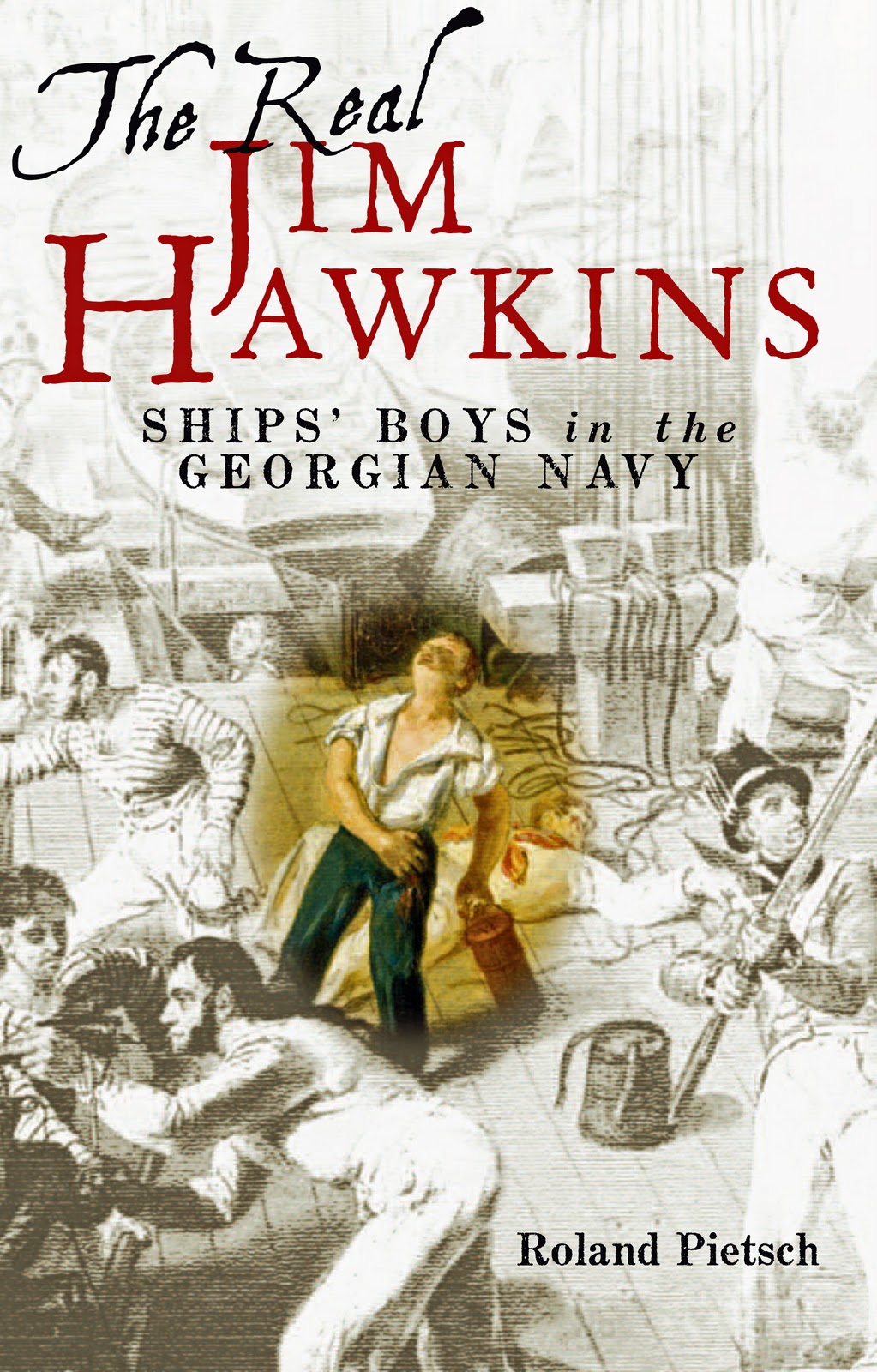
Roland’s book The Real Jim Hawkins, released this month, looks at the real-life counterparts of the hero of Treasure Island – boys as young as thirteen who enlisted in the Navy when Britannia ruled the waves. For fans of Robert Louis Stevenson’s great adventure story, it’s an opportunity to see the truth beyond the swashbuckling adventure.

‘Of course I was a Treasure Island fan as a kid, even though I grew up in the very non-maritime city of West Berlin,’ Roland told me.


Roland Pietsch

Treasure Island had been adapted as a West German television series. Then my auntie from the other side of the Wall gave me the actual book, and an East German record, as Christmas presents. Jim Hawkins’ treasure hunt not only easily crossed national borders, but even the hardened ideological borders in my childhood.’

As an adult researching his PhD, Roland discovered the truth behind Stevenson’s novel in the archives of the London Marine Society, an eighteenth-century charity that recruited thousands of impoverished boys for service at sea.

Roland found that the real-life boy sailors had a surprising amount in common with Stevenson’s Jim Hawkins: ‘Both were placed in such dangerous and adventurous situations, that they had to stop being boys and prove themselves in the adult world.’

One of the reasons for recruiting sailors so young was to make them immune to the horrors of war. The Navy fostered a culture of fearlessness and nonchalance in the face of danger. It was also necessary to impose discipline on unruly boys brought on board.

Roland compares this to ‘an eighteenth-century ASBO’, but then points out that Stevenson’s Jim Hawkins is no clean-cut hero himself: he takes the stolen treasure at the end of the novel, without considering that his mates have no more right to it than Long John Silver and company: ‘Doesn’t this hint that even the fictional Jim Hawkins was a bit of a cheeky character?’

Sadly the fictional Jim’s prospects were far happier than those of real 18th-century boy sailors.

In such dangerous roles as ‘powder monkey’, boys were expected to fetch gun powder from below decks to charge the ship’s guns, dodging shot and wooden splinters in the heat of battle.

‘Many lost their lives at sea,’ says Roland, ‘or struggled to come to terms with witnessing so much bloodshed at such a young age. Some battle scars went deeper than a wooden leg.’ Alcoholism and internment in the infamous madhouse at Bedlam were often the consequence of a seafaring youth.

One of the more incredible real-life stories discussed in Roland’s book is that of Mary Lacy. Disguised as a boy, this teenaged girl managed to serve on board a cramped Navy vessel. Ships of the time like HMS Victory comprised 850 men in a small wooden world, 50 metres long, 15 metres wide and 6 metres deep, a challenging place in which to conceal one’s true gender.

‘Then again,’ Roland points out, ‘washing opportunities were limited, so nobody ever detected Mary. The closest they came was when she challenged one of the other ship’s boys, who was a bit of a bully-boy, to a fight – she was expected to take her shirt off for the boxing match!’

Roland’s book offers a fascinating and often surprising glimpse of the truth behind the vision of seafaring life found in novels and movies. It’s available here, and you can find Roland’s article on The Real Jim Hawkins for Sabotage Times here. For more information, visit Roland’s website, http://www.rolandpietsch.com/

Next time on Books and Adventures – pausing only to catch breath after the Birmingham Half Marathon – we’ll be beginning our in-depth look at the writing, and legacy, of Australia’s Patricia Wrightson.

>help2read – Volunteer Literacy Support in South Africa

>Books and Adventures continues our world tour of literacy support this week, heading to South Africa to visit the literacy NGO help2read.

help2read founder Alex Moss started visiting South Africa shortly after the introduction of democracy to the country in 1994. A visit to a township with a leading member of the struggle against apartheid inspired Alex to help with the construction of a new society in South Africa.

‘I was struck by the shocking levels of illiteracy arising out of the lack of adequate education during the apartheid years,’ Alex explains. ‘I was convinced that the disadvantaged majority would only ever be able to reach their full potential if they could fully enjoy the benefits of education, benefits which require the prerequisite of literacy.’


Working as a volunteer with Volunteer Reading Help in the UK showed Alex a model of literacy support which could be taken to South Africa at a comparatively low cost, but it took time for the project to get off the ground.


Early in 2005, Alex met Dee Cawcutt, the Principal of Muizenberg Junior School, just outside Cape Town. Dee offered to put her school forward as the first for what would become the help2read programme. The children, aged 5-12, are selected by class teachers as being those, other than children with special needs, perceived as most in need of assistance. They read and play literacy games with their volunteer helper, working in the school library or a quiet place outside the classroom, supported by help2read’s resource boxes full of interesting and beautiful books.

Alex takes up the story:


‘In the summer of 2005 I persuaded my daughter to come back from Washington DC, to be trained at VRH and to go to Cape Town to set up the programme. She arrived in Cape Town in early November 2005 and quickly set about recruiting volunteers wherever she could. On 1 February 2006, six trained volunteers started at Muizenberg Junior School.’


Within weeks the school was reporting unprecedented change in the pupils on the programme, ‘from being completely shut down to becoming happily involved in school life and the excitement of learning.’


The early volunteers for help2read were, like those of VRH in the UK, often middle-class people eager to share the benefits of their education and make a contribution to society. In South Africa, this group continues to provide a significant minority of volunteers – but a great change has come about from 2006, when help2read began recruiting from among the parents of a township school.


This proved very successful and quickly became the model for most help2read volunteer recruitment. Alex explains: ‘The volunteers are the literate parents of children at the same school as the children they are helping and are able to achieve equally impressive results with the children as those we gained at Muizenberg. Volunteers also benefit from the empowerment that they experience in becoming a respected member of the school community and with the success which they achieve with the children they are helping.’


help2read has already helped over 5000 South African primary school children to become literate. ‘In every single case,’ says Alex, ‘these children would have been early drop outs from the education system without the help our volunteers have given them. Now each one of them has the opportunity to go all the way through the system, to university and beyond.’


help2read’s sights for the future are also set high. Having adapted the VRH model, developed in a wealthy Western country, to a South African setting, the help2read team are planning to extend their programme to all African countries where English is the medium for education.


‘We hope to open our first programme outside South Africa by 2012,’ says Alex. ‘In the longer term, we believe that the help2read concept can be replicated in other languages and can be a major part of the solution to the literacy problem that exists in all developing countries.’


To find out more and get involved, visit http://help2read.org/

>Reach Out and Read at New York Presbyterian Columbia University Medical Centre

>Staying with our transatlantic theme after our feature on San Francisco’s Reading Partners, this week finds Books and Adventures in New York to find out more about the Reach Out and Read (ROR) programme at the New York Presbyterian Columbia University Medical Centre.

ROR is a national literacy and healthcare programme which operates across the USA. Under the scheme, volunteers read stories to children in clinic waiting rooms, paediatricians advise carers on the importance of reading aloud, and children visiting their doctor from the ages of six months to five years receive a new book to take home at every check-up.

Paediatricians and educators working together founded the programme in Boston in 1989; in 1997, Reach Out and Read came to New York Presbyterian Columbia Medical Centre, serving families in largely Spanish-speaking areas of Northern Manhattan.

Over 13 years the programme has grown from a single site in Washington Heights to cover five clinics, serving more than 10,000 children and distributing nearly 20,000 books per year.

Volunteers commit at least six months a year to engaging children in literacy activities and demonstrating to carers that sharing books with a child helps them to bond and communicate with adults. Volunteers’ interactions in the waiting room can inspire parents and carers to support their children’s literacy at home.

Paediatricians and hospital administrators have shown equal dedication to the programme, reflecting their belief that exposing young children to high quality, age-appropriate literature will not only encourage a passion for books, but also have a positive impact on growth and development.

‘Paediatricians do not merely give books to their patients as lollypops at the end of a well-child visit,’ says Emelin Martinez, Literacy Co-ordinator at New York Presbyterian. ‘They provide parents with advice and strategies they can use to enhance their child’s social, cognitive and motor skills development in using books that are developmentally appropriate.’

ROR as a programme takes a long-term view of literacy support: as part of care visits throughout early childhood, doctors see the same children two to four times a year.

‘Advice from each encounter builds on the last encounter and at the end of the five years, each child has a library of 12-14 high-quality, culturally, developmentally and linguistically appropriate books,’ explains Dr. Mary McCord, medical director of the programme. Many volunteers establish a bond with patients who attend multiple well-child visits. As the average wait in a clinic runs to two hours, volunteers have plenty of time to engage children with pleasurable and constructive reading sessions on each visit!

What really marks ROR out from other literacy programmes we’ve discussed on Books and Adventures is its pre-emptive approach. Where many schemes operate with a remedial focus, ROR aims to prevent literacy problems before they start. There is a focus on delivering anticipatory guidance to the carers of young children, promoting literacy and healthy development from as young as six months.

Emelin Martinez explains how this attention to literacy benefits a community’s health and well-being: ‘From a population perspective, poverty is the single most important determinant of health. Education has proven to be the only strategy to successfully move people out of poverty. Promoting literacy is one of the most important tasks that a paediatrician has with their patients early in life, to ensure that children can become healthy and successful adults.’

The ROR team at Presbyterian are proud of the positive impact their programme has had on families in Northern Manhattan. Caregivers have reported that watching their children’s interaction with volunteers has inspired them to implement the strategies seen in the clinic when they get home.

Emelin Martinez says, ‘On many occasions, I’ve witnessed parents reading to their children in the waiting rooms of our clinics, which demonstrates that parents’ behaviour regarding early literacy is changing. For some families, ROR books are the first books they have in the home. For others, parental illiteracy emerges as a problem when giving out these books and encourages caregivers to attend literacy programmes themselves. For paediatricians, it is touching to see how children ask for the books as soon as they come in, changing a long standing tradition of having stickers or candy be the reward for a medical visit.’

Huge thanks to Emelin Martinez and Dr. Mary McCord for joining Books and Adventures to discuss a programme which reflects such a positive and progressive approach to literacy and well-being. You can find out more at http://www.columbia.edu/itc/hs/medical/residency/peds/new_compeds_site/programs_ror.html

>Reading Partners – One to One Literacy Support in California and Washington D.C.

>This week Books and Adventures crosses the Atlantic to feature Reading Partners.

This US non-profit literacy organisation, which celebrates its tenth anniversary this year, helps children to become lifelong readers by developing communities’ ability to provide individual literacy support.

I was particularly excited to discover the scheme as there are many parallels between Reading Partners and the UK literacy charity Volunteer Reading Help, on which you can find more here.

Reading Partners was founded in 1999. A retired school nurse, Mary Wright Shaw, was working in a neighbourhood of Palo Alto, California, when she discovered that many local children were unable to read the books provided in her clinic’s waiting room. Together with two friends, she committed to do something about this – and what was then the ‘YES Reading’ programme was born.

Now known as Reading Partners, the organisation has expanded throughout California and Washington D.C., serving over 1700 pupils and growing from a single trailer outside of an elementary school to 37 school sites.

Volunteers work on school campuses in 45-minute one-to-one sessions with children who need extra help to get their reading up to grade level. Many pupils, coming from homes where English is not the first language, may have stronger speaking skills, but still require support with reading and writing. Reading Partners, whose volunteers range all the way from high-schoolers through to retirees, records an 88% success rate in helping students accelerate their progress in reading.

Development Manager Allison W. Cohen joins Books and Adventures to tell us more.

‘Our model is scalable, high impact, and high quality,’ she explains. ‘In the past five years Reading Partners has grown by over 600% and maintained consistent results for students in the program.’

The Reading Partners scheme has its own curriculum, designed to California Department of Education standards in collaboration with experts from the Stanford School of Education. The organisation uses Houghton Mifflin’s RIGBY PM to assess student progress, alongside state standardized tests.

This commitment to providing measurable results makes Reading Partners an attractive option for charitable donors, as Allison makes clear: ‘Reading Partners gives donors measurable, tangible results that they can point to. It is easy to see how your money is being used and the value of that donation.’

Reading Partners has responded to the challenges of the economic climate by partnering with the federal AmeriCorps programme. As the charity becomes leaner and more efficient, plans for the future are optimistic: ‘We hope to serve at least 100 schools in the next three years and tackle the childhood literacy crisis on a national scale.’

You can find out more about Reading Partners, and read their report ’10 Stories for 10 Years’, here.

>Steve Killick Interview – Being Our Best at Cae Mabon

>Storyteller and child psychologist Steve Killick returns to Books and Adventures this week, in advance of his workshop ‘Being Our Best: Bridging Storytelling and Positive Psychology’, run with Eric Maddern at Cae Mabon this month.

The four day event offers participants the opportunity to explore and apply the wisdom of traditional stories in the context of modern psychology.

Steve explains: ‘By Being Our Best we mean looking at the best aspects of human nature, love, creativity, compassion, co-operation, rather than our negatives: selfish, destructive, short-sighted ,fearful. In a sense, this is the symbolic struggle between good and bad that is played out in stories.

‘Stories have always been the most effective ways of transmitting ideas, values and beliefs essential in religion, mythology and simply learning how to live. Education without them is impoverished and, in my mind, impossible.

‘In the course Eric Maddern and I are running we look at what Positive Psychology, the study of wellbeing and optimal performance, and what the wisdom of traditional tales is telling us- and what they have in common- and there are some surprises there!’

Steve is concerned that, in a technologised world, oral storytelling should continue to have a place alongside other media. ‘Storytelling takes place without technology, just “eye to eye, heart to heart and mind to mind” as the proverb goes.’

Often, participating in this oral tradition involves retelling time-honoured myths and fables. This requires a delicate balance of respect and reinterpretation:

‘On one hand, you cannot just change a story on a whim. On the other hand, it is a dynamic thing that needs to resonate again in the present, rather than be a museum piece to be looked at and never touched.

‘A story is a message from the past to today. For me it is about making the tale live now – what values do we find in this story now? We don’t always know what the story meant in the past.’

As an example, Steve points to the radical renegotiations of traditional stories which have been popularised by the like of Neil Gaiman and Angela Carter:

‘Heinrich Zimmer said about myths that they have to be questioned and consulted anew, with every age approaching them with its own variety of ignorance and understanding. If you are working with traditional material you do it with love and care. You retain the spirit and breathe new life: That’s what I think Carter and Gaiman have done fantastically. Carter’s reworkings, particularly, have contributed to the revival of interest in storytelling.’

There’s still an opportunity for participants to sign up for Steve and Eric’s journey of narrative exploration at Cae Mabon from 23rd-26th September. You’ll find more information on Steve’s site at http://www.wordsofwonder.co.uk/Cae-Mabon.html

>Interview: Young People’s Writing Squads

>Today Books and Adventures features the Young People’s Writing Squads, an exciting scheme run by Academi, the Welsh National Literature Promotion Agency and Society for Authors.


The squads give gifted young writers in both English and Welsh the opportunity to work with professional writers to develop their talents.


“The idea of the Young People’s Writing Squads is inspired by county sports squads, where talented young footballers or rugby players are pooled together to give them the opportunity for specialised training,” says Elena Schmitz, Academi’s Schemes and Data Manager.


“Similar to these sports squads, the Writing Squads are intended for children who show particular ability and promise for creative writing. This does not mean that they have to get good grades in school, be particularly good at English or be able to spell exceptionally well – but they do need to be able to demonstrate an above average ability for being able to write creatively – they need to be good at inventing characters, stories or using language in an unusual way, for instance.


“The Squads are not only for the gifted and talented performers in school, but for those with an unusual talent and passion for creative writing. “


The scheme has been running since 1996. Today, over 40 squads operate across Wales. Squads of around 15-20 schoolchildren meet four to six times a year for special training sessions. Squad members are encouraged to remain a member of a Writing Squad for the length of their school career.


Together, each squad gets the opportunity to experience and develop different styles, genres and techniques with a variety of writers.


“The children usually come together for a half day and work with one or two professional writers on a specific topic,” Elena explains. “This can include short story writing, science fiction, script writing or poetry. Some Squads tackle more unusual themes, such as writing for magazines, graphic novels or journalism. Often, the children are asked to prepare a piece of writing in advance which they can develop and improve during the session.”


Many squads have a ‘usual’ local venue where they meet. This is often a library, arts centre or council-owned venue. Occasionally, Squads meet in a school, although this is the exception. Academi is keen for Squad activities to take place outside schools and outside school hours, to ensure participation is voluntary and not seen as a school activity.


“In some cases, Squad sessions take place in unusual locations,” says Elena. “They can involve trips to a gallery, train journeys (poetry on a train), museum visits or even residential excursions to an island (the Cardiff Squad regularly visits Flat Holm Island in the autumn). The children are then usually asked to react to their environment and write about the art they have seen in a gallery, for instance.”


Examples of work from a trip to Cardiff National Museum by the Bridgend Writing Squad can be found here.


Academi was awarded a Beacon Company Award by the Arts Council of Wales in October 2008. This allowed Academi to develop the Writing Squad movement, establishing new Squads where no provision had previously existed, as well as creating a new website and running a number of conferences, workshops and special events all over Wales. Funding from the award came to an end in March of this year. Elena expresses disappointment that the additional funding will not be continued beyond 2010:

“A lot of the additional Squad activities which took place over the last 18 months will not be possible due to the lack of funding. We have pointed out to the Arts Council of Wales that timing for stopping the extra funding could not be worse: just when additional Squads have been established after a lot of hard work, money runs out to maintain them. And this at a time of the worst recession in decades, when local authorities – who share the costs for running Squad workshops with Academi – are faced with budget cuts on an unprecedented level.

“Nonetheless, Academi is committed to the Squads movement and we will try to do as much as we can to support them. We will continue to invite Squad members to special events, such as the National Eisteddfod or Hay Festival and provide funding for Squad workshops on an ongoing basis from our Writers on Tour funding scheme.”


The Writing Squad scheme remains ambitious for the future, despite these challenges. Plans to establish new Writing Squads in languages other than Welsh and English proved more difficult than first anticipated, so Academi has focussed on increasing provision, events and opportunities for these communities.


“We hope that by providing more events in languages other than Welsh and English and by engaging more closely with the Urdu and Somali communities in particular, we will be able to create more interest in creative writing amongst parents and will in future be able to establish new Writing Squads in Somali and Urdu, for instance,” says Elena.

One example of this community engagement is the joint Urdu-Welsh poetry reading organized by Academi and Swansea University at this year’s National Eisteddfod in Ebbw Vale.


Academi continues to welcome new Squads, particularly in areas where no Squads have yet been established, such as Anglesey or Rhondda Cynon Taf, as well as those areas where only limited provision exists.

“If teachers are interested, we’d recommend they contact the existing Squad Organiser in their area to start with, to see how their school can get involved,” says Elena. Details for the Squad Organisers in each area can be found at www.writingsquads.org/new-squads/, and if no Squad currently exists in your area, local teachers and librarians can contact Academi at http://www.writingsquads.org/contact/ to see how a new Squad can be established.


Our thanks to Elena Schmitz at Academi for speaking to Books and Adventures about this exciting scheme. You can check out the Squads’ site at http://www.writingsquads.org/

Next on Books and Adventures: carnivals, South America….and another visit Down Under!