Sometimes, there’s a thought out there, but we’re not yet the person who is able to think it.
Something comes to us as a glimmer or a hunch, an inkling, a vague intuition that we may or may not choose to pursue – or be capable of currently pursuing.
Let’s call such thoughts “unthunk”: it’s a satisfying sound.
Even practical and technical insights may arrive via dreams, daydreams, or moments of reverie before we can consciously handle them. A famous example is the chemist August Kekulé’s discovery of the structure of benzene. Kekulé claimed that he worked out the ring-shaped structure of the benzene molecule after dreaming of a snake swallowing its own tail:

The truths which can’t yet be thought may be more personal or intimate. They may involve aspects of our emotional makeup, our relationships, or our identity which we’ve shied away from. These can bubble up to the surface where they demand to be named and recognised, and in doing so change our sense of who we are.
These intuitions may even come to us via the screens of our smartphones. As I write this, Spotify users will have recently received “Spotify Wrapped”, an examination of our listening preferences over the year just gone.

All kinds of mundane realisations might emerge – including “I let my kids choose what we’re listening to a lot” and “I always use that same playlist when I go to the gym” – but sometimes, in the music we’ve picked, there’ll also be evidence of an unthunk thought: “I kept returning to that song last January, just because I felt like it, and now I find that something in the lyrics, or the tune, spoke to thoughts and feelings that I am only able to name in hindsight.”
Sometimes we look back on a season of life and – leaving aside our amazing ability to construct neat stories out of chaos in retrospect – we clearly perceive that our gut decisions, intuitions, and inclinations were leading towards something we hadn’t seen coming at the time.
Annie Reiner’s excellent introduction to the theories of Wilfred Bion includes a chapter on these “thoughts without a thinker”:
wild thoughts that come to us unbidden, like dreams, while we are asleep or awake, but of which we cannot claim ownership or are not yet able to think. These intuitive, imaginative, ephemeral thoughts are the numinous thoughts of seers or mystics or strokes of genius in the minds of artists, scientists, or psychoanalysts […] absolute truths that exert pressure on the mind to think them simply because they are true. Like “the elephant in the room,” one can either notice or turn away from truth, but it is still the truth. […] Once able to think it, the thought brings order to apparent disorder.
Thinking anew
In times of uncertainty, it can be hard to make decisions or to work together effectively, because we struggle to appreciate all the forces and factors at play.
Trapped in the tunnel vision of our usual frame of reference, clinging to the comfort of old certainties and old connections, fearing disorder and wanting so badly to believe that thinking the same old thoughts will suffice, we can’t or won’t turn our attention to the “elephant in the room”.

It may even be that the “elephant” can’t be perceived by any one of us alone. Like the ancient parable of blind men encountering such a creature – one touching its trunk, one its tail, one its ear, and so on – we may not even be able to discover the truth unless we are willing to entertain and integrate the perceptions of others.
This parable has been told many different ways, across many cultures and over many generations. Sometimes the men fight, sometimes they collaborate. Sometimes they find their way to a common understanding, sometimes they part ways still believing that they’ve each encountered a diifferent creature.
For me, the story is not about the limitations of the blind men – “if only we could see, we would have recognised what was before us”. Rather, it’s about the fact that no-one perceives or understands everything, whatever senses or knowledge or data are available to us. Only by talking it out, admitting uncertainty and the partiality of one’s own perspective, and processing the ideas of others, can the coherent thought (“There is an elephant in this room!”) arrive and bring order.
Something similar is true of work with organisations and communities facing the so-called “TUNA conditions” of turbulence, unpredictable uncertainty, novelty, and ambiguity. When such conditions apply, the world we face tomorrow may not behave as we expect based on the experience of the past or the beliefs we hold in the present.
Rafael Ramírez and Angela Wilkinson argue for us to consider such situations in terms of “strategic reframing”, surrendering our current structures of belief, perception, and appreciation in order to shift our “often tacit and untested ways of seeing the world and the issue”.
The collaborative, imaginative work of manufacturing scenarios – plausible visions of the future contexts we may inhabit, challenging to our current assumptions – can help us to collectively release old frames and find new ones, better suited to the truth of our situation. Scenario work – what Kees van der Heijden called “the art of strategic conversation” – invites us to come together and reflect on present circumstance from the vantage point of multiple imagined futures. From there, we each place our hands on the elephant in the room, sharing what we perceive and what we think that perception means, forming hypotheses, testing them against the perceptions and analyses of others, and making common ground in the midst of uncertainty.
Unlost
The writer Andrew Leland recounts the process of a personally challenging trend playing out, inexorably yet uncertainly, in his “memoir at the end of sight”, titled The Country of the Blind, and an article he wrote for the New Yorker earlier this year. Since high school, Leland has known that he suffers from retinitis pigmentosa, a rare condition which means he will lose his sight entirely by middle age.
The situation is fraught, the condition’s rate of progression can’t be fully foreseen, and the decay of sight is felt- when Leland isn’t in denial – as a profound and intimate transformation. For Leland, blindness is “a radically distinct way of being in the world. Humans are so fundamentally visual in their understanding and experience that blindness requires its own domain.”
In the New Yorker, Leland describes his “gaze like a dead flashlight”, uselessly roaming the bedroom in the half-light as he lies awake. The panic of time running out strikes: “I frantically wondered whether I should use my last years to, say, visit Japan, or plow through the Criterion Collection, instead of spending my evenings watching “Crazy Ex-Girlfriend” with Lily.”
A couple of near-miss car accidents force Leland to accept the end of his driving days. When he starts to use a white cane, as much to identify himself as visually impaired to others as to aid his own pedestrian navigation, it reveals that many people will now pigeonhole and even disdain him based on this newly evident identity. Then Leland decides to attend a residential training school for those who must learn to navigate the world without sight.
This school is part of the National Federation for the Blind, a U.S. organisation born in the mid-twentieth century with the civil-rights perspective that blindness “was merely a characteristic, like hair color; it was an intolerant society that was disabling”, and run by blind people rather than merely for them.
The Federation rejected traditional notions such as teaching students to travel by memorizing familiar routes, counting the number of paces to a coffee shop or post office; instead, it developed a method later known as “structured discovery”, whereby
…students learn to pay attention to their surroundings and use the information to orient themselves. Instructors were constantly asking Socratic questions, such as “What direction do you hear the traffic coming from?” and “Can you feel the sun warming one side of your face?”
This approach culminates in a challenge known as the “independent drop”, where students are left in an indeterminate location in the city, without a smartphone, and left to find their way back to the training school, allowed to ask only one person one question en route.
These tough methods are sometimes controversial, and have been critiqued, but Leland includes comments from an interviewee describing how such experiences helped them “make peace with the ‘relentless uncertainty’ of blind travel”. As another student puts it:
Until you get profoundly lost, and know it’s within you to get unlost, you’re not trained—until you know it’s not an emergency but a magnificent puzzle.
Who’s next?
When we experience uncertainty, dealing with it is not merely a case of reasoning out all of the contingencies, or plotting different trajectories and trends based on what we think we already notice unfolding in the present. More than mere calculation, it’s about checking our perceptions, and the assumptions which underpin them, and the frames through which they are interpreted. It means recognising, in the words of Rafael Ramírez and Jerry Ravetz, that “What one feels about something […] is the beginning of what one knows”: our feelings and our appreciation of a situation come before reasoning, and are as valuable to us as reason itself.
These steps can help all of us to resist panic in the face of uncertainty’s magnificent puzzle, and so to become “unlost”.
When we consider this in terms of Bion’s “thoughts without a thinker”, those intuitions which have come to us before we are ready or able to process them, it’s a reminder that in facing the future, it is not just a question of what we are going to do, but who we may need to become. (As Trudi Lang puts it, strategy and identity are entwined).
This includes becoming someone who is capable of processing the thoughts that were previously unthinkable for us. Those thoughts may have nagged at us through moods, dreams, hunches, and intuitions, but refused to yield to reason until we ourselves were ready to change.
It may mean letting go of the person we were before, with some measure of grief if need be, as we reach out to embrace a new identity with new vantage points and new capacities to think thoughts that were once too discomforting to entertain.
As I write this, in the first days of December 2023, we’re two episodes into the return of television’s Doctor Who, on the occasion of its sixtieth birthday. The show’s title character travels across time and space, taking on new faces, new bodies, and shifting personality characteristics as new actors take up the role through a process of “regeneration”.
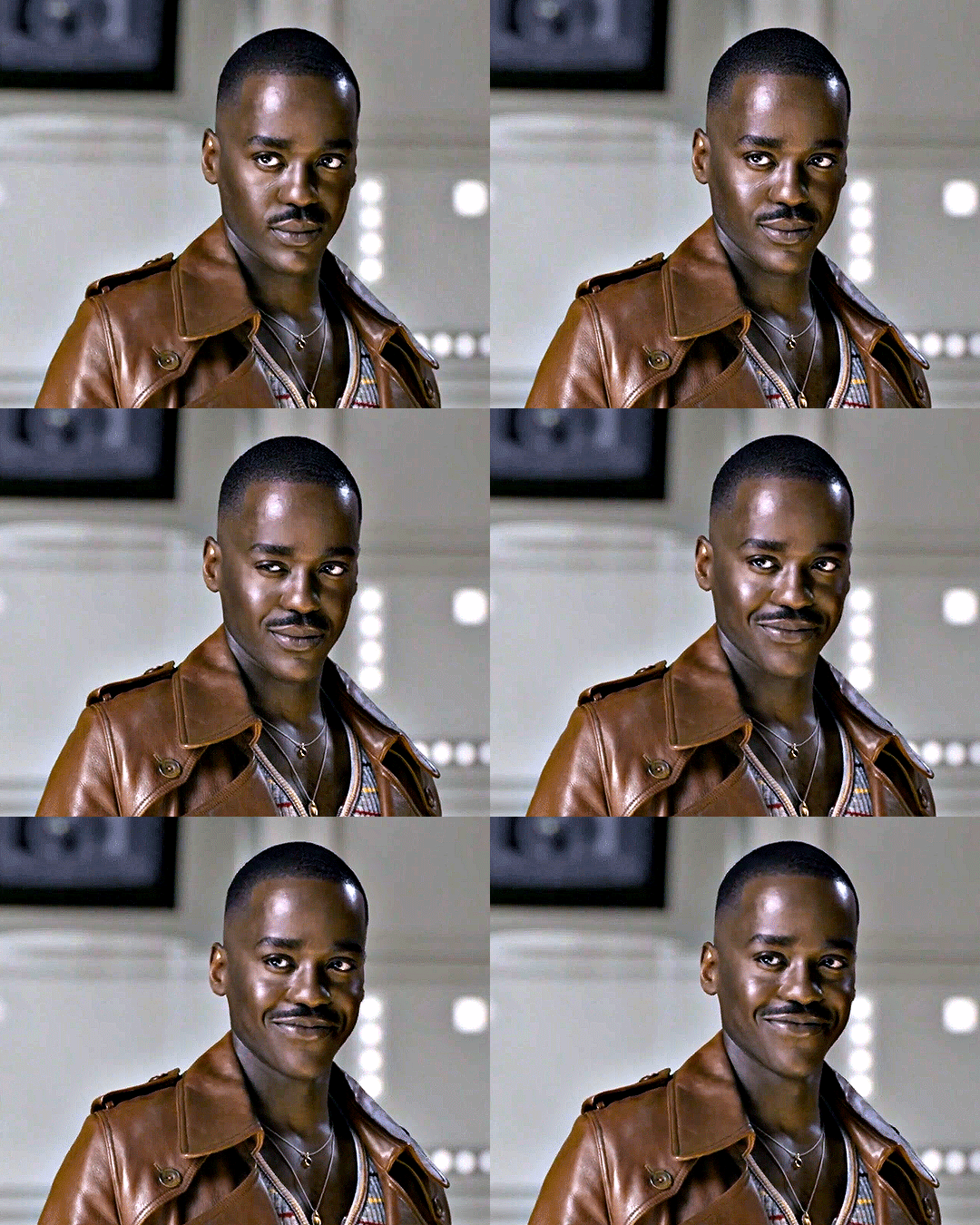
David Tennant has returned to the role as the current, fourteenth incumbent, having previously played the Tenth Doctor from 2005-2010, and will soon be replaced by Ncuti Gatwa as the Fifteenth Doctor. Tennant’s two incarnations of the character differ, not just in age and appearance but also personality; the new Doctor with an old familiar face seems to surprise himself at times, finding he is capable of declaring love in a way that he didn’t before, and announcing that Isaac Newton (whom he’s just met in passing on a time-travel jaunt) is hot.

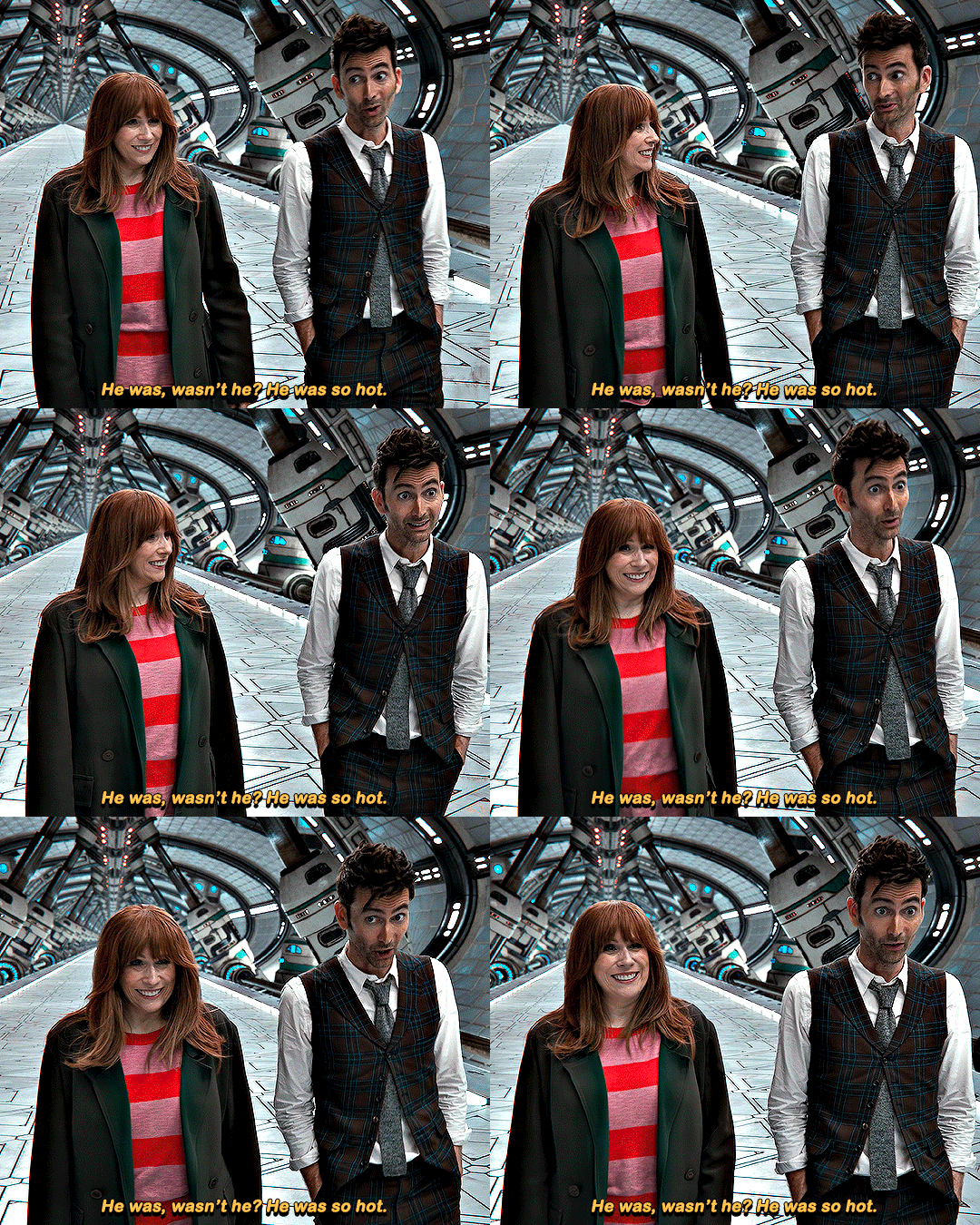
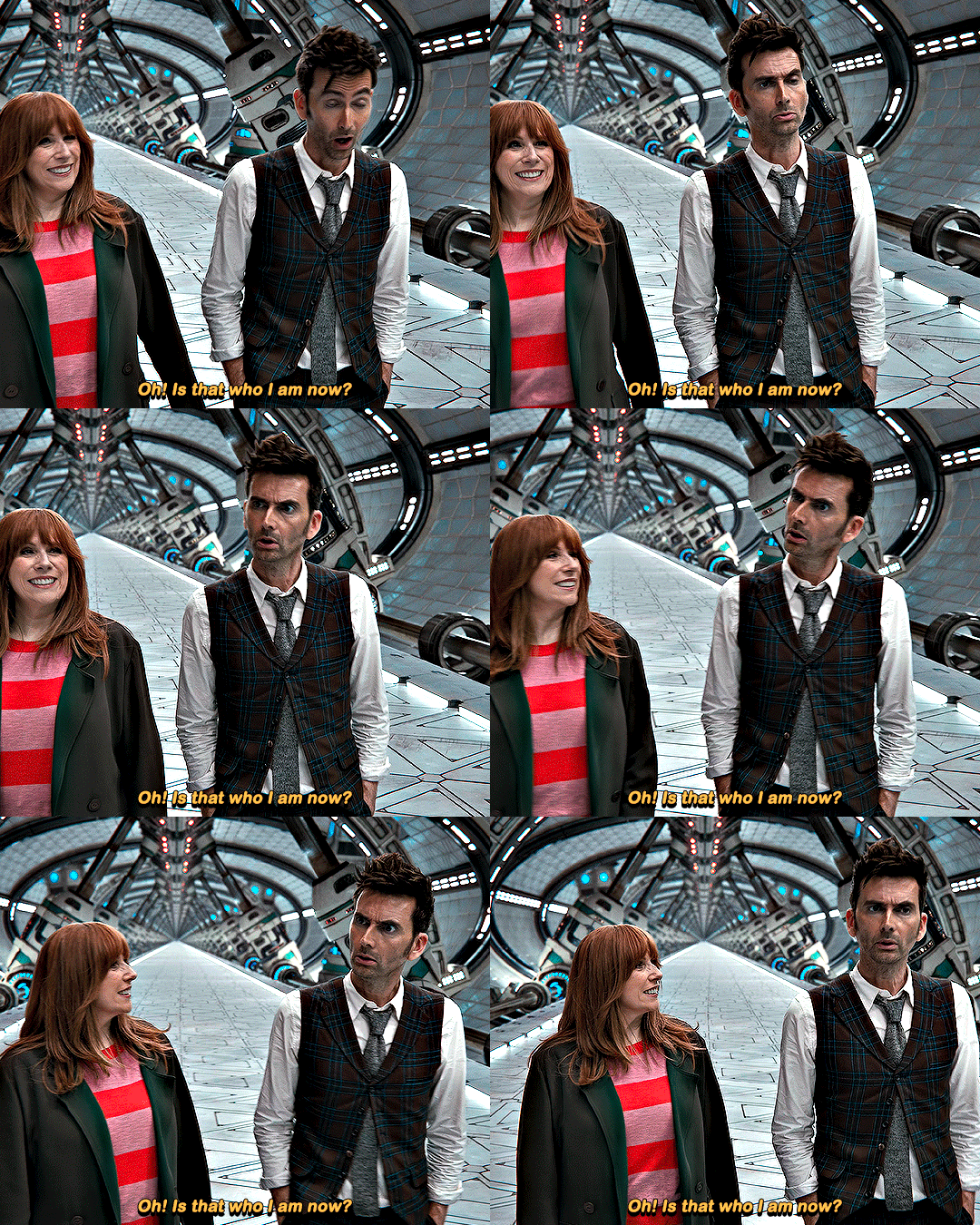
Perhaps this is the Fourteenth Doctor discovering that they have changed in the years since they last looked like David Tennant, or perhaps it’s the imminent arrival of Ncuti Gatwa’s Fifteenth Doctor already making themself known beneath the surface of their predecessor, like an unthunk thought about to have its moment.
Either way, it’s a reminder that change is not only inevitable, but an opportunity for joy and celebration; that such joy may nonetheless be shot through with nostalgia or mourning for the person we used to be; and that above all, it may be necessary for us to evolve simply so that we can finally face truths that we knew all along, but weren’t able to think, let alone speak, until we accepted our own transformation.
So: who are you yet to become? What will that person be able to think, which currently goes unthunk? And what might it take to usher that new self into existence…and so to become unlost?
 matt finch / mechanical dolphin


Always making me thunk. I needed to read this, didn’t get all of it, but letting go of the person we were really resonates.