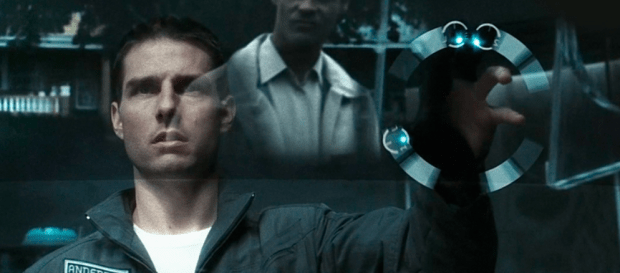
Surveying the (Criminal) Future: A Virtual Roundtable on Steven Spielberg’s Minority Report

On Thursday 30th April, I’ll join an interdisciplinary panel of researchers for an online discussion, organised by Surveillance & Society, about Steven Spielberg’s 2002 film Minority Report.

The movie is a dystopian thriller released early in the post-9/11 eraa, set in a world where the US government is beginning to use technologies to survey the future and stop crimes before they occur. The film follows a cop (Tom Cruise) who becomes targeted by the very systems he deploys to catch others before they act.

This early digital blockbuster captures a historic moment where safety and surveillance were often inextricably linked, while speaking to a future era defined by algorithmic surveillance, where our behaviors are swayed and dictated by mechanisms beyond our sight and often beyond our control.

My fellow panellists include University of Oslo media and communications researcher Professor Steffen Krueger; Associate Professor Kellie Marin of Texas State University, who specialises in research on civic participation within the surveillance state; and Malka Older, the writer, aid worker, and sociologist, who teaches on predictive fictions at Arizona State University. Our host and moderator is Texas Tech Associate Professor Fareed Ben-Youssef, who writes on the intersections between surveillance studies and popular cinema.

This interdisciplinary roundtable will consider how the competing visions of the future staged by the film echo contemporary concerns about prediction, control, and resistance in a networked world.

Sign up for the webinar via the Zoom event page for “Surveying the (Criminal) Future” .
Humanities @ Oxford: Death, dying, and afterlife in the age of AI

Alongside my other duties, I’m pleased to take on a new role leading the project “Death, dying, and afterlife in the age of AI” at Oxford University – a collaboration between the Uehiro Oxford Institute and TORCH – The Oxford Research Centre in the Humanities.

The prehistoric Newgrange mound, one of the world’s oldest extant funerary monuments, by Flickr user Ron Cogswell – CC BY 2.0

Emerging capabilities in artificial intelligence create the possibility of new relationships between the living and the dead.

After physical decease, what digital entities might live on in our stead? What agency will they have? How will the underlying technologies be developed, deployed, and managed? How will identity be authenticated?

What will be the impact on how individuals, families, communities, and societies approach the end of life, its associated rituals, and the ways in which we remember those who are gone?

Our team will use scenario planning to explore these questions and more, envisaging different future contexts for the relationship between AI and the afterlife, encompassing all aspects of memorial culture, funerary practices, and posthumous existence in the digital world.

Learn more at the TORCH website.

“Not Another KM Podcast” with Brittany Persinger and Rachel Teague

I made a guest appearance on the latest episode of “Not Another KM Podcast”, hosted by Brittany Persinger and Rachel Teague, to talk about scenario planning, foresight, and knowledge management.

You can find the podcast on YouTube, Apple Podcasts, and anywhere else you get podcasts.

Wise Enough for an Uncertain World: Scenarios, Metrics, and Social Impact 

My latest piece of writing, “Wise Enough for an Uncertain World: Scenario Planning and Social Impact“, can be found at the Danish social impact nonprofit Impact Insider.

It’s an exploration of how we make a measurable difference to social issues in an unpredictable world, drawing on research with the University of Oslo, the Global Outbreak Alert and Response Network (GOARN), the IMAJINE project, and Peat Hub Ireland.

If social impact means creating long-term change, then we face a difficult problem: we live in turbulent times, and the future in which our impact will unfold is deeply uncertain.

Scenario planning can help by developing multiple plausible and contrasting futures, relevant to current concerns but challenging to our assumptions. Building and using scenarios offers the opportunity to critically explore expectations, hopes, and fears about the world within which we hope to make an impact.

Photo by Raul Kozenevski on Pexels.com

Scenarios can inform the design of impact metrics which embody deeper values by considering the question: What might future generations wish we had measured in hindsight?

As we consider what inhabitants of different future scenarios might value, we can then identify and design appropriate impact measures to implement today. 

Read “Wise Enough for an Uncertain World” at Impact Insider.

Oxford Answers: Navigating the future of the networked world

At Oxford Answers, the blog of the University of Oxford’s Saïd Business School, Sophie Mitchell and I have a new post about the auDA scenarios built by Australia’s domain name registrar auDA.

“If global governance comprises not just formal institutions and regulations but the ‘mood music’ of the world, what part do we all have to play in shaping that mood today and taking responsibility for the future which transpires? Will leaders take collective action and contribute to digital civil society? Will digital platforms embrace a duty of care towards the most vulnerable users? Or will competitive opportunity be sought in the cracks, if tectonic shifts occur in the management of the global internet?”

Read more at Oxford Answers.

Navigating the sea of uncertainty: Global Youth Climate Summit Recording

One of my contributions to the 2025 Global Youth Climate Summit, hosted by the University of Oxford, has just gone online at the Oxford Climate Change Challenge site.

In the newly-released talk “Navigating the sea of uncertainty: challenging assumptions about what the future holds“, we consider ways to address times of turbulence, when the context in which we operate seems to be unsteady and unpredictable.

You can also see a previously released talk from the same event, “The black box of action: how to make your climate project count“, at the same site.

Entering a new year with a single question

From time to time, as one year draws to a close and another approaches, I share some tool or tip that may be useful: the “arrows of time“, value-creating systems, a wider reflection on scenarios as “stories of the future you didn’t see coming“.

This year, I offer just a single question.

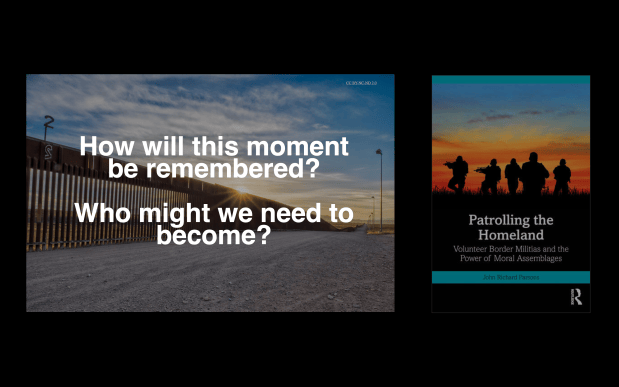
Ask yourself: “How will this moment be remembered?”

It seems innocuous, but an honest answer will force you to be brave in confronting your assumptions and beliefs.

Shiretoko-Shari Tourist Association

It stems from work of mine which was cited in Betty Sue Flowers’ new book, Scenarios: Crafting and using stories of the future to change the present.

There, I wrote that mature foresight work

enables people not to say, “Which future do I think I want, from the limits of my perception and understanding today”, but instead to ask “How would people in each different future judge the decision which I currently think to be so wise?”

This is the true benefit of manufactured hindsight: a kind of epistemic humility in the face of uncertainty, where instead of presuming we know what’s best for times which haven’t arrived yet, we enter into dialogue with potential futures and see beyond the received wisdom which may limit as well as reassure us.

If we simply ask ourselves, as we head into a new year, how this moment will be remembered, it tells us something about our understanding of the here-and-now – but also our beliefs about the future which is ahead of us.

The answers we come up with provide us with assumptions to explore, test, and challenge. What if a different future awaits, perhaps one that will judge us by different values and standards to those we hold today? What if hindsight will teach us a lesson we hadn’t yet imagined?

By exploring this question and different potential answers, we can reach for wisdom, rather than simply pointing at the future we think we want, on the basis of where we stand in the uncertain present.

New article: Uncertainty, agency, and the future context of internet governance

Uncertainty, agency, and the future context of internet governance: a foresightful conversation” is an article I co-wrote for the Journal of Internet Technology and Politics with colleagues Lucia Vesnic-Alujevic, Sophie Mitchell, Zoe Hawkins, and Cho Khong.

We explore how the structures, dynamics, and value of internet governance may play out in different scenarios – and the implications for the situations and decisions we face today.

Photo by panumas nikhomkhai on Pexels.com

Are we even talking about tomorrow? at UCL Languages of the Future

I’m speaking at the UCL Languages of the Future conference on 6th June, presenting a paper titled “Are we even talking about tomorrow? Uncertainty, agency, and the encounter with the sublime”.

The event brings together contributors from across academia and broader society to think through the complex relationships between languages and times to come. We’ve been given a few big questions to chew on, like: How can “languages of the future” encapsulate specific individual disciplines, embrace diverse knowledge systems, convey the urgency of problems that are yet to arise, and honour the voices of the more-than-human world?

I’ll be standing on the shoulders of thinkers like UCL’s Richard Sandford to explore uncertainty, agency, and the “thick present”: an understanding of the here-and-now encompassing remembrance and anticipation. As Rafael Ramírez and Angela Wilkinson have it,

The future is always an aspect of the present. The future has not “taken place,” but the present always “holds” the future, and holds it as potential. Indeed, the future is never “later,” is it always (experienced, imagined) “now.”

Droplets hanging from a leaf in close up. The image is titled WHAT MIGHT TRANSPIRE? and includes a quotation from Sandford 2023: 'It is precisely action that makes the present thick. Pursuing the ends that we have demands that we weave together pasts, presents, and futures, producing the thick present through the exercise of our agency.'