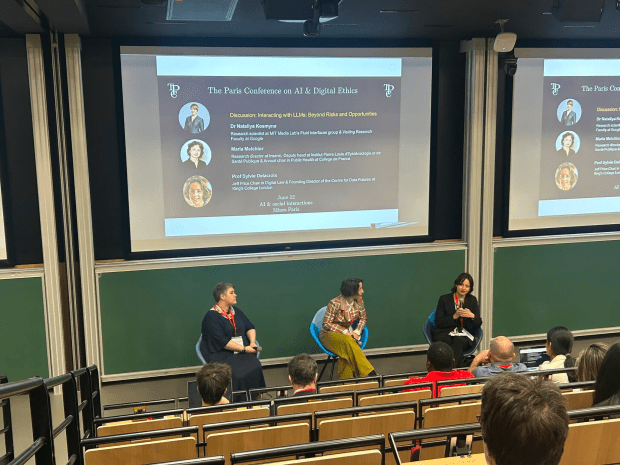
Nataliya Kosmyna, Maria Melchior, and Sylvie Delacroix on a panel discussion about interacting with LLMs
The best bits were the difficult ones – the little moments of tension and conflict which poked through the collegiality and cordiality and even the impeccable Parisian hospitality.
In Limn magazine, Oxford’s Javier Lezaun writes of mesocosms: experimental devices which allow us to observe natural interactions in a bounded and partially enclosed environment.
Specifically, Lezaun writes about polyurethane bags, mounted on hexagonal frames, which float in Taliarte harbour, on the east coast of the German island of Kiel.
Filled with water from the North Atlantic, the four-metre-long bags are used to determine how plankton responds when alkaline materials are added to seawater. Each bag contains a different quantity of sodium carbonate and sodium bicarbonate, so that different levels of alkalinity can be compared.
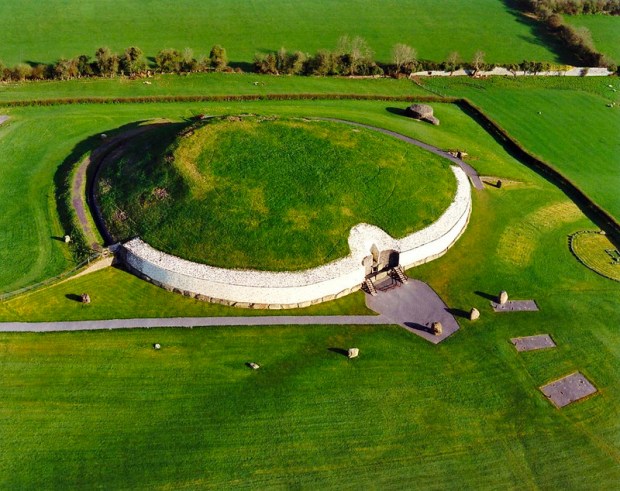
The prehistoric Newgrange mound, one of the world’s oldest extant funerary monuments, by Flickr user Ron Cogswell – CC BY 2.0
Emerging capabilities in artificial intelligence create the possibility of new relationships between the living and the dead.
After physical decease, what digital entities might live on in our stead? What agency will they have? How will the underlying technologies be developed, deployed, and managed? How will identity be authenticated?
What will be the impact on how individuals, families, communities, and societies approach the end of life, its associated rituals, and the ways in which we remember those who are gone?
Our team will use scenario planning to explore these questions and more, envisaging different future contexts for the relationship between AI and the afterlife, encompassing all aspects of memorial culture, funerary practices, and posthumous existence in the digital world.
I was a guest on the latest Strategy Meets Reality podcast with consultant, strategic adviser, and ex-instructor of the Royal Military Academy Sandhurst, Mike Jones.
Catch up on YouTube below, or wherever you get your podcasts.
I made a guest appearance on the latest episode of “Not Another KM Podcast”, hosted by Brittany Persinger and Rachel Teague, to talk about scenario planning, foresight, and knowledge management.
If social impact means creating long-term change, then we face a difficult problem: we live in turbulent times, and the future in which our impact will unfold is deeply uncertain.
Scenario planning can help by developing multiple plausible and contrasting futures, relevant to current concerns but challenging to our assumptions. Building and using scenarios offers the opportunity to critically explore expectations, hopes, and fears about the world within which we hope to make an impact.
Scenarios can inform the design of impact metrics which embody deeper values by considering the question: What might future generations wish we had measured in hindsight?
As we consider what inhabitants of different future scenarios might value, we can then identify and design appropriate impact measures to implement today.
“If global governance comprises not just formal institutions and regulations but the ‘mood music’ of the world, what part do we all have to play in shaping that mood today and taking responsibility for the future which transpires? Will leaders take collective action and contribute to digital civil society? Will digital platforms embrace a duty of care towards the most vulnerable users? Or will competitive opportunity be sought in the cracks, if tectonic shifts occur in the management of the global internet?”
It has been my pleasure to contribute to the course as a tutor since its inception, and to make a small contribution to the celebratory volume, which offers a range of practical tools for those who might want to set up their own “citizen laboratory”, working with communities and institutions to experiment and innovate on social and cultural issues.
enables people not to say, “Which future do I think I want, from the limits of my perception and understanding today”, but instead to ask “How would people in each different future judge the decision which I currently think to be so wise?”
This is the true benefit of manufactured hindsight: a kind of epistemic humility in the face of uncertainty, where instead of presuming we know what’s best for times which haven’t arrived yet, we enter into dialogue with potential futures and see beyond the received wisdom which may limit as well as reassure us.
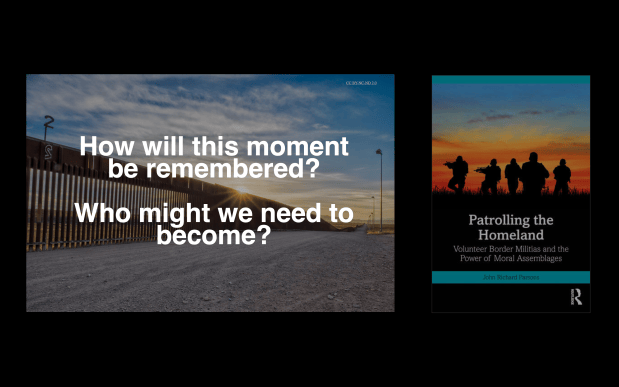
If we simply ask ourselves, as we head into a new year, how this moment will be remembered, it tells us something about our understanding of the here-and-now – but also our beliefs about the future which is ahead of us.
The answers we come up with provide us with assumptions to explore, test, and challenge. What if a different future awaits, perhaps one that will judge us by different values and standards to those we hold today? What if hindsight will teach us a lesson we hadn’t yet imagined?
By exploring this question and different potential answers, we can reach for wisdom, rather than simply pointing at the future we think we want, on the basis of where we stand in the uncertain present.
“What I liked most about the workshop was getting to experience a framework for discourse between different stakeholders where everyone was approaching challenging ideas with an amount of vulnerability and openness. Things like the icebreaker question and being pushed outside of our cognitive comfort zones led to a kind of shared sense of uncertainty and unease that made it much easier for conversation and creativity to happen.”
Words from a participant at the scenarios workshop I led as part of the Peat Hub Ireland initiative, funded by the Irish Environmental Protection Agency and delivered by UCD colleagues under the leadership of Florence Renou-Wilson, including David Wilson, Kate Flood, and Elena Aitova.