Are we even talking about tomorrow? at UCL Languages of the Future

I’m speaking at the UCL Languages of the Future conference on 6th June, presenting a paper titled “Are we even talking about tomorrow? Uncertainty, agency, and the encounter with the sublime”.

The event brings together contributors from across academia and broader society to think through the complex relationships between languages and times to come. We’ve been given a few big questions to chew on, like: How can “languages of the future” encapsulate specific individual disciplines, embrace diverse knowledge systems, convey the urgency of problems that are yet to arise, and honour the voices of the more-than-human world?

I’ll be standing on the shoulders of thinkers like UCL’s Richard Sandford to explore uncertainty, agency, and the “thick present”: an understanding of the here-and-now encompassing remembrance and anticipation. As Rafael Ramírez and Angela Wilkinson have it,

The future is always an aspect of the present. The future has not “taken place,” but the present always “holds” the future, and holds it as potential. Indeed, the future is never “later,” is it always (experienced, imagined) “now.”

Droplets hanging from a leaf in close up. The image is titled WHAT MIGHT TRANSPIRE? and includes a quotation from Sandford 2023: 'It is precisely action that makes the present thick. Pursuing the ends that we have demands that we weave together pasts, presents, and futures, producing the thick present through the exercise of our agency.'

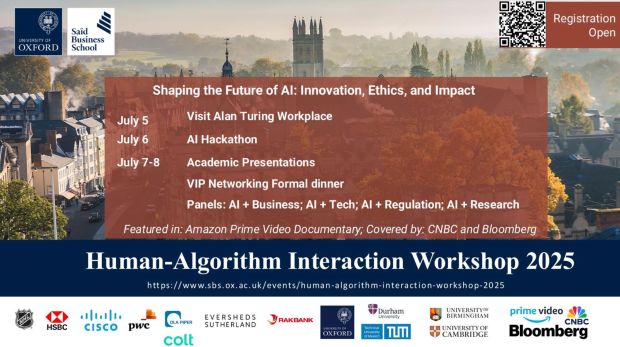
Oxford Human-Algorithm Interaction Workshop 2025

I’m pleased to be presenting at the University of Oxford’s Human-Algorithm Interaction Workshop 2025, on “Governing the futures you didn’t see coming: artificial intelligence scenarios“.

Do join us in Oxford, 5-8 July, for an interdisciplinary event delving into the complex and evolving relationship between humans and algorithms.

The annual workshop is a gathering of industry leaders, AI pioneers, and leading researchers who will explore the evolving role of AI in business, governance, and society. This year’s theme is “Shaping the future of AI: innovation, ethics and impact.”

Find out more and register here.

Webinar: How Dual-Use Tech Is Redrawing the Global Power Map

On June 9th, I’m hosting a discussion about dual use technologies for Oxford’s Emerging Threats Group.

A wide range of items are now recognised as “dual use”, capable of being employed for both civil and military purposes. From drones, robots, and software including AI to chemical and biological tools, the term has evolved beyond its original post-World War 2 meaning as a category of nuclear materials that could serve both the energy sector and the development of nuclear weapons.

Today anything is a weapon and may be used as such, especially in hybrid warfare. We live in an era when countless technologies can be used with benign or hostile intent, and when the governance mechanisms of global trade are being shaken under heightened geopolitical tensions. Under such circumstances, innovation, application, and regulation all become increasingly fraught. Businesses may find themselves drawn into new dilemmas if their technology is turned to malign ends, or seek opportunities that arise from a new era of dual use. Governments must act judiciously in an age when many items may be weaponised against them…or by them.

Join me, and four transatlantic experts, to consider the past, present, and future of dual use technology, 5pm-6.30pm BST on June 9th.

Register and RSVP at the Emerging Threats website.

The Ghosts We See From The Mountains: New book chapter available

It feels somehow timely that “The Ghosts We See From the Mountains“, a chapter co-written with the University of Galway’s Marie Mahon for the Routledge volume Crisis and Body Politics in Twenty-First Century Production, is now live online and open access.

The chapter explores the useful intersection of Oxford-style scenario planning with issues of spatial justice and Verónica Gago’s concept of the “body-territory”.

Thanks to volume editors Charlotte Spear and Maddie Sinclair for bringing everything together.

Title of the Routledge edited volume Crisis and Body Politics in Twenty First Century Cultural Production

Appointment to Futures Council, National Security College, Australia

I’m pleased to have been appointed to the Futures Council of the National Security College (NSC) at Australian National University.

The Council is an international group of individuals with expertise relating to the mission of the NSC’s Futures Hub, a whole-of-government and whole-of-nation resource for futures analysis in Australia.

Read more about the Hub and their work at the NSC here.

Oxford Emerging Threats Group: Soft Power in a Digital Age

How is the nature of soft power changing?
What part are critical and emerging technologies playing in these changes?
What is the role of soft power in 21st century geopolitical dynamics?
What threats and opportunities might be emerging?
Do we see ways in which changes in the soft power environment affect the changing character of armed conflict?

Join me and a panel of experts to explore these questions and more with the Emerging Threats Group at Oxford University, November 25, 5:00 pm – 6:30 pm GMT.

ISF Podcast: Threat Horizon and the auDA scenarios

I recently joined the Information Security Forum’s Mark Ward and auDA’s Sophie Mitchell for a short podcast discussion exploring foresight, uncertainty, cybersecurity, and Internet governance.

We looked at these issues through the prism of auDA’s recent scenarios for the future of the Internet and ISF’s own Threat Horizon foresight product.

Check out our episode of the ISF podcast here.

Oxford Scenarios Programme 2024

In an uncertain world, scenario planning equips you with skills and tools to deal effectively with potential opportunities, threats and challenges.

This new video from the team at Oxford’s Saïd Business School showcases the latest cohort from the award-winning Oxford Scenarios Programme, which helps participants learn how to develop robust strategies in the face of numerous plausible futures.

As one graduate of the programme puts it, “I always come to Oxford expecting to have my mind really stretched…the thing that surprised me most this time was that I’ve come away with a feeling of confidence that I can take what I’ve learned and really apply it in my day job.”

(It’s also a tremendous amount of fun).

Enrolment is now open for April and October 2024. Find out more here: https://www.sbs.ox.ac.uk/programmes/executive-education/person-programmes/oxford-scenarios-programme