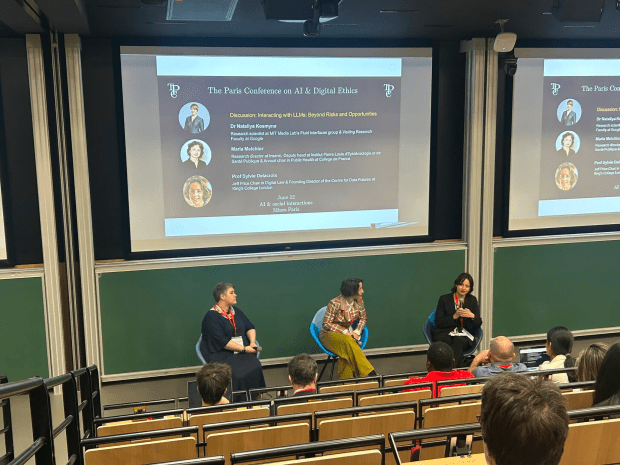
Nataliya Kosmyna, Maria Melchior, and Sylvie Delacroix on a panel discussion about interacting with LLMs
The best bits were the difficult ones – the little moments of tension and conflict which poked through the collegiality and cordiality and even the impeccable Parisian hospitality.
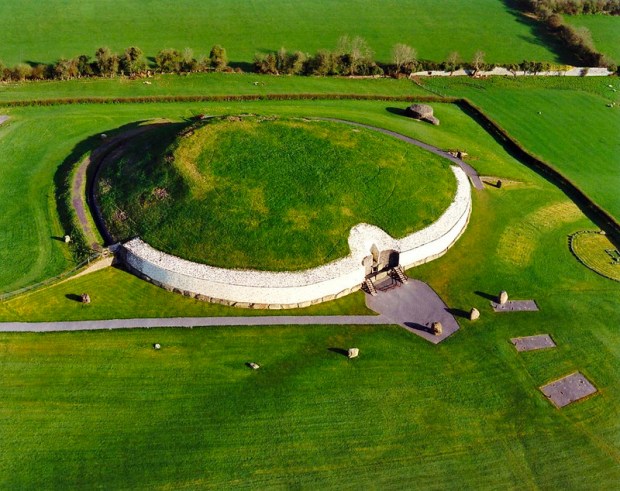
The prehistoric Newgrange mound, one of the world’s oldest extant funerary monuments, by Flickr user Ron Cogswell – CC BY 2.0
Emerging capabilities in artificial intelligence create the possibility of new relationships between the living and the dead.
After physical decease, what digital entities might live on in our stead? What agency will they have? How will the underlying technologies be developed, deployed, and managed? How will identity be authenticated?
What will be the impact on how individuals, families, communities, and societies approach the end of life, its associated rituals, and the ways in which we remember those who are gone?
Our team will use scenario planning to explore these questions and more, envisaging different future contexts for the relationship between AI and the afterlife, encompassing all aspects of memorial culture, funerary practices, and posthumous existence in the digital world.
The world could always be otherwise than it is. Sometimes fate is only a failure of imagination. The trajectory of automation is not only uncertain, it is unwritten. The fundamental question is less about technical capacity than ethics, authority, and accountability: Who will create the future – and with what ends in mind?
In the latest instalment of ‘Scripturient’, my quarterly column for Information Professional magazine, I draw together comments from a few different thinkers on automation and art.
What do I do? I help people think through big decisions, individually or collectively, when situations are uncertain.
It’s strategy, not therapy, but there’s kinship between the two.
Learning about “what goes on within and between us”, the psychology of individuals and groups, nourishes the work – and you can find that nourishment in unexpected places.
Sometimes it’s pretty conventional: a journal article, a course at the Tavistock, formal professional gatherings such as a group relations conference.
Sometimes learning seems to find its way to you: a challenging event in your personal life yields a nugget of wisdom, a conversation with a musician provides an unexpected metaphor, or maybe you get an unexpectedly helpful book recommendation from a chatty shop assistant. (That’s how I first encountered the work of Irvin Yalom).
In the new issue of the journal Surveillance & Society, Oxford’s Carissa Véliz, sci-fi writer and aid worker Malka Older, and Capgemini Invent’s Annina Lux join me to talk about how future scenarios can inform discussion, debate, and decision-making about the relationship between artificial intelligence and surveillance.
The latest edition of Scripturient, my column for Information Professional magazine, features Alex Roberts of IP Australia, the government body responsible for administering intellectual property (IP) law in Australia.
As director of the agency’s IPAVentures unit, Alex leads a team dedicated to exploring what might be needed for the IP rights system of the future. They use foresight and innovation tools to consider how we regulate “creations of the mind”: everything from literary and artistic works to trademarks, brand names, and protected product designs.
Recently, IPAventures developed a set of scenarios exploring the impact of generative AI on intellectual property – ranging from ever more lengthy and elaborate patent specifications to accelerated ideations by inventors and even changes to the regulation of plant breeding.