I’m just back from the Paris Conference on AI and Digital Ethics, an excellent and lively event.
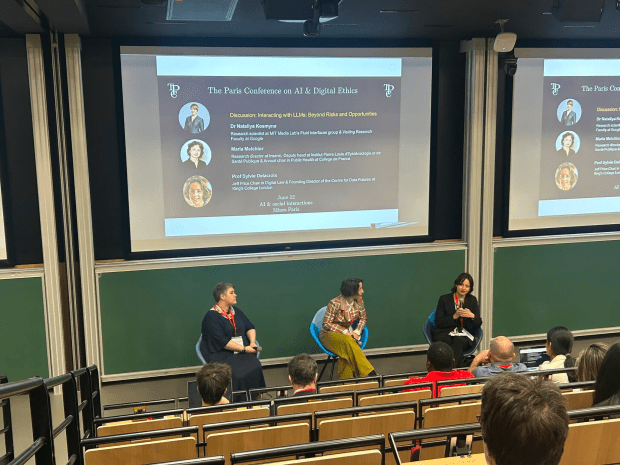
The best bits were the difficult ones – the little moments of tension and conflict which poked through the collegiality and cordiality and even the impeccable Parisian hospitality.
When a tech company speaks enthusiastically of inclusion in a world of AI-supported education, what will that broad term cover? Uncontentiously, it may mean ensuring that resources work for learners with dyslexia as well as those without. Will it also support an adolescent’s right to gender self-expression, when that is contested in some communities and some jurisdictions?
When it is proposed, in an apparent spirit of generosity, to provide certain AI tools on the model of Open Educational Resources – teaching, learning, and research materials that are in the public domain or released under an open license – does this need a critical eye?
Such resources had been touted in Nigeria as a way of sustaining students’ learning during higher education strikes, which raised the question of whether this self-consciously benevolent movement was in fact in the business of union-busting – and where a similar benevolent impulse regarding AI capabilities might lead.
Yet, at the same time, if such tools remain proprietary, we risk living life on an instalment plan, in a world of reinforced global inequalities, dependent on subscriptions, locked in to contracts.
Even a term such as “people-centred AI”, batted back and forth at the conference with a waspish joke (“That sounds nice, but what’s the alternative anyway? Capital-centred AI?”), reminded us of the importance of looking to the past as well as the future.
As an intellectual historian by training, I try to be attentive to the terms we use, the contexts in which we use them, and how they came to be. “People-centred AI” might be seen as a follow-on from the notion of “human-centred design” and the work of John Arnold and others at Stanford – but it’s worth taking the time to fully explore this.
Understanding exactly who uses these terms today and how – with what intent, with what reception, with what precedents, and in contrast to what other options – is valuable work which informs the way we frame problems and make decisions in the present.
So the conference’s difficulties were, for me, its most valuable moments. Following the philosopher John Dewey, the best source of new ideas may be reflection on a felt difficulty anyway, so no surprises there.
Some of today’s AI difficulties might be understood as what Jerome Ravetz, another philosopher, calls “contradictions”,
here meaning a tension whose resolution, or a problem whose solution, is impossible in the terms of the currently accepted frameworks…. Contradictions evolve with the system they affect. They can be less salient at the outset, and can indeed be suppressed for a long time. But they can eventually ‘mature’ and require resolution lest they damage or destroy the whole system.
One way to crack this nut is with a single, simple question:
How will this moment be remembered?
Asking this forces us to consider, not just what we think is going on right now, but what will be going on in the future. It moves us beyond the current frameworks, and trains the tools of the historian on us, from the vantage point of futures which await.
How will those who succeed us remember us? What values do we think they’ll hold? What judgements might they pronounce on us with the benefit of hindsight?
This question – how will this moment be remembered? – is the beginning of good foresight work, putting us in conversation with times that are yet to come: not merely to set out what we currently expect or hope or fear, but to give ourselves access to the kind of perspective that we normally only find in life’s rear-view mirror.
We can ask of the current AI moment:
Will it be seen as the dawn of a glorious new age, with humans empowered and liberated by the aid of thinking machines?
Will it be remembered as the beginning of civilizational collapse, or the death knell of democracy?
Or will the narrative be less dramatic, the retrospective analysis more muddled and contested?
Will we be remembered fondly, as people who were wise when it really mattered? Will the next generation facepalm and say, “I can’t believe what those bozos did, it’s amazing how they missed the real issues that were hiding in plain sight?” Or will we be seen as having done a good enough job, more or less?
Even if we do sleepwalk into harm, will it be a plummet off a sheer cliff, or merely a stumble that leads to a twisted ankle?
If there is harm, how will it be distributed and will it be addressed? Who will be harmed? Will their suffering and loss matter to those in power?
There are futures in which today’s technology is seen to have ushered in an age of wonders. Others in which today’s AI looks like thalidomide or the insecticide DDT: once touted as miracle technologies, only to become infamous for the harms they caused, now superseded and only used in highly constrained and regulated circumstances. And there are many other plausible, relevant, challenging futures still.
My job as a foresight practitioner isn’t to have the one right answer, but to be the midwife to others’ wisdom: together, finding the possibilities that had gone unconsidered, thinking through the tensions and implications, and moving towards judicious action.
Gatherings like the Paris conference nourish this work by putting sophisticated and forward-looking points of view into debate and play. And where they happen matters just as much as who is in the room, what topics are selected – and what is ultimately said.

The conference venue was close to the Musée du Luxembourg, which currently has an exhibition on an artist who is very important to me, Leonora Carrington.
A British writer, sculptor, and painter who was part of the Surrealist movement in the mid-20th century, Carrington spent most of her adult life in Mexico, fleeing there after traumatic experiences in France and Spain during World War II. Her work has a phantasmagoric quality which reflects the traumas and multiple displacements she had endured.
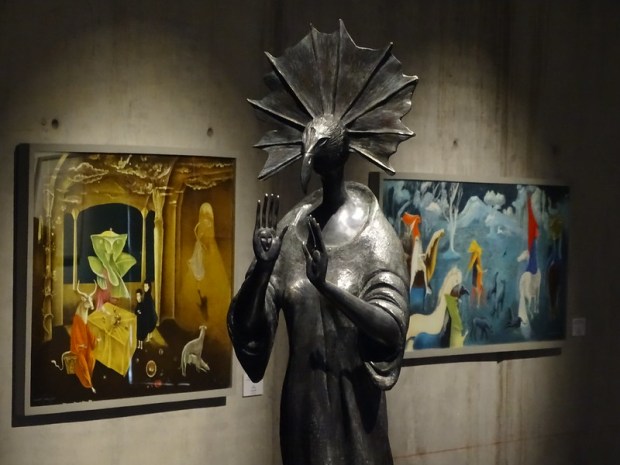
It was good to step briefly out of the AI conference and into the past, revisiting Carrington’s eerie world. Above all, I valued an installation which presented excerpts from a video interview conducted with the artist late in life, where she reflected on all she had experienced with a dry, flinty humour, puffing on a cigarette in her studio, drifting back and forth between English and Spanish. It reminded me of how Ravetz, the Oxford philosopher, had written about the power of aesthetics to help us make new sense of turbulent, feral situations.
After the show, I ducked into the patisserie adjoining the museum, where they had come up with a confection “inspired by” Carrington’s art. Because, apparently, what that hard-won artistic journey out of trauma had lacked was gianduja.


I couldn’t quite bring myself to eat that, but the patisserie is an outpost of Angelina’s, where they invented the Mont-Blanc, consisting of meringue and whipped cream with chestnut paste piped on the top.
A friend told me I couldn’t skip the Mont-Blanc, so I ordered one and ate it while I processed the day, the conference papers, the discussion, the exhibition.

I thought of how the novelist David Lodge got an entire book out of the idea of looking at a scholar’s life and thinking: Nice work if you can get it.
I thought of the Viennese on the eve of the First World War, enjoying their lives, not seeing what was about to unravel.
The sun shone and the tourists milled around and it was entirely possible to forget that a couple of thousand kilometres away, Europe’s eastern flank is under attack, or that the US government had just ordered Anthropic to prevent foreign nationals from using its Fable 5 and Mythos 5 tools.
Perhaps that’s why it was important for the Paris Conference to be the Paris Conference: when the leading AI models are American or Chinese, and governments are willing to put export controls on those models, Europe is confronted with the importance of developing its own capabilities.
I finished the dessert and made my way back to the event. Soon it was time for the closing drinks reception. It was one of the best I have ever attended, lively, thought-provoking, fun.
As we enjoyed the summer sun in the venue’s back garden, talking and savouring the refreshments, it was also possible to think: in times to come, when years have passed, how will I look back on June 12th 2026, and all that happened today? Will I think that I spoke wisely? Will I value what I heard?
Will I still be enjoying the same pleasures and privileges as I did on that day? Will I still subscribe to the same values and beliefs? What will be lost, what will be gained?
We talked until sunset. The time came to leave. But the technology is still changing, developing. And the questions are still in play.

