In Limn magazine, Oxford’s Javier Lezaun writes of mesocosms: experimental devices which allow us to observe natural interactions in a bounded and partially enclosed environment.
Specifically, Lezaun writes about polyurethane bags, mounted on hexagonal frames, which float in Taliarte harbour, on the east coast of the German island of Kiel.
Filled with water from the North Atlantic, the four-metre-long bags are used to determine how plankton responds when alkaline materials are added to seawater. Each bag contains a different quantity of sodium carbonate and sodium bicarbonate, so that different levels of alkalinity can be compared.
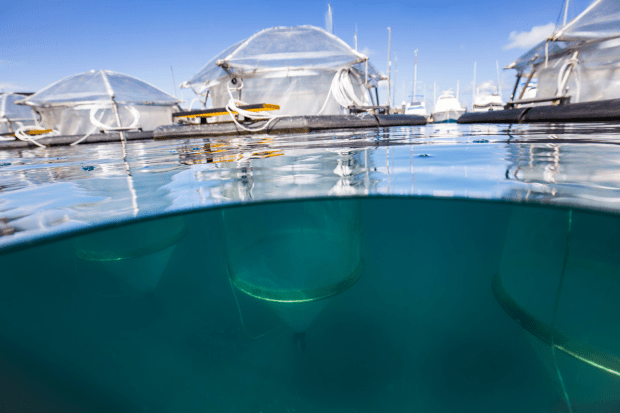
Scientists are doing this to explore the impact of methods which could increase the oceans’ alkalinity at scale, accelerating their uptake of CO₂.
“Can we imagine a climate future in a giant plastic bag?”, asks Lezaun.
*
Eugene Odum coined the term ‘mesocosm’ in 1984, meaning mid-sized experimental setups in the environmental sciences, where “parts (populations) and wholes (ecosystems) can be investigated simultaneously by a team of researchers”.
For Odum more than forty years ago, the mesocosm was a way to “bridge the gap between the laboratory and the real world”. Now, the approach is increasingly used to address climate change, with researchers recognising that mesocosms “narrow the gap between smaller-scale, less realistic, microcosm experiments, and larger-scale, more complex, natural systems, in which mechanistic relationships are often difficult to identify.”
Something similar happens in foresight processes when groups are convened to explore the futures that they didn’t see coming, as a way of better understanding the uncertainties which surround and suffuse their environment today.
A group are convened to manufacture plausible, contrasting visions of the future, challenging to current assumptions but anchored in relevance to the situation which they face today.
They may be executives, policymakers, activists, researchers, regulators, community members, investors, analysts, strategists.
They may work with a consultant, or an external facilitator; they may recruit participants for the scenario-building dialogue from within their own organization, group, or community, and might also bring in others from further afield – partners, neighbours, rivals, competitors, enemies, allies, mavens, provocateurs.
The dialogue itself takes place within a workshop environment which serves as a kind of mesocosm. A social system forms among the workshop’s members, at a smaller scale than the convening entity whose strategic concerns have driven the process: a sea within the sea.
Within this system, participants will take up roles, formally or informally, consciously or unconsciously. Pressures may apply from outside, or arise from within the group.
Grappling with uncertainty, imagining what the future might hold beyond current hopes, fears, and expectations, is a challenging cognitive and emotional task; it can bring all sorts of feelings to the surface. Fear. Hope. Anger. An exuberant silliness which may be the basis for fruitful creative play…or a way of masking deeper fears and disdaining the process…or both.
It’s not lab work. The workshop is larger, less controlled. People bounce around, flare up, clash, question one another, concur, diverge. They’re not perfectly sealed from the wider context: concerns from the wider organisation, and the external environment beyond that, should be expected to permeate. In truth, that’s why they’re there. And it’s how the learning happens.
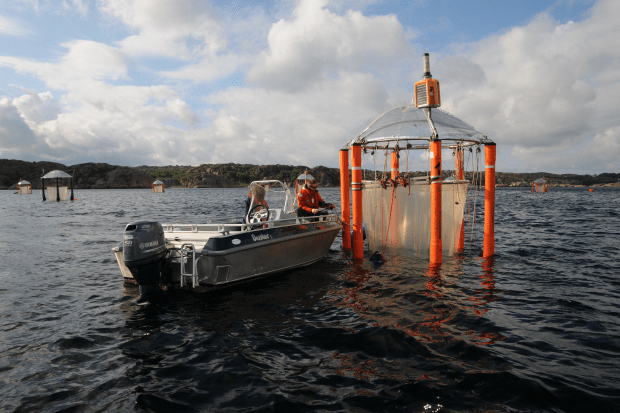
At Taliarte, where the plastic bags bob in the North Atlantic, diligent work is done to maintain the validity of the experiments. The bags must be gently brushed every other day so that their interior walls do not film over with organic material which will distort the result. Once a week, the exterior walls are delicately scrubbed by specially trained scuba divers.
The facilitators of a foresight process, similarly, work to maintain conditions within which the research process can succeed and maintain validity. They listen, intervene judiciously – sometimes without saying a word, simply by positioning themselves in the room in such a way that they draw attention or let someone know that they are being listened to.
Human interactions are not like the mechanical or chemical relationships which environmental scientists explore via mesocosms. But they still can yield useful information, and even imaginative conversations about the future can be conducted with sufficient rigour and care that they provide “interesting” – that is to say, useful and actionable – research.
As the mesocosm never leaves the sea or the river or the estuary, the workshop, too, is never fully sealed off from the wider organization or group. What is going on in this room says something about what is going on for the wider organization. And what comes out of that room – a set of plausible, relevant, challenging, and contrasting scenarios – can nourish that wider organization in turn.
One of the researchers whom Lezaun spoke with at Taliarte described “mesocosmic amnesia”: the swift forgetting of just how much effort went in to constructing and deploying the experimental apparatus.
Similarly, half the work of facilitation, if not more, is done in the set-up: getting the room just so; preparing one’s opening remarks; considering who will be in the room and how they may relate to one another; making provisions for everyone to be properly fed and watered, and to have enough breaks. A lot of this will be forgotten afterwards, even if, as Lezaun puts it, “this memory is never quite lost, if only because preserving the interiority of each mesocosm is an ongoing endeavour”.
*
At Taliarte, something unexpected happened: a film of solid calcium carbonate appeared inside one mesocosm. The materials were “just not doing what we expected them to do”, a researcher told Lezaun: if this had been an actual carbon-capture experiment at scale, there would have been an increase of CO₂ leakage, compounding the climate problem, as the alkaline substances were consumed by the precipitation of calcium carbonate.
Similarly, in workshops oriented towards questions of uncertainty, where we lay aside prediction or an expression of desired futures to ask ourselves What else could happen?, we may see assumptions undermined and expectations thwarted, sometimes in the most disconcerting and counterintuitive ways.
For the Taliarte researchers, it remains unclear what happened to the carbonate chemistry in the bag with the white film. They have some ideas, but further research is needed. In the same way, a foresight workshop may leave us with a sense of things having gone awry, of something having been overlooked, of a need for us to do further research, adjust our gaze, or reconsider the analysis we thought was so sound.
That’s not a failure of the process, it’s a gift. All too often, people attending a foresight workshop expect swift resolutions, definitive answers, easy comforts, “a-ha” moments of strategic realisation which arrive like bolts from the blue, and a sense of confidence, not just about what the future might hold, but also the right course of action to take.
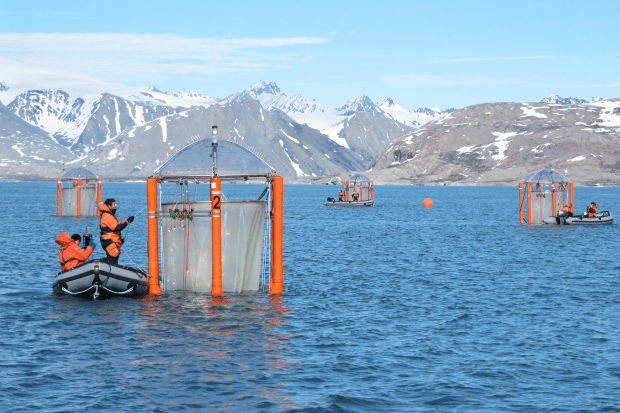
Lezaun contrasts the forms of knowledge generated by mesocosms with mathematical models or metaphysical representations. Mesocosms, being more practical, and therefore sometimes wayward, tools produce something “that is never entirely self-contained or fully self-assured.”
In truth, foresight work disturbs one’s mental models, challenges judgements, invites us to think again. Not to leave us in a state of anxiety, nor trapped in endless analysis, but to recognise that when matters are uncertain, the need to maintain curiosity is unending. As is the need for attention to the ecosystem we inhabit, the relationships that comprise it, and the part we play within.
Like those plastic bags floating off the German coast, working in this way offers a unique insight into “problems that are neither outside nor inside human experience, and that might require middling interventions rather than definitive solutions.” Here we follow John Dewey in believing that the best source of new ideas is reflection on a felt difficulty.
Such insights, leading to wise action, may look less like Alexander slicing the Gordian knot once-and-for-all, and more like a strategy of cultivation: judicious, creative, ongoing, iterative; at once shrewd and humble; not without its ambitions, but also mindful of its limits.

