Oxford Human-Algorithm Interaction Workshop 2025

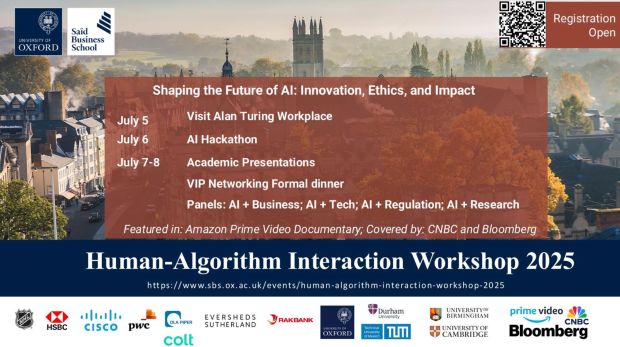
I’m pleased to be presenting at the University of Oxford’s Human-Algorithm Interaction Workshop 2025, on “Governing the futures you didn’t see coming: artificial intelligence scenarios“.

Do join us in Oxford, 5-8 July, for an interdisciplinary event delving into the complex and evolving relationship between humans and algorithms.

The annual workshop is a gathering of industry leaders, AI pioneers, and leading researchers who will explore the evolving role of AI in business, governance, and society. This year’s theme is “Shaping the future of AI: innovation, ethics and impact.”

Find out more and register here.

Right Here, Right Now Global Youth Climate Summit

I’m pleased to be delivering two sessions as part of the University of Oxford’s contribution to the Right Here Right Now Global Youth Climate Summit, a 24-hour virtual event presented by UN Human Rights and the Saïd Business School.

The online gathering brings together students and educators from across the world to share ideas about embedding climate action at the heart of education systems.

Find out more at the Saïd Business School website or register for the 24-hour livestream here.

'Dreaming Spires', by Flickr User JJBullock - Copyright JJ Bullock 2010
‘Dreaming Spires’, by Flickr User JJBullock – Copyright JJ Bullock 2010

The Ghosts We See From The Mountains: New book chapter available

It feels somehow timely that “The Ghosts We See From the Mountains“, a chapter co-written with the University of Galway’s Marie Mahon for the Routledge volume Crisis and Body Politics in Twenty-First Century Production, is now live online and open access.

The chapter explores the useful intersection of Oxford-style scenario planning with issues of spatial justice and Verónica Gago’s concept of the “body-territory”.

Thanks to volume editors Charlotte Spear and Maddie Sinclair for bringing everything together.

Title of the Routledge edited volume Crisis and Body Politics in Twenty First Century Cultural Production

New chapter: Crisis and Body Politics in Twenty-First Century Cultural Production

Title of the Routledge edited volume Crisis and Body Politics in Twenty First Century Cultural Production

My 2023 conference paper “The ghosts we see from the mountains: Scenario planning and the territorial body in time” will be published next year in Routledge’s edited volume Crisis and Body Politics in Twenty-First Century Cultural Production, as a co-authored chapter with Marie Mahon of the University of Galway.

Marie and I collaborated on the foresight elements of the IMAJINE project, a Horizon Europe-funded programme exploring spatial justice and regional inequality across Europe.

We look at how scenario-based thinking can inform strategic conversations and policy decisions around territorial inequality: Do citizens have equal rights and opportunities regardless of wherever they live? Are different places treated fairly? Is your ability to realise your rights compromised by where you live? How will the answers to these questions vary as contemporary uncertainties unfold?

See more at the Routledge website.

ISF Podcast: Threat Horizon and the auDA scenarios

I recently joined the Information Security Forum’s Mark Ward and auDA’s Sophie Mitchell for a short podcast discussion exploring foresight, uncertainty, cybersecurity, and Internet governance.

We looked at these issues through the prism of auDA’s recent scenarios for the future of the Internet and ISF’s own Threat Horizon foresight product.

Check out our episode of the ISF podcast here.

Oxford Scenarios Programme 2024

In an uncertain world, scenario planning equips you with skills and tools to deal effectively with potential opportunities, threats and challenges.

This new video from the team at Oxford’s Saïd Business School showcases the latest cohort from the award-winning Oxford Scenarios Programme, which helps participants learn how to develop robust strategies in the face of numerous plausible futures.

As one graduate of the programme puts it, “I always come to Oxford expecting to have my mind really stretched…the thing that surprised me most this time was that I’ve come away with a feeling of confidence that I can take what I’ve learned and really apply it in my day job.”

(It’s also a tremendous amount of fun).

Enrolment is now open for April and October 2024. Find out more here: https://www.sbs.ox.ac.uk/programmes/executive-education/person-programmes/oxford-scenarios-programme

“The True Source of Hope Is That We Never Know”: Scripturient x Design by Fire, with Brett Milligan

The latest edition of Scripturient, my quarterly column for Information Professional magazine, is out now and can be downloaded here.

In it, I interview UC Davis’s Brett Milligan, who together with Emily Schlickman is the author of Design by Fire, a new book exploring our relationship to wildfires.

A transcript from the interview underpinning my column can be read below.

Matt: What was your first ever encounter with fire in nature?

Brett: It would have been the hearth at home, or campfires; my dad took me, sometimes the whole family, camping a lot as a kid and would be very clear about taking care to extinguish it properly. I wasn’t exposed to wildfires until my time in California, decades later, and my first close-up experience with a large wildfire, the smoke, the immediacy of it, came with the LNU (Sonoma-Lake-Napa Unit) complex fires a few years back.

By Dripwoods – Taken of the LNU Hennessey Fire, CC BY-SA 4.0, https://commons.wikimedia.org/w/index.php?curid=93869076
Read more

Climate action and the vantage point of imagined futures: a scenario-based conversation

npj Climate Action has today published a new article, “Climate action and the vantage point of imagined futures: a scenario-based conversation“, co-written by Marie Mahon, Malka Older, David Robertson, and myself.

Drawing on the example of the IMAJINE project, the peer-reviewed piece explores how scenarios can provide the basis for discussion across disciplines and offer fresh ways to nourish our thinking about climate action.

It covers topics including: the nature of climate change and our understanding of it in different scenarios; questions of risk and responsibility now and in times to come; the use of scenarios to identify current blind spots and stimulate creative thinking; and the possibility that scenarios might offer fresh perspectives which allow us to reevaluate our notions of the sustainable “good life” and identify vulnerabilities which are overlooked in the present day.

Read the whole piece at npj Climate Action.