The concept of practising failure perhaps prompts us to discover our inner dweeb, to be underachievers, to fall short, to get distracted, to take a detour, to find a limit, to lose our way, to forget, to avoid mastery, and, with Walter Benjamin, to recognise that “empathy with the victor inevitably benefits the rulers.”
– Judith Halberstam, The Queer Art of Failure
It’s a funny thing, foresight work.
You help people to build pictures of the future context for a given entity or issue — but you’re not saying what you think is going to happen.
We’re not in the prediction business, nor even that of saying what we want the future to be.
Instead, we’re looking at ways in which today’s uncertainties might play out over time, challenging current assumptions and expectations, even current hopes and fears.
The scenarios we create together can offer unique vantage points on the issues of the here-and-now: manufactured hindsight. You know, as a scenario user or learner, that you’ve done a good job if you see something strategically useful which you couldn’t see at the outset of your work.
That sense of going beyond what you could already perceive, or conceive, is sometimes called the “a-ha” moment: a realisation, not always comfortable, that things could be otherwise.
This is why scenarios should be built with people, not for them. Re-perception of our current situation comes as much from the process as the end product; you can’t outsource the thinking that lets you see the world anew.
Still, as my Oxford colleague Gerard Drenth points out, there’s a danger of “So what?”
The work can’t just be interesting, it has to be useful.
Some people think that what’s useful is to “get it right” – to correctly forecast what the future will bring.
But the job is not merely to guess what happens next. Rather, it’s to see what we’re missing in our understanding of what’s already around us, right here and now.
Trudi Lang and Richard Whittington call this “taking the broad view, not the long view“; attending to contextual uncertainties that might reshape our environment.
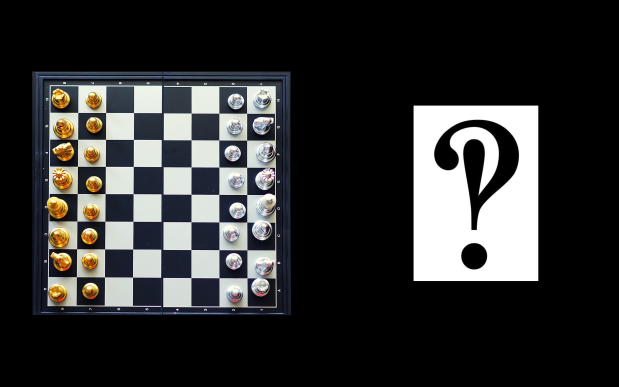
It’s not just about predicting the next moves in the “chess game” as it currently stands, but exploring how forces around us might change the players and their motivation, the rules and their enforcement, the moves available, even the landscape in which the game is played.
That means you can’t “win” foresight by “getting the future right”. All scenarios fall short as forecasting tools, because that isn’t their purpose.
In fact, if you look at a tool like the Oxford Scenario Planning Approach’s map of “contextual and transactional environments” – the “island” which a scenario learner inhabits today, and the “sea” of uncertainties which surrounds them – it’s not really a diagram of the future at all. It’s a map of our own perceived agency in the present. The only reason we go to the future is in order to experience and think through the potential impact of present-day uncertainties, perceived to be beyond our direct control.

In her book The Queer Art of Failure, Judith Halberstam writes about Tracy Moffat’s photographic series Fourth Place, which documents athletes who came fourth in various events at the 2000 Sydney Olympics.
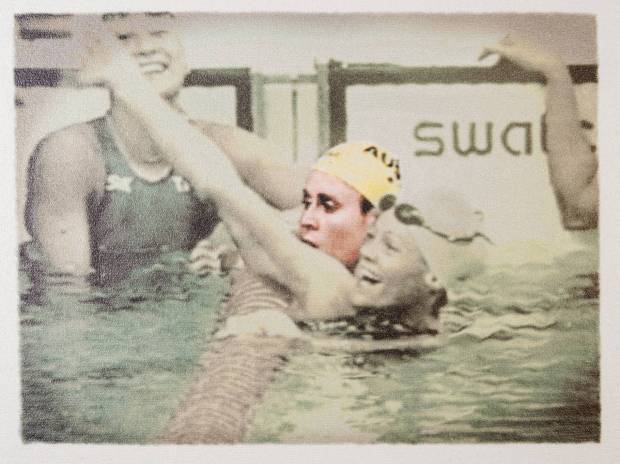
Moffat’s idea was to photograph, from the TV coverage, those who just missed out on the winners’ podium. This proved difficult, as “the cameras are inevitably focused on the winner rather than the losers”.
Her photographs show us something that was sidelined, almost framed out, from the narrative of the Olympic Games. Moments, events, and experiences that were fraught with emotion, essential to the competition, yet all but ignored in the rush to see the winners of the event which just finished.
There’s something here which speaks to the true work of strategic foresight, and the ways in which it inevitably “falls short” when it comes to predicting the future.
What do we miss if we think the only view that matters is the one from the first-place podium today? It’s seductively panoramic up there, but of course you don’t really see everything that’s going on in the stadium or the world beyond – in fact, you might be blinded by all of that adulation, or rest too long on your laurels.
The person who won the race just run might not win the next, or have any insight about what’s coming if the rules of the contest change. And it’s not athletes alone who determine the outcomes, governance, or reception of any sporting event.
You may want, instead, to stand with Halberstam and Moffat, to look at what is merely on the periphery of the official narrative, what lies perhaps entirely out of frame.
To see what can be discovered when one willingly falls short, gets distracted, takes a detour, finds a limit, or loses one’s way.
One might wish to avoid mastery as it is conventionally understood, to take a risk and see what new forms of excellence can be obtained beyond standard criteria. Bode Miller, one of the most successful Alpine ski racers in Olympic history, took an erratic route to his accolades – and often missed out on the podium entirely. He infamously said “I was having the greatest time making mistakes, crashing” in his wild pursuit of the limits of his sport.
One might wish to forget certain things, as well as learn new ones – George Burt and Anup Karath Nair talk about foresight work as a space of “unlearning”, where assumptions can be suspended temporarily while we explore alternatives and relax “rigidities of imagination”.
The real work is to strategise under conditions of uncertainty – the so-called “TUNA conditions” of turbulence, unpredictable uncertainty, novelty and ambiguity.
Developing strategy means first understanding one’s context, including its uncertainties. Scenarios are one route into the uncomfortable work of living with those uncertainties, rather than trying to reduce them to a falsely comforting surety.
Ultimately, this understanding, and the resulting accommodation with the reality that certain aspects of our environment remain irreducibly uncertain, serves to nourish our strategic conversation and lets us address the anxious but necessary work of making a consequential decision: I am going to do X and not Y, and this is the reason why.
Such strategy needn’t always be competitive, either. Exploring the map of our perceived agency, the island of present-day relationships surrounded by the sea of uncertainty, can also help us to find new collaborations, partnerships, and arrangements which increase our agency and the stability of our environment – “reclaiming territory from the sea of uncertainty”.
In this way, we meet my colleague Gerard’s criteria of being not just interesting, but useful – going beyond the “So what?” to make a real difference.
But to get there, we don’t just need to know what it looks like to be a winner today. We need to truly engage with what is going on around us. And that includes being unafraid to examine the view from fourth place.
 matt finch / mechanical dolphin