Writing, Designing and Acting Doctor Who – Holiday courses at NIDA Sydney

Australia’s Cockatoo Island has a chequered past as a former shipyard and prison turned nature reserve – but recent school holidays saw it transformed once more. The UNESCO world heritage site in the city of Sydney became the scene for intergalactic adventure and time-travelling mystery as the BBC’s Doctor Who came to Australia in a whole new form.

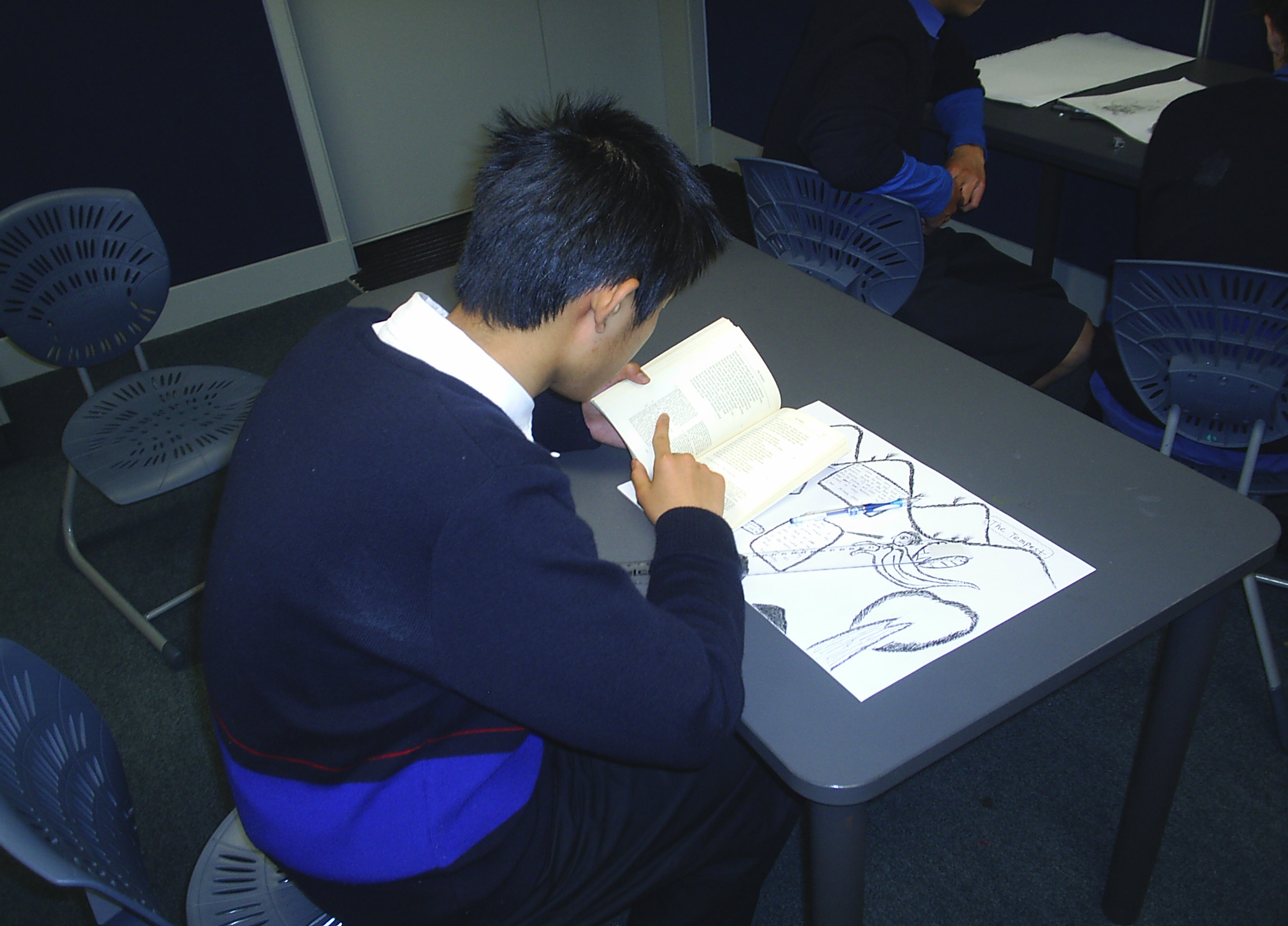
Work from NIDA's Designing Doctor Who Course
A monster design from Designing Doctor Who at NIDA

For three years, NIDA, Australia’s National Institute of Dramatic Art, has offered a range of Doctor Who-themed holiday courses for children and young people, taught by industry professionals. I dropped in to see what was on offer and speak with the team behind this unique education programme.

This year, Designing Doctor Who students spent three days creating their own detailed alien worlds and artefacts, while Writing Doctor Who students got the opportunity to devise mini-scripts performed by students on the Acting on Screen: Doctor Who course in front of an audience of parents and friends.

The holiday activities including location shooting on Cockatoo Island, where one student-penned adventure saw the Doctor and his companion Amy pursued by Fashion Police opposed to bow ties and short skirts!

Peter Mountford, Manager of Youth and Holiday activities at NIDA, said, “This was the third holiday program at NIDA to feature Doctor Who themed courses and I am pleased to say that it was the most successful yet. Both tutors and students had a fantastic time filming their self-devised Doctor Who stories out at Cockatoo Island – a setting that is perfect for time-travelling adventurers!”

Read more

Interview: Rebecca Wallace-Segall, Writopia Lab

A lot of the schemes we feature on Books and Adventures involve encouraging reluctant readers and promoting literacy in the family or wider community. Some, like Wales’ Young People’s Writing Squads, offer support and encouragement to those who already have a talent for writing and want to develop it.

New York’s Writopia Lab project is one of these schemes.

So why do Writopia kids want to write?

‘I just want to have fun writing for myself, and do it for the rest of my life.’

‘I watched my friend cry when she read my story – I want to make kids feel things.’

‘I like to read newspapers and magazines. I want to be part of the conversation that I hear going Rebecca Wallace-Segallon.’

That third “kid” was Rebecca Wallace-Segall, who grew up to found Writopia Lab in 2007. A journalist in New York, Rebecca spun off a residency at a private school into a non-profit organization giving children and young people the chance to hone their literary skills with professional writer-instructors.

Rebecca and I met earlier this year at her New York headquarters on the Upper West Side, a cosy place of pine floorboards, comfy sofas and beanbags, its walls decorated with images of books where the children can write the names and titles of their own work on the spines. These are the ‘library walls’ which provide a record of success for Writopia participants, but the available spaces are quickly filling up. ‘We’re going to end up having to go on the ceiling!’ says Rebecca.

She began by explaining to me how Writopia Lab’s mission differs from community literacy programmes which seek to engage reluctant readers and writers.

Read more

Teaching and testing – the Finnish case

Helsinki Panorama by Flickr user Huzhead


A tweet from Trevor Cairney, a fellow writer-educator based in Sydney, led me to David Sirota’s recent article on Finnish education in Salon.com.

Sirota’s article gives the lie to claims that a culture of rigorous testing is the only way to improve standards in US schools – pointing to Finland’s success in creating a world-class education system by cherishing teachers, rather than imposing tests.

The Finns have a remarkable system which produced top scores in the last PISA (Programme for International Student Assessment) study by the OECD.

Teaching staff lie at the heart of Finland’s achievement. Well-trained, well-supported and given a great deal of independence, Finland’s teachers are trusted academic professionals, choosing their methods and materials themselves. Testing is used as the teacher sees fit – for self-evaluation and development, rather than for league tables and outcomes.

The Finns’ success is a great riposte to forces in the UK and US who continually push intensive testing regimes on our schools. As I said at the House of Commons last year, the current culture of testing and targets is so harmful to learning, especially in the field of literacy.

Read more

Nnedi Okorafor Interview, Part 4: ‘Chittim’ and Earning for Learning

Find the first part of this interview here.

One of the most distinctive inventions of Nnedi Okorafor’s new novel Akata Witch is chittim – a currency earned by magical practitioners when they learn an important lesson, delivered in the form of a shower of varying-sized metal rods falling from the sky.

‘I liked the idea of earning something for your knowledge, for learning,’ says Nnedi. ‘The rods are based on objects used in real-life Nnedi Okoraformagical practices, but I don’t know where they come from in the world of the novel! They’re not from God, they just…fall from the sky when you learn something new.’

Like most writers and teachers, I could always do with some extra currency, and I love learning, so I adored the idea of chittim.

Nnedi offered her own example of a ‘chittim moment’ from her teenage years as a tennis player:

‘When I was about seventeen, I was in California playing the nationals. I don’t know what part of the draw I was at in the tournament. It was early on. Not the finals or semi-finals or anything. I was playing this girl. Both of us were there alone. No parents or friends or siblings had come with us. But we were battling. We were evenly matched. We had no audience.

‘As our match drew on for hours, other kids finished playing each other and went home for the day. But she and I kept slugging it out. We split sets (she won one set, then I won the second). We played for over FIVE HOURS. No one knew we were there on that far tennis court in the sun. No one cheered. No one was on the edge of his or her seat. But we were battling. We both wanted to win even if no one else cared.

‘I eventually won and there were no cheers. We sat together drinking water, quiet, smiling occasionally, sweaty as heck. It was awesome. It didn’t matter who won, that’s what I learned that day. It was all about the game, pushing yourself, and playing your brains out.’

Nnedi’s perspective on education is shaped by such experiences, and the notion that learning as embodied by chittim is not about formal study:

‘I was a late bloomer – I struggled with tests, and didn’t blossom until grad school. I felt I had missed out because of assumptions made at an early age about which class you were put through.

‘Exams and learning are sometimes really in conflict. It’s not about passing the test, it’s what you learn, the things you choose to develop. I don’t know how many chittim you would get from taking a formal exam…maybe one if you were lucky!’

‘I feel that kids should be given space to change. There’s so much pressure now on young people to achieve and conform. The whole idea of “Tiger Mothering” and “Helicopter Parenting” is also connected to people trying to control fate.

‘As a mother, I understand parents wanting to choose the destiny of your child. But you must let your child become her/his own person – and resist your urge to take control!’

With her writing appealing to a young adult audience, Nnedi has taken her work into high schools in the U.S. and beyond.

‘My last school visit was in Trinidad, a peaceful place where I was very comfortable! They really got Zahrah, because the world of Ginen reflects that same mix of peoples and cultures you find in Trinidad. They identified with that.

‘I had the students do a writing exercise – to work together and create a character, as a group.

‘I was delighted with the result – a mixed-race boy with pink hair…and he could fly!’

Nnedi’s future plans include more schools outreach work and contact with inspiring young writers like the students in Trinidad. In the meantime a film of Who Fears Death is in the works and, of course, Akata Witch is available in all good bookstores!

Akata Witch by Nnedi Okorafor

Nnedi Okorafor Interview, Part 3: Palm Tree Banditware – The Future of the Book

Find the first part of this interview here.

During our interview in Chicago, Nnedi showed off one of her prized possessions, an object which stands as a manifestation of her fantasy world in ours: a Kindle which has been decorated to resemble a giant folded leaf.

Reminiscent of the ‘Sandpiper’ laptops built from natural materials in William Gibson’s Idoru, Nnedi’s Kindle is a real-life emblem of the kind of distinctive technology which exists in her fantasy world, Ginen – a realm which blends plants and hardware, where the term ‘techno-organic’ has more to do with sustainability than the Borg or H.R. Giger’s Alien.

Zahrah the Windseeker coverThe defining technology of Nnedi’s stories, however, is one that’s already centuries old – the book. Time and again books play a key part in her novels, whether it’s Akata Witch’s Fast Facts for Free Agents – an unreliable, conservative set of rules for young wizards – or the Forbidden Greeny Jungle Guide of Zahrah The Windseeker, which is virtually a character in its own right.

Uncooperative and all too fallible, the Guide is Zahrah’s only source of information on the mysterious jungle into which she must venture. The device is reminiscent of science fiction’s first and greatest guidebook, The Hitch-hiker’s Guide to the Galaxy – and that’s not by chance.

Hitch-hiker’s was my first sci-fi experience, and the first book that ever made me laugh out loud,’ admits Nnedi. ‘The physics, the jokes, the way Douglas Adams writes. It was inspiring.

‘I added some extra features to the e-book of Zahrah to give it that Hitch-hiker’s feel. You can read entries from the Forbidden Greeny Jungle Guide on my website that don’t appear in the novel – including real creatures, like the suicide ant!

‘For the Zahrah e-book, I wanted pop-up ads – palm tree banditware, obnoxious recipes by the author – but it had to be exactly as I envisaged it, like in the book, and the technology’s not quite there yet. But just you wait!’

Fast Facts for Free Agents, the book given to Akata Witch’s hero Sunny as she enters the world of wizardry for the first time, is just as unreliable and prejudiced as Zahrah’s Guide.

Nnedi chalks some of this perspective up to her postgraduate studies, especially in journalism.

‘In grad school, I learned a new way of reading. It taught me that you can’t just ‘get information out of a book’. You need to know what forms of information exist, what angle they take.

‘Especially in Nigeria, authors of guide books are often almost yelling at you to convey their perspective –every ethnic group says their way is the best. There are no ‘facts’ in writing about some of the Nigerian villages – it’s always shaped by a perspective, by Original cover, Zahrah the Windseekersome writer talking down to you – yet these documents nonetheless contain real information.

‘The same is true of Fast Facts and the Guide – they’re examples of how to look at information, reminders to not always believe, and even when you do believe, always consider the perspective of one who gave the information.’

In the fourth and final part of my interview with Nnedi Okorafor, we talk about ways of learning, and the most distinctive inventions of Nnedi Okorafor’s new novel Akata Witch, chittim – a currency earned by learning , delivered as a shower of metal rods falling from the sky.

Nnedi Okorafor Interview, Part 2: Nigerian/American, Athlete/Nerd – Labelling Magic

Find the first part of this interview here.

Nnedi Okorafor has received great acclaim for her young adult writing, but her work spans journalism and academic research as well as short stories and novels for a more adult audience.

From an acerbic early short story skewering the notion of the ‘Magical Negro’ through to Who Fears Death, a mystic science-fictional meditation on weaponized rape, Nnedi’s writing is difficult to pigeonhole – and she wouldn’t want it any other way.

Who Fears Death‘I read everything when I was young – literary, mainstream, only a little sci-fi but a lot of fantasy. I wasn’t specifically looking for genre writing.

‘I was a product of the creative writing program at Champagne-Urbana, which was great, but my instructors spent so much time trying to get me not to write speculative fiction, fantasy or sci-fi. The change for me was going to the Clarion workshop at Michigan State, where they welcomed exactly that kind of writing!’

Even within the bounds of ‘genre fiction’, Nnedi’s work is especially resistant to conventional boundaries.

Zahrah is set in Ginen, a world inspired by African cultures and societies, while The Shadow Speaker takes place in the year 2070, bringing together magic and teen adventure in a post-apocalyptic Niger. And woven subtly through each novel are clues suggesting that all of these tales may be taking place in a shared universe.

Over lunch in Chicago, Nnedi laughs when I ask her about the problem of labels.

‘I’m very much a neither-and-both person: Nigerian/American, athlete/nerd – and that goes for my writing too. I don’t know who I am, on or off the page.

‘Even my first piece of non-fiction, “The House of Deformities” was magical – a memory of being 8 years old and venturing to the back of an old house in Nigeria to find pink ducks, bulldog puppies and an outhouse that looked like the mouth of hell!

‘My editor describes my work as ‘magical futurism’ – I love the term, but what even IS that?’

Who Fears Death, which features an adolescent protagonist but deals explicitly with issues such as rape and female circumcision, crosses boundaries of fantasy, science-fiction and even horror writing.

‘The closest comparison I can make for Who Fears Death is the movie Pan’s Labyrinth,’ says Nnedi.  ‘Both the book and the movie cross a borderline between adult and young adult material, with a young character going through a world which is dark both in terms of monsters and in terms of politics.’

Nnedi’s most provocative literary tool in dealing with these issues is Ginen, a science-fictional world which echoes African cultures and societies.

‘Ginen comes from a lot of things: happy childhood memories of Nigeria, the wishes I have for the future of Africa, and my huge American love of gadgets and technology!’

Ginen isn’t a utopia, except in the most literal sense of the word. Zahrah faces conservatism and prejudice among the populace of her home town. In The Shadow Speaker, Earth and Ginen collide – and Nnedi is scrupulous about documenting the flaws and virtues of both sides in the conflict.

Seeing the best and worst in more than one culture comes easily to Nnedi, with a perspective which is both Nigerian and American at once – something that her publishers initially found challenging.

Nnedi’s children’s book Long Juju Man was pigeonholed as an African novel, with Macmillan only releasing it on that continent, butLong Juju Man the proud use of a provocative Igbo term in the title of Akata Witch brings together African and American contexts – a move which is typical of Nnedi’s work.

Akata – a derogatory term for foreign-born black people in Nigeria – came to the author after her editor suggested she change the proposed title Sunny and the Leopard People.

‘A Nigerian man had recently told me, “You’re not really one of us, you don’t speak Igbo, you weren’t born and raised in Nigeria. You’re an Akata!”

‘It’s a word that comes up often if you challenge the patriarchy. African-American women get accused of being lazy, ignorant and loose – corrupted by foreign influence. It’s a powerful slur.

‘At one level, Akata Witch is all about the conflict between and complexities within the world’s African communities – something I’d been meaning to address ever since I started writing. So akata was a perfect word to use in the title.

‘I decided to reclaim it wholly, positively for me – as a compliment. It marks you out as different, and although it denotes ugliness to Nigerians, I refuse to buy into perceived notions of beauty!

‘The same goes for witch – it’s a word that has a lot of weight in Nigeria, where men often use it – not always harshly, to be fair – to signify unmarried, independent and ‘different’ women.’

Next time on Books and Adventures we’ll be looking at books and technology in the novels of Nnedi Okorafor. Find part 3 of this interview here.

Nnedi Okorafor Interview, Part 1: ‘Is everything written? And if it is, can you rewrite it?’

Nnedi OkoraforThe novelist Nnedi Okorafor is one of today’s most compelling YA authors. Her books offer a unique mix of African culture, science fiction and fantasy adventure, at once accessible to a wide audience and definitively rooted in a non-Western tradition.

In her latest novel, Akata Witch, all the tropes of Harry Potter and its ilk – the hero’s journey of a young magician, schools of wizardry, teens caught up in a battle for the fate of the world – are rethought and refreshed through a cosmopolitan, transnational perspective that ditches the grey stone and largely white faces of Hogwarts for a tender yet uncompromising Afrocentric vision of the cosmos.

Nnedi’s debut Zahrah the Windseeker won the Wole Soyinka Prize in 2008 – and Akata Witch (which I reviewed here for Brooklyn Rail), takes her writing to new heights.

Sunny, the 12-year-old ‘witch’ of the title, is an albino African-American who returns to Nigeria, her parental homeland, only to be doubly ostracized for her pale skin and US background. Sunny gradually discovers that she has magic powers, and is destined to play a small but vital role in a conflict that threatens the future of humanity.

As Nnedi explained when we met in Chicago’s Senegalese restaurant Yassa, ‘Destiny has always been something I’ve grappled with. Is everything written? And even if it is, can you rewrite it? I’m fascinated by destiny, but I also resist it.’

Nnedi’s own career owes directly to such acts of irresistible fate.

Growing up in the suburbs of Chicago, she was a teenage tennis star until surgery for scoliosis left her paralyzed and bedridden at the age of 19.

‘Until then, I’d never have thought to pick up a pen. I was only nineteen, really athletic, but scoliosis painted my life. I left college as an athlete – and came back using a cane!’

A friend recommended that Nnedi take a creative writing class, beginning a journey that took her through journalism, short stories and a PhD thesis en route to her current career as a novelist.

‘My bout of paralysis was terrible, brutal and completely changed my life in a very specific way. In the same way, the kids in Akata Witch are at the mercy of their powers – those gifts are part of who the kids are, but they can’t be chosen. Destiny is brutal, it does not care about you.’

This philosophical perspective shapes even the most action-packed moments of Nnedi’s writing.

In Zahrah, a key moment involves the teenage heroine’s encounter with a giant, deadly ‘whip scorpion’, from which she is ultimately saved by an even larger jungle beast.

Nnedi admits during our interview, ‘I actually stole Zahrah’s escape from the whip scorpion from the first Star Wars prequel – the sea creature chasing our heroes gets eaten by a larger monster, and Liam Neeson says, “There’s always a bigger fish.”

What seems corny in George Lucas’ hands (for a while, I wondered if ‘There’s always a bigger fish’ was going to replace ‘I’ve got a bad feeling about this’ as the inane Star Wars catchphrase), here ties in to Nnedi’s ideas about humility and fate.

In Akata Witch, Sunny is no Harry Potter, a ‘chosen one’ destined to be a key player in the battle for the survival of tAkata Witch by Nnedi Okoraforhe world.

Sunny and her friends are explicitly told by their mentors that they are expendable in the fight against evil: ‘The world is bigger than you are, it will go on without you.’

Nnedi’s writing offers one balm for this uncomfortable truth: the realization that we must appreciate the gifts that life chooses to grant us.

The thrill of Sunny’s first soccer match grips the characters, and the reader, just as much as the climactic final showdown. Akata Witch may puncture the comforting notion of a guaranteed “special destiny,” but it also celebrates the shared adventure of everyday life on our planet.

Next time on this blog, more from my interview with Nnedi Okorafor, as we discuss her genre-busting position as a Young Adult writer whose work refuses to be pigeonholed.

Find the second part of the interview here.

>Q&A with Ken White, Manager of Educational Programs at Brookhaven National Laboratory

>

This week on Books and Adventures we’re joined by Ken White, manager of educational programs at Brookhaven National Laboratory (BNL), an advanced research facility run by the U.S. Department of Energy.


BNL was founded in 1947, with a mandate to promote research across the fields of physics, chemistry, biology and engineering. I began by asking Ken how long BNL has been involved with schools outreach and science education.


‘The Laboratory has been a supporter of science education pretty much since its inception. Science education and workforce development are part of our mission at BNL, and we have been fortunate to have leadership support to enable greater interaction with our academic community.  College students have come here for internships since the early 1950s and the Lab frequently had open houses and school outreach programs well back into the early 1960s. 

Over the past six years we have developed hands-on inquiry-based experiences for middle and high school students to enable them to conduct science similar to that of our researchers.  These are offered at cost and have become quite popular with local schools.  These programs have expanded the way in which we satisfy our responsibility for educating the next generation of scientists.

Successful offerings need to be exciting, with engaging activities that enable students to realize science is accessible to them.  The best programs often include a story as well – we try to humanize the program by relating it to our scientific staff actually working on the problems being presented.  Programs that show how the academic work applies to real life problems we face as a society tend to do well.’

What can a visit to BNL do for students in mainstream schooling?

A visit to BNL becomes a very memorable experience for students.  The excitement of science and the magnitude of the facilities, with seven Nobel Prizes being earned here, leaves a lasting impression.  Ideally, the visit provides students with relevance to their academics, a bit of career exploration, an understanding of the integration of subject matter, and an appreciation for what science is and can do for humanity.


How can you make cutting edge research accessible to such a wide age range of visitors?

This can be a challenge because of the depth of training our scientists go through to become world class researchers.  Their communication processes become fraught with technical jargon and complex content to the point that researchers in other fields may not fully understand the content.  One thing you find out quickly about scientific staff is that they have a passion for sharing their work with interested people.   Often, we will work with researchers to help them drop their jargon and put things into laymen’s terms, and to help them clarify the “so what” of their research.  This makes for a more enjoyable interaction for both the scientists and the audiences they reach out to.


What is the lasting impact of a visit to BNL?

As noted above, the experience is usually a memorable one. There are several ways for students to stay engaged. Venues would include everything from readings in a bibliography supporting our elementary programs, to summer research experiences, attending open to the public seminars and lectures, or participating in science-based competitions.  Another great way is to have the teacher participate in programs such as our “Introducing Synchrotron Science to the Classroom” or the “Open Space Stewardship Program.”  In these programs, teachers can work with the Lab, interact with scientific staff and others, and develop and enhance their own skills in guiding students in science classes and research.  

Do your educational programs focus on “hard science” or is there scope for students to consider the social & philosophical implications of BNL’s work?
Much of the work at BNL is on the hard sciences, but there are often considerable social and philosophical implications from our work as well.  For example, students working in the nuclear diagnostics area for neuroimaging are deeply engaged in “hard science,” but their results can have a profound impact on the larger understanding of addiction and treatment.  Another good example is the work the Lab does on nuclear non-proliferation.  This work is technical in nature, but also crosses into policy discussions affecting nuclear material management, control and safeguards. 

In an age of ruthlessly pragmatic ‘Tiger Mothering’ and an increasing focus on educating children to aid them in a future job market, what can students learn from the ‘blue skies’ research at BNL?
So much of talent in the workplace is in the ability to question, think critically, solve problems, be resilient to failure, and move forward productively toward a reasonably well understood objective, while still being flexible to change.  “Blue Skies” kind of research can be a way to learn many of these skills.  Be creative and thoughtful, design a means to test your hypothesis, don’t be afraid of failure, and find a way to right yourself. What more could an employer want?
You can find out more about the educational programs at Brookhaven National Laboratory at http://www.bnl.gov/education/

Telling Stories From Cultures Not Our Own

This week’s guest post comes from Eric Maddern, writer, teacher, singer, storyteller and mastermind behind the Welsh retreat centre Cae Mabon.

Eric – an experienced traveller and storyteller – kindly agreed to share his thoughts on ‘Telling Stories from Cultures Not Our Own’.

By what right do storytellers tell stories from Africa, Native America, Aboriginal Australia and other similar cultures? Isn’t appropriating and telling these peoples’ stories an extension of colonialism? We stole their lands and livelihoods; we decimated their cultures; we virtually drove them to extinction. Now we want to tell their stories. Isn’t this just the latest stage of colonial theft? It’s not surprising that some survivors from such cultures think so.

Storytellers who want to tell stories from other cultures need to be sensitive to this issue, in terms of both choice of story and where and when the story is told. It seems any story in print is fair game and therefore tellable. But first you have to find a story you like.

A storyteller may read dozens of stories before finding one he or she wants to tell. And then it’s not just a matter of liking it. You’ve got to develop a relationship with it. Learning it for telling requires effort. In time you must grow to love your story. If you don’t it won’t survive in your repertoire.

The more you love and relate to a story the more meaningful it becomes. It helps if you care about its culture of origin. You have to make the story your own, but in the telling you have to show an appreciation of its source. As you get inside the story so, to a degree, do you get inside the culture itself. The story should help you cultivate an empathy for the culture that you will convey in the telling.

It makes sense to look, initially, for stories from cultures you already have some relationship with, whether it be ancestral, geographic or perhaps through travel. Knowing what is your ‘own culture’ is not always easy these days. The mixing of bloodlines, geographic mobility and increasing globalisation mean that roots and influences can be many and varied.

I was born in Australia with Cornish and Scottish ancestry, spent my teenage years in England, travelled for ten years around the world through the Americas, the Pacific and Australasia, and now live in Wales. That’s quite a mix but at least it gives me scope to choose stories from cultures with which I have associations.

One of the biggest influences on me was the work I did in the Aboriginal communities of Central Australia. This led me to feeling great sympathy for the people. Not surprisingly the first story I ever told was an Aboriginal story. I wanted a tale that would convey the power and beauty of the culture. The story I chose came from ‘Australian Dreaming’, a beautiful coffee table book edited by Jennifer Isaacs. It was from the Dalabon people in northern Australia about how the rainbow bird stole fire from the crocodile.

The story was only a paragraph in length so I was soon embellishing it in the telling. I’d throw myself on the ground to become the crocodile, stand on one leg with outstretched arms to be the bird. After telling this story for years, my publisher – I was writing children’s picture books by then – asked for another story and I sent them ‘Rainbow Bird’. An artist was chosen and the book progressed to the point where ‘the galleys’ were done. The text and pictures were ready to be made into the book.

It was at this time that I went to Australia again, my first visit in ten years. Eventually I made my way to Katherine in the Northern Territory to visit a cousin who worked in Aboriginal communities. He took me to Manyallaluk where, it turned out, they knew ‘Rainbow Bird’ story. I had the galleys with me and so showed them to a young man who carefully read the entire text then said: ‘Come to me tomorrow and I’ll tell you the story.’

The next morning he dictated the story and made me write it down. He wanted to be sure I got it right. This meant I could ask questions for clarification. I wanted to know, for example, whether at the beginning the main character was a man or a crocodile. He was a man. The young man and his friend demonstrated the fire making referred to in the story. And I learned about the nits! It was a much fuller and more satisfying version of the story than my original.

But back in Britain my publishers couldn’t change the galleys, as it meant redoing the whole book. So the picture book remained based on the Dalabon version from ‘Australian Dreaming’, not the more nitty gritty, personal version I’d been given at Manyallaluk. Paradoxically, though it is the picture book I’m least satisfied with, it sells more than any other book I’ve done. Perhaps the title ‘Rainbow Bird’ has the appeal. Would it have sold so well if it had nits in it? Who knows? Fortunately I was later able to get the fuller version published in the ‘Young Oxford Book of World Folktales’ edited by Kevin Crossley Holland.

I was lucky to track down my first story to its source and to be given both a fuller version and, it seemed, permission to tell it. Very rarely will storytellers be able to do such a thing. Even though I feel I have permission to tell the story I’m still careful about where I do. I feel OK telling Aboriginal stories in Britain where there are very few Aboriginal people to speak for themselves. But in Australia I’d be more cautious. If I was trying to get white Australians to appreciate Aboriginal culture it might be fine. But if there were Aboriginal people present I probably wouldn’t, or at least I’d ask them if it was OK first.

Paradoxically I now live in Wales and am often called upon to tell traditional Welsh legends and folktales to Welsh kids and sometimes adults. Perhaps here the difference is that very few Welsh adults can tell the traditional tales and they enjoy hearing them told well. Also, the time when those stories were a really live part of the culture is, for most people, long ago, so there’s not so much of an issue about ownership and rights any more.

But in other cultures – the Native American for example – the stories are still very much a live part of their culture. Although plenty of their stories are in print and therefore available for retelling (always bearing in mind the context), if you hear a Native American storyteller tell a story which you’d love to tell, you must ask for permission first. And don’t expect it to be granted. Or if it is it may come with a condition. For example I once asked a Lebanese storyteller if I could tell a story she’d told which had been written by a Palestinian man for his daughter. ‘You can tell it,’ she said, ‘As long as you tell it better than I do!’

So we have to be sensitive in choosing the stories we tell. Those in the public domain are, by and large, available to tell but, as always, need to be appropriate to your audience. Preferably choose stories where you have some personal connection to the culture of origin. Develop a relationship with the story. Get inside the story and let the story get inside you. Be cautious about telling someone else’s story where it’s clear they’ve done a lot of work on it. You must do your own work to make it yours. And where the story is particularly personal – either culturally or autobiographically – leave well alone. There are plenty of stories to choose from. Find ones you love and love them into life.

Find out more about Eric Maddern’s work at www.ericmaddern.co.uk

>Interview: Sally Wendkos Olds, Super Granny

>

Today’s interviewee, Sally Wendkos Olds, is an accomplished writer, with special expertise in child development, families and travel. Sally has 11 books and over 200 articles to her name. Even more importantly, she’s the devoted grandmother of 5 lucky children.
Sally’s book Super Granny: Great Stuff to Do With Your Grandkids is packed with original and exciting activities for modern grandmothers to do with grandkids of all ages, from high-tech intercontinental Skype chats to simply eating your dessert before your dinner!
Sally’s book and award-winning blog address the new breed of grandmothers who don’t look like the fluffy-haired, passive picture-book stereotype of the past. Glamorous, jet-setting, technologically savvy, the Super Granny is more likely to catch up with her grandkids via Blackberry than slump on the sofa with tea and biscuits.
Here at Books and Adventures we recognize that learning and reading is an adventure which children share with many people beyond their immediate family. Friends, teachers and relatives, including grannies, have so much to offer as we learn and grow.
Sally kindly took time for a Q-and-A with Books and Adventures by e-mail. There’s more on her work here, and you can find the Super Granny book here.
Q: The Super Granny ‘doesn’t look like the grandmothers in the picture books….like your own grandmothers or even your own mothers. And you don’t act like any of these either.’ What’s brought about this generational change?

A: One major reason this generational change came about is the improved health and vigor of today’s Super Granny generation, due partly to the fitness revolution, which encouraged women (and men) to exercise more, eat better, and in general pursue a healthier life style. Youthful experiences and attitudes have also played a part: people in their sixties, and even seventies, don’t consider themselves old and don’t act old (“60 is the new 40”). The new technologies are helpful, but the bigger change is in Super Granny’s willingness to use them.

Q: You also note in your book that grandmothering is an ancient tradition in which today’s grandmas still take part. So what common ground is there between Super Granny and her predecessors?
A: Grandmothers have always been the traditional “next-best-to-Mom” in terms of loving and caring for children. Even today, if a grandmother lives nearby, is healthy, and doesn’t have outside work commitments, she’s usually the caregiver of choice while Mom is at work or school. And in most cases, you couldn’t ask for anyone more loving to your children or better able to take care of them.
Q: How does a busy Super Granny make that time for her grandchildren? Are there sacrifices involved in being a Super Granny?
A: All through life we set priorities in terms of how we spend our time. No matter how busy a grandmother is, if the will is there to be with your grandchildren (and it usually is), you can manage to carve out some time for them. It’s not the quantity of time — the number of hours we spend — but the quality, so that when we are with our grandchildren, we are totally with them. This is what matters in any relationship, and what can be meaningful in a really short span of time.
Q: You have experience of living and working in Nepal, which clearly had a major influence on your life. What did you learn from Nepalese grandmothers? Is it truly possible to be a Super Granny without a cellphone, Skype account and plenty of frequent flyer points?
A: Sure, you can be a Super Granny without all those techno gadgets. The grandmothers I met in the hill villages of Nepal didn’t have any of them! Of course, the ones I met did live close to their grandchildren and were a constant presence in their lives. It’s harder, of course, when grandmothers (like me) live far away from our grandchildren and don’t have the time or the means to visit frequently, but still there are so many ways of reaching out. I do use phone, email, and Skype — but also snail-mail. Kids love getting letters, poems, and cards that they can actually touch — in addition, of course, to presents!
I have lived far from three of my grandchildren ever since they were born, so I am especially aware of the need to make extra efforts to have a relationship across the miles. And that’s why my book points out so many activities that Super Grannies can do long-distance — some that I have done myself, some that other grannies told me about.
Q: ‘Grandparents and grandchildren share a common enemy.’ What does a Super Granny, devoted to her grandchildren and armed with a roster of cool and creative projects, feel about the current debate around ‘Tiger Mothering’ and ‘Attachment Parenting’. Is having a Super Granny going to help a child get into law school? Or is it all about fun and frivolity?
A: There are many styles of grandmothering, just as there are styles of mothering. Some Super Grannies focus on fun and frivolity, while others are more interested in stimulating their grandchildren’s intellectual curiosity and offering projects that will, in fact, help children achieve in school and in life.
There’s no one right way for everyone. When I was researching my book, I was struck by all the different ways that the grandmothers I met related to their grandchildren. So some of the activities in the book don’t have any goal other than enjoying your time together, while others are more oriented toward education. You have to allow for individual differences in families and in individual personalities of both granny and child.
A Super Granny might relate one way to one grandchild and a different way to another. As long as you let all your grandchildren know that you love them, you don’t need to be the same kind of grandmother with each one.
Q: The research on parenting and child development is advancing all the time. Have your opinions on how we should bring up our children changed dramatically over the years between your roles as Super Mom and Super Granny?
A: My opinions about the important issues in raising children — being sensitive to their individual needs and encouraging them to follow their own interests and abilities, while helping them to become competent and caring members of society — have not changed. What has changed is my attitude.
I have discovered over the years that some of the things I worried about as a young mom — and even an older one — didn’t come to pass, and that lets me be more relaxed with my grandchildren than I was with my children. I care about and love my grandchildren as much as I did (and do) my children, but I don’t worry so much about them, and as a result I can enjoy them more. This is one of the glories of being a grandmother!
Find out more about being a Super Granny at Sally Wendkos Olds’ site – http://www.sallywendkosolds.com/.

My latest news from Peru can be found at http://lavidaidealist.org/2011/04/09/escrutineo/