Guest Post: Lee Castledine on Storytelling for Young Children, Part 2

Today on Books and Adventures, we have the second part of a guest post by Lee Castledine, the Australian storyteller, youth librarian and secretary of the Australian Storytelling Guild.

You can find the first part of this post on Storytelling for Young Children using Props and Audience Participation here.

Props aren’t suitable for all stories and shouldn’t be used to prop up a bad story!  It is important to choose simple props that enhance the telling.  Don’t overwhelm the story by trying to use too many props or props that are difficult to manoeuvre, as they can distract the audience’s attention from the story.  Once you choose your props, it is important to practise using them until you are comfortable handling them without constantly looking at what your hands are doing.  Remember, it is vital to maintain eye contact with your audience.  Props can help a storyteller to remember the sequence of the story, but if you become distracted with handling the props, you can lose your audience.

Many storytellers are of the opinion that the use of books in storytelling isn’t true storytelling.  I agree somewhat, as there is considerable difference between story reading and the art of story telling.  But to me, and to many other children’s librarians, a picture book can either be read to an audience, or it can be used as a visual prop for the audience.  If a storyteller knows the book well, they don’t read it, they tell it, whilst showing the pictures to the audience to invite audience participation at certain parts of the story.

Read more

Guest Post: Lee Castledine on Storytelling for Young Children, Part 1

Today on Books and Adventures, we’re joined by Lee Castledine, an Australian storyteller, youth librarian and secretary of the Australian Storytelling Guild.

I was lucky enough to see Lee’s workshop on storytelling with young children at the Annual Paint the Town REaD Convention this month. Lee demonstrated her accomplishments as a performer, educator and storytelling maven, and today, Saturday 17th September, I’ll be venturing over to the New South Wales Writers’ Centre to see a Storytelling Workshop Day organised by Lee. Therefore I’m very pleased to present a timely guest post from her on Storytelling for Young Children using Props and Audience Participation.

A candle, a book, an apron, a string, a puppet, a piece of paper….Props used in storytelling for young children can be anything the storyteller can think of, that enhances the story.  Some props are useful for encouraging audience participation, and manipulation props enchant the audience.  Not all stories need a prop – sometimes actions are the prop.

Read more

Guest Post: The Physics of Reading by Raymond Huber

Continuing our Kiwi theme, today Books and Adventures is joined by New Zealand author and editor Raymond Huber with a guest post on ‘The Physics of Reading’. A skier, teacher, apiculturist and all-round adventurer, Raymond is currently in Australia promoting his novel for junior readers, Wings.

Wings by Raymond Huber

‘The universe is made of stories, not atoms’ (Muriel Rukeyser). There’s truth in the poet’s words: the universe is only 4% atoms while the rest (mysterious dark stuff) has barely been fathomed. Some scientists believe the universe is geared towards the development of mind – ‘The universe is aboutsomething’ (Paul Davies, physicist) . That’s why I think stories matter.

Consider the mental energy of reading for children. ‘When reading takes place, the brain is forever changed’ (Maryanne Wolf). Reading forges new neural pathways which then become available for innovative thinking. One reason for this is that reading a book encourages the brain to be active in constructing and imagining the story. Imagination is like the electromagnetic force which has infinite range. It’s the force behind the great children’s books. In the Moomin stories for example, Tove Jansson imagines a fantasy world populated with endearing creatures such as brave Moomintroll and the shocking Hattifatteners.


Read more

‘In a way, the quakes have pushed us to develop our community role’: Interview with Carolyn Robertson of Christchurch City Libraries, New Zealand

There can be no greater challenge to a library service than a natural disaster – except perhaps that same disaster repeated.

That’s exactly what faced Carolyn Robertson and her team at Christchurch Libraries when, in September 2010 and again in February and June of this year, earthquakes struck their home city on New Zealand’s South Island.

Yet, as Carolyn explained to me recently, ‘In a way, the quakes have pushed us to further develop our community role. They’ve actually strengthened Christchurch Libraries’ vision of equity of access.’

Carolyn Robertson of Christchurch City Libraries, New Zealand
"We understand the word “library” in the widest possible sense." - Carolyn Robertson, Christchurch City Libraries

I visited Carolyn, Christchurch City Libraries and Information Manager, at the city’s South Library earlier this year. It’s one of the liveliest and most modern I’ve seen in on literacy adventures throughout Northern Europe, the USA, and Australia as well as New Zealand.

The community has clearly taken to this bright, multipurpose space which includes a great café, children’s play area and an exceptional periodicals collection. The only evidence of the quakes is a display of letters from well-wishers around the world, which brightens one wall of the reading area.

Yet this lovely headquarters for the library service is actually a fallback space, taken up as the city’s principal library after the February quake put the Central Business District out of bounds.

In the days immediately following the disaster, the librarians of Christchurch demonstrated the importance of libraries as a community service in times of need – a vital message at a time of increasing financial austerity around the world.

Read more

Australia’s Paint the Town Read Scheme Brings Communities Together

Dr Matt Finch with Behind the Book's Comic Workshop in Brooklyn, NYC

Tonight, Thursday 1st September, I’ll be the guest speaker at the opening dinner of Paint the Town REaD’s Annual Convention in Sydney.

You can find them online at their new home, http://paintthetownread.info/

To discover more about this amazing Australian community literacy scheme, read my recent piece on the website of New York literacy organisation Behind the Book:

http://behindthebook.wordpress.com/2011/08/17/in-australia-communities-come-together-to-%E2%80%98paint-the-town-read%E2%80%99-for-early-literacy/

Writing, Designing and Acting Doctor Who – Holiday courses at NIDA Sydney

Australia’s Cockatoo Island has a chequered past as a former shipyard and prison turned nature reserve – but recent school holidays saw it transformed once more. The UNESCO world heritage site in the city of Sydney became the scene for intergalactic adventure and time-travelling mystery as the BBC’s Doctor Who came to Australia in a whole new form.

Work from NIDA's Designing Doctor Who Course
A monster design from Designing Doctor Who at NIDA

For three years, NIDA, Australia’s National Institute of Dramatic Art, has offered a range of Doctor Who-themed holiday courses for children and young people, taught by industry professionals. I dropped in to see what was on offer and speak with the team behind this unique education programme.

This year, Designing Doctor Who students spent three days creating their own detailed alien worlds and artefacts, while Writing Doctor Who students got the opportunity to devise mini-scripts performed by students on the Acting on Screen: Doctor Who course in front of an audience of parents and friends.

The holiday activities including location shooting on Cockatoo Island, where one student-penned adventure saw the Doctor and his companion Amy pursued by Fashion Police opposed to bow ties and short skirts!

Peter Mountford, Manager of Youth and Holiday activities at NIDA, said, “This was the third holiday program at NIDA to feature Doctor Who themed courses and I am pleased to say that it was the most successful yet. Both tutors and students had a fantastic time filming their self-devised Doctor Who stories out at Cockatoo Island – a setting that is perfect for time-travelling adventurers!”

Read more

Interview: Rebecca Wallace-Segall, Writopia Lab

A lot of the schemes we feature on Books and Adventures involve encouraging reluctant readers and promoting literacy in the family or wider community. Some, like Wales’ Young People’s Writing Squads, offer support and encouragement to those who already have a talent for writing and want to develop it.

New York’s Writopia Lab project is one of these schemes.

So why do Writopia kids want to write?

‘I just want to have fun writing for myself, and do it for the rest of my life.’

‘I watched my friend cry when she read my story – I want to make kids feel things.’

‘I like to read newspapers and magazines. I want to be part of the conversation that I hear going Rebecca Wallace-Segallon.’

That third “kid” was Rebecca Wallace-Segall, who grew up to found Writopia Lab in 2007. A journalist in New York, Rebecca spun off a residency at a private school into a non-profit organization giving children and young people the chance to hone their literary skills with professional writer-instructors.

Rebecca and I met earlier this year at her New York headquarters on the Upper West Side, a cosy place of pine floorboards, comfy sofas and beanbags, its walls decorated with images of books where the children can write the names and titles of their own work on the spines. These are the ‘library walls’ which provide a record of success for Writopia participants, but the available spaces are quickly filling up. ‘We’re going to end up having to go on the ceiling!’ says Rebecca.

She began by explaining to me how Writopia Lab’s mission differs from community literacy programmes which seek to engage reluctant readers and writers.

Read more

Teaching and testing – the Finnish case

Helsinki Panorama by Flickr user Huzhead


A tweet from Trevor Cairney, a fellow writer-educator based in Sydney, led me to David Sirota’s recent article on Finnish education in Salon.com.

Sirota’s article gives the lie to claims that a culture of rigorous testing is the only way to improve standards in US schools – pointing to Finland’s success in creating a world-class education system by cherishing teachers, rather than imposing tests.

The Finns have a remarkable system which produced top scores in the last PISA (Programme for International Student Assessment) study by the OECD.

Teaching staff lie at the heart of Finland’s achievement. Well-trained, well-supported and given a great deal of independence, Finland’s teachers are trusted academic professionals, choosing their methods and materials themselves. Testing is used as the teacher sees fit – for self-evaluation and development, rather than for league tables and outcomes.

The Finns’ success is a great riposte to forces in the UK and US who continually push intensive testing regimes on our schools. As I said at the House of Commons last year, the current culture of testing and targets is so harmful to learning, especially in the field of literacy.

Read more

Nnedi Okorafor Interview, Part 4: ‘Chittim’ and Earning for Learning

Find the first part of this interview here.

One of the most distinctive inventions of Nnedi Okorafor’s new novel Akata Witch is chittim – a currency earned by magical practitioners when they learn an important lesson, delivered in the form of a shower of varying-sized metal rods falling from the sky.

‘I liked the idea of earning something for your knowledge, for learning,’ says Nnedi. ‘The rods are based on objects used in real-life Nnedi Okoraformagical practices, but I don’t know where they come from in the world of the novel! They’re not from God, they just…fall from the sky when you learn something new.’

Like most writers and teachers, I could always do with some extra currency, and I love learning, so I adored the idea of chittim.

Nnedi offered her own example of a ‘chittim moment’ from her teenage years as a tennis player:

‘When I was about seventeen, I was in California playing the nationals. I don’t know what part of the draw I was at in the tournament. It was early on. Not the finals or semi-finals or anything. I was playing this girl. Both of us were there alone. No parents or friends or siblings had come with us. But we were battling. We were evenly matched. We had no audience.

‘As our match drew on for hours, other kids finished playing each other and went home for the day. But she and I kept slugging it out. We split sets (she won one set, then I won the second). We played for over FIVE HOURS. No one knew we were there on that far tennis court in the sun. No one cheered. No one was on the edge of his or her seat. But we were battling. We both wanted to win even if no one else cared.

‘I eventually won and there were no cheers. We sat together drinking water, quiet, smiling occasionally, sweaty as heck. It was awesome. It didn’t matter who won, that’s what I learned that day. It was all about the game, pushing yourself, and playing your brains out.’

Nnedi’s perspective on education is shaped by such experiences, and the notion that learning as embodied by chittim is not about formal study:

‘I was a late bloomer – I struggled with tests, and didn’t blossom until grad school. I felt I had missed out because of assumptions made at an early age about which class you were put through.

‘Exams and learning are sometimes really in conflict. It’s not about passing the test, it’s what you learn, the things you choose to develop. I don’t know how many chittim you would get from taking a formal exam…maybe one if you were lucky!’

‘I feel that kids should be given space to change. There’s so much pressure now on young people to achieve and conform. The whole idea of “Tiger Mothering” and “Helicopter Parenting” is also connected to people trying to control fate.

‘As a mother, I understand parents wanting to choose the destiny of your child. But you must let your child become her/his own person – and resist your urge to take control!’

With her writing appealing to a young adult audience, Nnedi has taken her work into high schools in the U.S. and beyond.

‘My last school visit was in Trinidad, a peaceful place where I was very comfortable! They really got Zahrah, because the world of Ginen reflects that same mix of peoples and cultures you find in Trinidad. They identified with that.

‘I had the students do a writing exercise – to work together and create a character, as a group.

‘I was delighted with the result – a mixed-race boy with pink hair…and he could fly!’

Nnedi’s future plans include more schools outreach work and contact with inspiring young writers like the students in Trinidad. In the meantime a film of Who Fears Death is in the works and, of course, Akata Witch is available in all good bookstores!
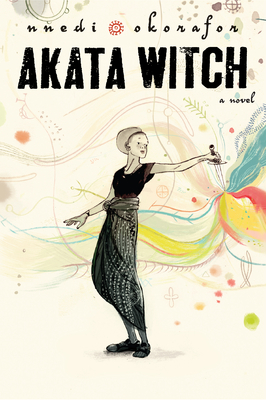
Akata Witch by Nnedi Okorafor

Nnedi Okorafor Interview, Part 3: Palm Tree Banditware – The Future of the Book

Find the first part of this interview here.

During our interview in Chicago, Nnedi showed off one of her prized possessions, an object which stands as a manifestation of her fantasy world in ours: a Kindle which has been decorated to resemble a giant folded leaf.

Reminiscent of the ‘Sandpiper’ laptops built from natural materials in William Gibson’s Idoru, Nnedi’s Kindle is a real-life emblem of the kind of distinctive technology which exists in her fantasy world, Ginen – a realm which blends plants and hardware, where the term ‘techno-organic’ has more to do with sustainability than the Borg or H.R. Giger’s Alien.

Zahrah the Windseeker coverThe defining technology of Nnedi’s stories, however, is one that’s already centuries old – the book. Time and again books play a key part in her novels, whether it’s Akata Witch’s Fast Facts for Free Agents – an unreliable, conservative set of rules for young wizards – or the Forbidden Greeny Jungle Guide of Zahrah The Windseeker, which is virtually a character in its own right.

Uncooperative and all too fallible, the Guide is Zahrah’s only source of information on the mysterious jungle into which she must venture. The device is reminiscent of science fiction’s first and greatest guidebook, The Hitch-hiker’s Guide to the Galaxy – and that’s not by chance.

Hitch-hiker’s was my first sci-fi experience, and the first book that ever made me laugh out loud,’ admits Nnedi. ‘The physics, the jokes, the way Douglas Adams writes. It was inspiring.

‘I added some extra features to the e-book of Zahrah to give it that Hitch-hiker’s feel. You can read entries from the Forbidden Greeny Jungle Guide on my website that don’t appear in the novel – including real creatures, like the suicide ant!

‘For the Zahrah e-book, I wanted pop-up ads – palm tree banditware, obnoxious recipes by the author – but it had to be exactly as I envisaged it, like in the book, and the technology’s not quite there yet. But just you wait!’

Fast Facts for Free Agents, the book given to Akata Witch’s hero Sunny as she enters the world of wizardry for the first time, is just as unreliable and prejudiced as Zahrah’s Guide.

Nnedi chalks some of this perspective up to her postgraduate studies, especially in journalism.

‘In grad school, I learned a new way of reading. It taught me that you can’t just ‘get information out of a book’. You need to know what forms of information exist, what angle they take.

‘Especially in Nigeria, authors of guide books are often almost yelling at you to convey their perspective –every ethnic group says their way is the best. There are no ‘facts’ in writing about some of the Nigerian villages – it’s always shaped by a perspective, by Original cover, Zahrah the Windseekersome writer talking down to you – yet these documents nonetheless contain real information.

‘The same is true of Fast Facts and the Guide – they’re examples of how to look at information, reminders to not always believe, and even when you do believe, always consider the perspective of one who gave the information.’

In the fourth and final part of my interview with Nnedi Okorafor, we talk about ways of learning, and the most distinctive inventions of Nnedi Okorafor’s new novel Akata Witch, chittim – a currency earned by learning , delivered as a shower of metal rods falling from the sky.