Guest Post: Walking Through Walls – Library Spaces Everywhere

Following guest posts from Adrienne Hannan on what librarians can learn from military strategy and Hamish Lindop on the best way to reach out to our customers, we’re joined this week by Auckland Libraries’ Baruk – aka @feddabonn on Twitter – an outspoken, audacious, and innovative librarian who co-designed and delivered our interactive teen space (featuring real live teens!) at the recent Auckland Libraries hui New Rules of Engagement. Here’s Baruk on ‘Walking Through Walls’:

We usually think of libraries as being confined to specific spaces that people come to. Even the more liberal expressions I have heard, “parks with walls” still focuses on a particular geographic space…with walls. And one wonders – does this attitude wall us in psychologically as well?

I’m an Aucklander and a librarian: although I grew up in a remote corner of north eastern India, I work in New Zealand’s largest city, in the biggest public library system in the southern hemisphere. A decade into the 21st century, the majority of the human race lives in an urban environment – but at the same time, the concept of the city is being re-imagined. This breakdown is a rich source of inspiration for librarians; here are three examples.

Frieze magazine recently published a piece on the methods of urban warfare used by the Israeli Defence Force (IDF). It’s a philosophical change as much as a tactical one, based on a drastic re-conceptualisation of space. If a soldier sees an urban space as consisting of streets and houses, each doorway and window becomes a threat that could hold a sniper or be booby trapped. The IDF therefore ‘walks through walls’, using explosives to blow apart roofs and walls that stand in the way of the direction they wish to go.

“We interpreted the alley as a place forbidden to walk through and the door as a place forbidden to pass through, and the window as a place forbidden to look through, because a weapon awaits us in the alley, and a booby trap awaits us behind the doors. This is because the enemy interprets space in a traditional, classical manner, and I do not want to obey this interpretation and fall into his traps.” – Brigadier-General Aviv Kokhavi

What’s good for war is also good for play: the increasingly popular sport of parkour does something similar, in its refusal to stick to prescribed paths laid down by urban planners. Parkour players – “traceurs” – make a game of moving vertically, climbing walls and jumping roofs to move between spaces. While at first glance it looks like it requires more athleticism and gymnastic ability than most of us have, it is more about one’s attitude to space, and really another way of tracing desire lines in the urban landscape. (See more on desire lines and libraries from Books and Adventures guest Jess Begley).

If we lack the acrobatic skill to move through the urban space as a traceur would, there are other options. Read more

Guest Post: Hamish Lindop – Buying Library Users A Birthday Present

Today’s guest post comes from Hamish Lindop, who is Reference Librarian-Learning Services at Auckland Libraries, but has also turned his hand to numerous special projects in the city this year – from street promotion for our Dark Night festival to behind the scenes work on our 2013 Children’s and Youth Service conference, “the hui of awesome awesomeness”.

Auckland Libaries Youth Hui

The hui was a huge success, bringing together librarians from across New Zealand and Australia for panel discussions, hands-on Nerf-gunning workshops, and a teen space which attendees could visit to experience youth librarianship in action. You can follow the discussions via the Storify page created by Auckland’s own social media maven Tosca Waerea.

One of the biggest tensions I sensed at the hui was between the need for librarians to be courageous and creative, and the tendency of managers to struggle as they balanced this creativity with the demands of administration and the bigger picture of the libraries’ business plan. It’s very hard to not take bureaucracy personally when one is also being directed to be passionate and innovative…

Hamish has done some work reconciling these challenges with a wonderful common-sense analogy: buying our communities a birthday present.

I’ve been thinking a lot about how a public library can deliver the best value to the community that it sits in. The answer that I have come up with is this: we can get the community a birthday present. This is my favourite analogy for how to synthesize listening to your community, and innovating to surprise and delight them.

Read more

Dark Night: Bromance Coda – Carol Borden on Superman and Masculinity

As a coda to my series  for Auckland Libraries’ Dark Night, I’m reposting a great essay on the Man of Steel from Carol Borden, editor of Canada’s great online arts journal The Cultural Gutter.

As Man of Steel hits our screens and offers us a pretty brutal take on the boy from Krypton, Carol finds new and exciting ways to affectionately explore gender identity in…“Loving the Alien”.

Read Loving the Alien: Superman and Masculinity at Carol’s website, Monstrous Industry.

Dark Night: Bromance, 3 – “I’m Taking A Ride With My Best Friend”

This is my final piece looking at bromance in the context of Auckland Libraries’ Dark Night festival exploring sex and sexuality on page, stage, and screen.

The first time we hung out together, he pissed me off and I threw my bike at a tree.

The last time I saw him, we went out for my birthday, overindulged, and I ended up passing out at some godawful steampunk gig in Oxford.


Read more

Dark Night: Bromance, 2 – Jules

Julio Iglesias, I started writing about that awful word “bromance” after the launch of Auckland Libraries’ Dark Night festival exploring sex and sexuality on page, stage, and screen. Our guest speaker, Dr. Pani Farvid, introduced the movie Shame by pointing out that it many ways it wasn’t about sex at all. Its topic was addiction, and more broadly than that, the ways in which society disciplines all of our feelings, not just our sexuality; telling us that these are the permissible ways in which to have and express emotions.

In the pub afterwards, we talked about how heterosexual men define themselves as much through their relationships with other men as those with women. And after that, I knew I would spend this week of Dark Nights writing about Mike, and Jules, and J. That, if I could write about sexual relationships of varying intensity and duration, I could do the same for three varieties of “bromance”.
Read more

Dark Night: Bromance, 1 – “I am serious, and don’t call me Shirley”

Ted and Elaine from AIRPLANE/FLYING HIGH

You know Ted and Elaine from Airplane* are the most romantic couple of all time, right?

*(“Flying High” to some of you Antipodeans out there)

You’ve probably forgotten. That’s okay. I’ll give you a quick reminder.

Last Friday I was at the launch for Dark Night, Auckland Libraries’ festival exploring sex and sexuality on page, stage, and screen. Afterwards, in the pub, the conversation got pretty deep as we considered the ways in which society influences the way we show our gender and sexuality to the world.
Read more

On a Dark Night, You Can See For Ever: Library Burlesque hits Auckland

Dark Night at Auckland Libraries
Image by Dylan Horrocks

21st June sees the launch of Auckland Libraries’ Dark Night, a guerrilla festival of burlesque, literary, and cinematic events that question, celebrate, and challenge sex and sexuality on page, stage, and screen.

Opening with a screening of Steve McQueen’s Shame, a harrowing portrait of sex addiction starring Michael Fassbender and Carey Mulligan, the season includes library services in Auckland bars, author talks, and a cabaret evening including the sultry, saucy stars of Auckland Fringe Festival, Oh! Is For Opera. Read more

A spatulate depression, part III: A coda on library spaces

Okay, this is my last time paraphrasing that passage from Nabokov which kicked off this series of blog posts.

I could also distinguish the glint of a special puddle (the one Krug had somehow perceived through the layer of his own life), an oblong puddle invariably acquiring the same form after every shower because of the constant spatulate shape of a depression in the ground. Possibly something of the kind may be said to occur in regard to the imprint we leave in the intimate texture of space.

Nabokov is writing about a fictional character, but I’ve been arguing that all of us, living and dead, real and fictional, leave these kind of impressions in the world through words, images, deeds, artefacts – the kind of things which it’s a library’s job to help members of the public find and use as they see fit.

In my previous post, ‘The Mission of the Librarian’, I used an essay by the philosopher Ortega y Gasset to suggest that librarianship itself was, like the other professions, one of these puddly spaces, slowly etched by our peers and predecessors, which we get to fill with our own daily life and action.

Usually I’m more excited by librarians than libraries. Politicians like cutting the ribbons on big new builds of steel and glass, but what interests me is what services you can provide when there’s zero budget, zero resources, the politicians disapprove, and all you really have is your own imagination and initiative. I really like that R. David Lankes sometimes asks if librarianship has a future separate from libraries themselves – and I pushed pretty hard for Auckland’s librarians to go off-site and offer their services in other spaces, like comic book stores and even bars.

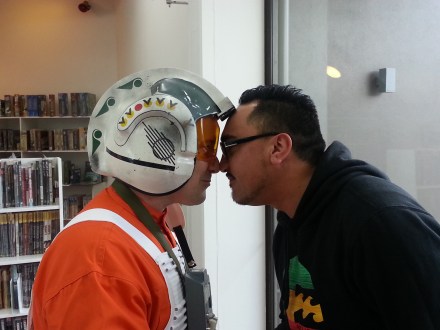
A hongi with the Rebel Alliance
Distinctively geeky, distinctively Kiwi – Auckland Libraries staff in a comic book store for Star Wars Day

BUT…I have been thinking about library spaces too, since I last wrote.

I’m currently working on a couple of projects that provoked this.

Read more

A spatulate depression, part II: The mission of the librarian

This is a standalone blog post, but also the second part of some larger thoughts around archives, libraries, and how words shape who we are. Click to read the first part.

When I first started working with libraries, I downloaded and read a copy of the Spanish philosopher José Ortega y Gasset’s ‘The Mission of the Librarian’ (PDF download). It was written in 1934, but I hoped there would be some lingering insights about libraries or – let’s be frank – cool, glib quotes that I could share in speeches or workshops to make myself look smart and erudite.

Read more

Key 23 and the Nth Degree, part III: Your words in the real world

This is the third part of a blog series giving a personal take on librarianship, archives, and the powers of words. Start here for the first post in the series.

Key 23 is something I only discovered because, working in Auckland for six months, I am using a public library like a regular reader for once – borrowing books simply because they interest or excite me.

A lot of the books I’m borrowing are comics – I love the economy of storytelling and really believe, as I was telling the State Library of New South Wales last year, that this medium might hold the future of space, word, and image. Among the comics I’ve been reading is Grant Morrison’s The Invisibles, which chronicles the adventures of a secret society battling extradimensional forces in the run up to the year 2000.

In The Invisibles, there’s a drug called Key 23 which makes the user experience whatever they read as real. It’s a lovely conceit, which Morrison also flips by adding the notion of a ‘fiction suit’ which (I may have got this wrong…) allows characters to travel through the world of discourse.

Panel from Grant Morrison, The Invisibles
Dream, reality, self and other are breaking down in Grant Morrison’s The Invisibles

Read more