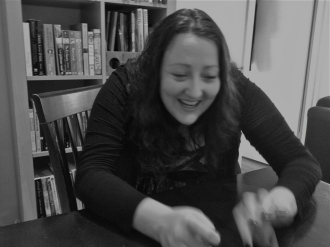
My Dinner With Hergé: Raymond Huber and Hugh Todd

This is one in a series of posts supporting my article in the June 18th curriculum supplement to the New Zealand Education Gazette. Find more resources, interviews and features on comics in education via my site’s comicsedu tag.

Today, I’m joined by Raymond Huber and Hugh Todd, lifelong devotees of the iconic boy reporter, Tintin.

Tintin and Snowy

Raymond is a New Zealand children’s author whose novel Wings was a finalist in the 2012 Julius Vogel awards.

Hugh, a fellow Kiwi now based in Australia’s Blue Mountains, is a cartoonist, graphic designer and author of the Scholastic picture book Bring Back the Ball, Daisy Dog.

Raymond and Hugh agreed to discuss the enduring appeal of Europe’s most famous comic book character and his creator, Georges Remi, over an informal “dinner with Hergé”.

Read more

Comics in the classroom: the artists’ perspective

As a writer with the shaky draftsmanship of a toddler on Red Bull, I tend to avoid discussing the visual aspect of comic book literature – this despite holding a Ph.D. which looked at the lives of many 20th century art historians!

I really struggled with art in high school. The only recognition a teacher ever showed for my artistic talents was at the age of 13, when I decorated the interior and exterior covers of my maths book with an epic stick-figure comic depicting the escapades of Jimmy Joe the Spew Surfer as he battled his way to a Ramones gig.

At the bottom of that week’s homework, Mr. O’Grady wrote: ‘7/10, some corrections to be made. Please kindly cover over the adventures of Jimmy Joe et al, or purchase a new exercise book.’ He then made me collect litter from the campus after school.

Jessica Abel, self-portrait
Self-portrait from 2007’s Life Sucks, by Jessica Abel

In this blog post, I want to redress the balance and hear artist-educators’ thoughts on using comics in the classroom. From the USA, we’re joined by acclaimed graphic novelist Jessica Abel, co-creator of the Drawing Words, Writing Pictures comics textbook. In London, Kel Winser works with children and young people creating Egyptian-themed superhero comics at the Petrie Museum of Egyptian archaeology, while Australian writer and illustrator Steve Axelsen runs workshops for young people in Western Sydney via the Westwords programme.

Read more

Comics in the classroom: Dr. Yen Yen Woo and the Dim Sum Warriors

Dr. Yen Yen Woo is a filmmaker, comics creator and associate professor of education at Long Island University. She’s one half of the creative team behind Dim Sum Warriors, a comic-book iPad app which features pork buns, dumplings and other dim sum dishes battling for the throne of a fabled kingdom. The narrative is designed as a bilingual learning tool including English and Mandarin Chinese elements.

Yen Yen joins us today for her top tips on using comics in the classroom.

Read more

Comics in the classroom guest post: Nick Sousanis of Teachers College, New York

American artist and educator Nick Sousanis is one of the experts interviewed in this month’s education article on Comics in the Classroom. Nick made his name on the Detroit art scene before beginning a Ph.D. at Teachers College in New York.

Unusually, Nick’s own doctoral thesis takes the form of a comic book – putting into practice his belief that the medium can be a powerful tool for intellectual inquiry and the communication of complex arguments.

Possibilities comic by Nick Sousanis
A page from Nick Sousanis’ ‘Possibilities’, a philosophical and historical examination of games

Nick is currently speaking at the Rocky Mountain Conference on Comics and Graphic Novels. In today’s guest post, Nick shares his thoughts on making the most of comics in education.

Read more

Cody Pickrodt – Comics in the classroom

This is one in a series of posts supporting my article in the curriculum supplement to New Zealand Education Gazette, out on June 18th. Find more resources, interviews and features on comics in education via my site’s comicsedu tag.

Cody Pickrodt is an American indie comics creator and educator who runs comic book workshops for Brooklyn kids through the non-profit organisation Uproar Art.

Poster for Chicago Alternative Comics Expo
Cody Pickrodt will be attending CAKE – Chicago’s Alternative Comics Expo – this weekend.
Image by Laura Park.

Cody joined me for an interview on my site back in February 2011, and features in my upcoming piece for the Gazette.

Today, Cody shares some of his top tips for getting students to create their own cartoons, comics and graphic narratives.

Read more

The Petrie Museum, University College London: Using comics to bring ancient Egypt to life

This is the first of a series of posts supporting my article on comics in the classroom, which appears in the June 18th curriculum supplement to the New Zealand Education Gazette. Find more posts on comics and education under the comicsedu tag on my site.

One of the most exciting comic book education projects I’ve discovered takes place in the Petrie Museum, where University College London holds its collection of archaeological findings from ancient Egypt.

Supergods workshop flyer from the Petrie Museum, University College London
Image property of University College London.

It can be a tall order attracting children and young people to an academic museum, especially with a capital city’s attractions on your doorstep. Since 2010, artist and educator Kel Winser has run workshops at the Petrie, using ancient Egyptian culture as an inspiration for children and young people to create their own superhero characters.

Kel and the Petrie Museum’s education officer Debbie Challis joined me to discuss their innovative use of comics as an education tool.

Read more

Comics, Ink and Science

Bryan Grieg Fry with an alligator
Bryan Grieg Fry

My article on Bryan Grieg Fry, the heavily tattooed venom expert at the University of Queensland, appears in the forthcoming print edition of Australasian Science magazine.

I’ve also written on using comic books in the classroom for the curriculum supplement to this month’s New Zealand Education Gazette.

To tie in with this article, I’ll be posting additional interviews, resources and guest writing on using comics in the classroom under the comicsedu tag.

Watch out for posts and wise words from the likes of graphic novelist Jessica Abel, artist-educator Nick Sousanis, staff from University College London’s “Supergods” workshops, and many more.

The joy of copywriting: taking on government garble

I recently took a contract putting stilted government language into plain speech.  I’m rewriting hundreds of web pages covering all kinds of public service – from pest control to parking and schools to recycling.

Public sector copywriting might not sound glamorous, but it’s fun to attack a mountain of jargon and break it down into something clear, friendly, and informative for a wider readership.

I meet a lot of students who want to make a living as a writer. Although there’s a few working on screenplays, many teens imagine themselves growing up to be novelists – solitary, self-reliant figures hunched over a desk, creating a masterpiece which will earn them Rowling megabucks.

Yet the joys of many writing jobs are not solitary but social. Journalism and copywriting both involve getting out, talking with people, communicating and learning.

Read more

New article at ScienceWise

Australian venom expert Dr. Bryan Grieg Fry

My latest article for ScienceWise, on Australian scientists who have tattoos of their own research, appears in print tomorrow, with an online copy visible today – visit the ScienceWise website to read more.

Dr. Bryan Grieg Fry, venom expert at the University of Queensland, is pictured above. He appears in another piece on science tattoos, also coming soon in the Aussie science press.

April update: Science tattoos, teen bloggers, copywriting, and comics

It’s been a little quiet on the blog lately as I ploughed through a swathe of writing assignments and tried (only partly successfully) to stay clear of the Internet.

I have a couple of articles out later this year for the Australian science magazines ScienceWise and Australasian Science, profiling scientists who featured in Carl Zimmer’s book Science Ink. Carl uncovered the weird and wonderful world of researchers who have their work tattooed on their bodies after he spotted a DNA helix inked on the arm of a respected neurobiologist at a pool party in the States. This led to a great book collecting photos of striking, beautiful and downright bizarre science tattoos from around the world.

Read more