Adrienne was a guest speaker at the Auckland Libraries conference ‘New Rules of Engagement (PDF download)‘ – now she offers 10 ways librarians can learn from the military’s can-do attitude and take our operations to a new level of efficiency, effectiveness, and panache.
On the eve of the Auckland Libraries children’s and youth librarian conference New Rules of Engagement: A Hui of Awesome Awesomeness (PDF download), I’m joined by one of our guest speakers, Adrienne Hannan. She’ll be showing Australian and Kiwi librarians how to run a thrilling educational Nerf gun activity.
Adrienne is children’s and youth coordinator at Wellington City Libraries in the Kiwi capital…but she also has a rather intriguing double life which I’ll let her explain as she takes us into the world of The Strategic Librarian…
As Man of Steel hits our screens and offers us a pretty brutal take on the boy from Krypton, Carol finds new and exciting ways to affectionately explore gender identity in…“Loving the Alien”.
This is my final piece looking at bromance in the context of Auckland Libraries’ Dark Night festival exploring sex and sexuality on page, stage, and screen.
The first time we hung out together, he pissed me off and I threw my bike at a tree.
The last time I saw him, we went out for my birthday, overindulged, and I ended up passing out at some godawful steampunk gig in Oxford.
I started writing about that awful word “bromance” after the launch of Auckland Libraries’ Dark Night festival exploring sex and sexuality on page, stage, and screen. Our guest speaker, Dr. Pani Farvid, introduced the movie Shame by pointing out that it many ways it wasn’t about sex at all. Its topic was addiction, and more broadly than that, the ways in which society disciplines all of our feelings, not just our sexuality; telling us that these are the permissible ways in which to have and express emotions.
In the pub afterwards, we talked about how heterosexual men define themselves as much through their relationships with other men as those with women. And after that, I knew I would spend this week of Dark Nights writing about Mike, and Jules, and J. That, if I could write about sexual relationships of varying intensity and duration, I could do the same for three varieties of “bromance”. Read more →
As we finally reach the opening of Dark Night, Auckland Libraries’ guerrilla season of events exploring sex and sexuality, I’m blogging on the way that films and literature shape the way we think about relationships.
It’s a different take on the arguments I’ve been making in recent weeks, that libraries offer a place for us to immerse ourselves in culture and participate in a way unique from any other space.
The books we read and the movies we watch can have drastic effects on the lives we lead: in this third Dark Night post, I look at the way films skewed my take on romance and led to me poisoning myself for love at a London railway station. Read more →
I could also distinguish the glint of a special puddle (the one Krug had somehow perceived through the layer of his own life), an oblong puddle invariably acquiring the same form after every shower because of the constant spatulate shape of a depression in the ground. Possibly something of the kind may be said to occur in regard to the imprint we leave in the intimate texture of space.
Nabokov is writing about a fictional character, but I’ve been arguing that all of us, living and dead, real and fictional, leave these kind of impressions in the world through words, images, deeds, artefacts – the kind of things which it’s a library’s job to help members of the public find and use as they see fit.
In my previous post, ‘The Mission of the Librarian’, I used an essay by the philosopher Ortega y Gasset to suggest that librarianship itself was, like the other professions, one of these puddly spaces, slowly etched by our peers and predecessors, which we get to fill with our own daily life and action.
Usually I’m more excited by librarians than libraries. Politicians like cutting the ribbons on big new builds of steel and glass, but what interests me is what services you can provide when there’s zero budget, zero resources, the politicians disapprove, and all you really have is your own imagination and initiative. I really like that R. David Lankes sometimes asks if librarianship has a future separate from libraries themselves – and I pushed pretty hard for Auckland’s librarians to go off-site and offer their services in other spaces, like comic book stores and even bars.
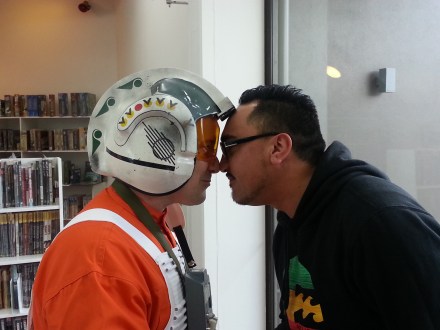
Distinctively geeky, distinctively Kiwi – Auckland Libraries staff in a comic book store for Star Wars Day
BUT…I have been thinking about library spaces too, since I last wrote.
I’m currently working on a couple of projects that provoked this.
This is a standalone blog post, but also the second part of some larger thoughts around archives, libraries, and how words shape who we are. Click to read the first part.
When I first started working with libraries, I downloaded and read a copy of the Spanish philosopher José Ortega y Gasset’s ‘The Mission of the Librarian’ (PDF download). It was written in 1934, but I hoped there would be some lingering insights about libraries or – let’s be frank – cool, glib quotes that I could share in speeches or workshops to make myself look smart and erudite.
One of my favourite novels is Vladimir Nabokov’s Bend Sinister. I guess it’s a pretty minor work of his, and I only ever picked it up because I liked the goofy, almost Hitchockian cover of the Penguin paperback.
Vladimir Nabokov, Bend Sinister
The book’s about Adam Krug, a philosopher from an Eastern European country which is under a totalitarian regime. He fights the tyrannical dictator Paduk at great personal cost, building to a bizarre climax in which Krug is saved from a moment of grief and rage thru a bit of metafictional deus ex machina. It’s really not the best thng Nabokov ever wrote. It’s kind of M. Night Shyamalan for the Times Literary Supplement set, but I still love it – and partly for that cheat ending, which includes the narrator (Nabokov himself?) uttering the lines:
I could also distinguish the glint of a special puddle (the one Krug had somehow perceived through the layer of his own life), an oblong puddle invariably acquiring the same form after every shower because of the constant spatulate shape of a depression in the ground. Possibly something of the kind may be said to occur in regard to the imprint we leave in the intimate texture of space. Twang. A good night for mothing.
I love that whole paragraph. It’s so perfect, right down to that mad ‘twang’ and reference to Nabokov’s lepidoptery, it sets me on fire. [Pale Fire?] It’s something that you’d never, never say in real life – it’s the essence of wanky literary-speak – and yet, it has a poetry. The vision of the puddle, the imprint in the ground, filling with water – seeing this on the page, knowing it to be a trick of words – to me it’s the essence of why we read. To see that constant depression filled once again with a glint of life.


 As a coda to
  I started writing about that awful word “bromance”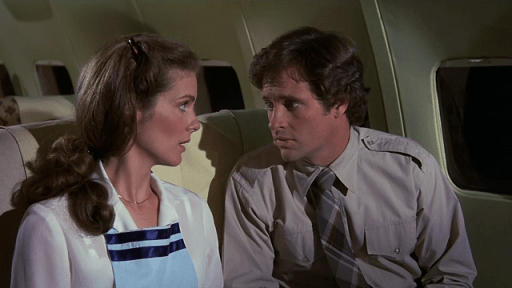


 matt finch / mechanical dolphin