The Brisbane Times has just published a story on the State Library of Queensland’s acquisition of the last ever interviews with Aussie celebrity chef Bernard King.
Back in May, I led a couple of sessions for Queensland’s Heritage Leaders Workshop, exploring ways to turn audiences into participants and expand the conversations we have at panels, keynotes, and other events.
“We believe in the genius in everyone, in everyone an artist and everyone a scientist, and that creativity in community can change the world for the better.
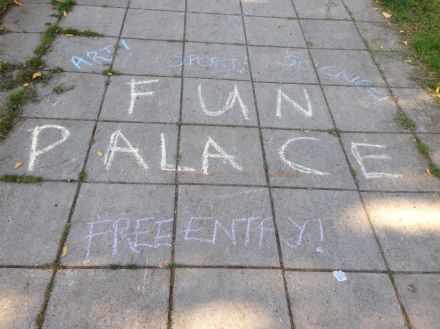
We believe we can do this together, locally, with radical fun – and that anyone, anywhere, can make a Fun Palace.”
– Fun Palaces Manifesto
October might seem far off, but plans are underway for Fun Palaces across the Sunshine State in 2016.
What’s a Fun Palace? It’s the opportunity for a community to come together and explore the arts and sciences for free.
From fancy inner-city venues to radio stations, theatres, websites, suburban parks, swimming pools, remote tropical islands, people’s back gardens, and, yes, libraries, Fun Palaces are a way for people to get together with friends, family, neighbours, workmates, and strangers in their community, to celebrate the artist and scientist in all of us.
Theatre director Joan Littlewood and architect Cedric Price came up with the idea of Fun Palaces back in the 1960s. They imagined “a laboratory of fun” that would serve as a pop-up community venue for both art and science.
Today, Fun Palaces take place all over the world on the first weekend in October, allowing communities to be part of something bigger, setting off sparks of inspiration and connection which lead to lasting benefits for the people involved.
In 2015, I was co-producer to 11 simultaneous Fun Palaces across a 13-mile stretch of South London. Football clubs and firefighters, jewellers and businesspeople, comic stores and kickboxers, university students and lecturers, plus many more all joined forces to celebrate the arts and sciences in the London Borough of Lambeth. London’s 2015 Fun Palaces also included an online comic maker built for us by the State Library of Queensland, where I’m currently based.
If you’re a Queenslander who’d like to get involved with Fun Palaces this year, our team at the State Library can give advice and support, or connect you to venues which are already running Fun Palaces across the state – including every single public library in the city of Brisbane. We’re also equally excited if you just want to make a tiny Fun Palace in your office or your garden or your kitchen, with your mates or your neighbours or your family.
We all have something to offer, we all have something we’d like to learn or explore. If you’d like to join the adventure in Queensland, either contributing to a Fun Palace on the weekend of 1-2 October, or helping Fun Palace organisers in the run-up to their event, contact the State Library’s Signature Team.
Three years ago tonight, I was on stage in the Auckland suburb of Grey Lynn, MC’ing the grand finale of our Dark Night festival.
Image by Dylan Horrocks
The weeklong, citywide programme sought to “question, celebrate, and challenge sex and sexuality on page, stage, and screen,” bringing together artists, writers, academics, and fans for open and frank discussions about identity, sex, and the media.
The people who made me came to England from Germany, Ireland, Scotland, Italy, and other places besides. My parents met in Spain, a country where I would work in my early twenties. From my first year of life, Germany and Spain were as important to our sense of family as the green fields of England.
I was born in London, that great world city, and I moved straight back there from the country when I turned eighteen. I was a student and a barista at the Soho YMCA. The people around me were from Finland, Austria, Colombia, Ireland, Brazil. I kept studying: my doctorate looked at refugees, exiles, and émigrés who came to Britain fleeing the Nazis, and from that I went on to work with asylum-seeking children.
Since then, I’ve been lucky enough to travel and work overseas.I’ve been made welcome in communities thousands of miles from where I was born, found new family, found new friends; I hope I’ve done that, in turn, for people who have come to live and work alongside me.
It wasn’t so much a choice as a vocation. Everything in my life has involved crossing seas, crossing borders. So much of who I am is founded on a sense that our lives and identities are about routes more than origins; time more than territory. That freedom of movement is vital.
A new interdisciplinary literacy is the only hope for finding a way to square our current arrangement of life with the continuation of human and planetary life as such. Scientists, philosophers, anthropologists, politicians, political theorists, historians, writers, and artists must gather their wisdom, develop a level of mutual literacy, and cross-pollinate their severed lineages.
I think there’s a lot of merit in Beth Povinelli’s words about science and the arts and different ways of knowing.
I’ve been thinking about this a lot as momentum builds for this October’s Fun Palaces, the international community-led celebration of arts and sciences.
Fun Palaces can look like cuddly fluffy things, but they’re also events which are serious about acknowledging the talents and understanding which local communities already have. They’re very serious, too, about exploring what it means to say, as their motto does, “everyone an artist, everyone a scientist.”
Those two terms can seem intimidating sometimes. “Artists” and “scientists” sound like privileged, elevated folk compared to you and I – so the way I always put it is this:
If a two-year-old ever handed you an imaginary phone and said “Ring ring”, and you answered it, you’re an artist – because you joined in their creative play.
And if you ever made soup from a recipe, tasted it, and said “needs more salt”, then added some, you’re a scientist – because you revised your belief in the face of evidence.
What are libraries trying to achieve? What’s helping them, and what’s getting in their way? What should a big organisation like the State Library of Queensland (SLQ) be doing for its smaller siblings across the country?
Results indicate that local governments, who own and manage libraries, do not always see the positive impact libraries have on the community, and this limited awareness keeps governments from investing more resources and giving the libraries free reign.
However, free reign and resources are the primary things libraries need to make an impact. Strategies that help overcome this challenge include proving impact through evidence, gaining freedom in communication, using innovative methods to circumvent red tape, and acquiring resources locally.
Pointing out that many non-library-users and even library staff are unaware how much libraries have changed and what they can now do, the report’s authors encourage librarians to connect with peer organisations, source skills and resources from their local community, and identify “low-cost yet high impact marketing techniques.”
The report recommends that Queensland’s State Library builds “an inspirational network of equals to stimulate mutual exchange…develop and realise visions together, and share success stories and mistakes”; it warns that “combining services should only be pursued if there really is insufficient funding to offer services separately […as] combining services primarily means that library services suffer”; and it tells us that in Queensland,
the community’s appreciation for their library seems to be highest when, on top of preserving and guiding access to collections, libraries also stimulate and guide
Saturday saw the State Library of Queensland (SLQ) host its first Human Library as part of the Big Day of Belonging festival.
After a member of the public approached our team asking about a “scheme where you could borrow people like library books”, I contacted the global Human Library organisation in Denmark and also Toronto Library’s Linda Hazzan, who runs one of the world’s most outstanding Human Library programs. Linda in Toronto, Ronni Abergel in Denmark, and Greg Watson of Human Library Australia all provided advice and mentoring to us.
Human Libraries let you borrow people instead of books for a short conversation with someone you might not ordinarily meet in your day-to-day life: people with unusual life experiences or special skills, people who are marginalised or stigmatised in society, people who are – as we all are – well worth listening to.



 matt finch / mechanical dolphin