Oxford Human-Algorithm Interaction Workshop 2025

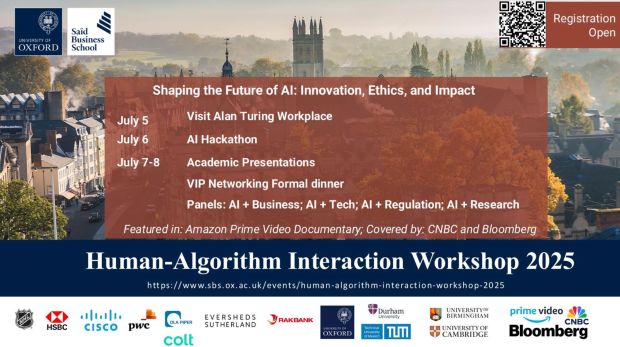
I’m pleased to be presenting at the University of Oxford’s Human-Algorithm Interaction Workshop 2025, on “Governing the futures you didn’t see coming: artificial intelligence scenarios“.

Do join us in Oxford, 5-8 July, for an interdisciplinary event delving into the complex and evolving relationship between humans and algorithms.

The annual workshop is a gathering of industry leaders, AI pioneers, and leading researchers who will explore the evolving role of AI in business, governance, and society. This year’s theme is “Shaping the future of AI: innovation, ethics and impact.”

Find out more and register here.

Webinar: How Dual-Use Tech Is Redrawing the Global Power Map

On June 9th, I’m hosting a discussion about dual use technologies for Oxford’s Emerging Threats Group.

A wide range of items are now recognised as “dual use”, capable of being employed for both civil and military purposes. From drones, robots, and software including AI to chemical and biological tools, the term has evolved beyond its original post-World War 2 meaning as a category of nuclear materials that could serve both the energy sector and the development of nuclear weapons.

Today anything is a weapon and may be used as such, especially in hybrid warfare. We live in an era when countless technologies can be used with benign or hostile intent, and when the governance mechanisms of global trade are being shaken under heightened geopolitical tensions. Under such circumstances, innovation, application, and regulation all become increasingly fraught. Businesses may find themselves drawn into new dilemmas if their technology is turned to malign ends, or seek opportunities that arise from a new era of dual use. Governments must act judiciously in an age when many items may be weaponised against them…or by them.

Join me, and four transatlantic experts, to consider the past, present, and future of dual use technology, 5pm-6.30pm BST on June 9th.

Register and RSVP at the Emerging Threats website.
Right Here, Right Now Global Youth Climate Summit

I’m pleased to be delivering two sessions as part of the University of Oxford’s contribution to the Right Here Right Now Global Youth Climate Summit, a 24-hour virtual event presented by UN Human Rights and the Saïd Business School.

The online gathering brings together students and educators from across the world to share ideas about embedding climate action at the heart of education systems.

Find out more at the Saïd Business School website or register for the 24-hour livestream here.

'Dreaming Spires', by Flickr User JJBullock - Copyright JJ Bullock 2010
‘Dreaming Spires’, by Flickr User JJBullock – Copyright JJ Bullock 2010

The Ghosts We See From The Mountains: New book chapter available

It feels somehow timely that “The Ghosts We See From the Mountains“, a chapter co-written with the University of Galway’s Marie Mahon for the Routledge volume Crisis and Body Politics in Twenty-First Century Production, is now live online and open access.

The chapter explores the useful intersection of Oxford-style scenario planning with issues of spatial justice and Verónica Gago’s concept of the “body-territory”.

Thanks to volume editors Charlotte Spear and Maddie Sinclair for bringing everything together.

Title of the Routledge edited volume Crisis and Body Politics in Twenty First Century Cultural Production

Appointment to Futures Council, National Security College, Australia

I’m pleased to have been appointed to the Futures Council of the National Security College (NSC) at Australian National University.

The Council is an international group of individuals with expertise relating to the mission of the NSC’s Futures Hub, a whole-of-government and whole-of-nation resource for futures analysis in Australia.

Read more about the Hub and their work at the NSC here.

New chapter: Crisis and Body Politics in Twenty-First Century Cultural Production

Title of the Routledge edited volume Crisis and Body Politics in Twenty First Century Cultural Production

My 2023 conference paper “The ghosts we see from the mountains: Scenario planning and the territorial body in time” will be published next year in Routledge’s edited volume Crisis and Body Politics in Twenty-First Century Cultural Production, as a co-authored chapter with Marie Mahon of the University of Galway.

Marie and I collaborated on the foresight elements of the IMAJINE project, a Horizon Europe-funded programme exploring spatial justice and regional inequality across Europe.

We look at how scenario-based thinking can inform strategic conversations and policy decisions around territorial inequality: Do citizens have equal rights and opportunities regardless of wherever they live? Are different places treated fairly? Is your ability to realise your rights compromised by where you live? How will the answers to these questions vary as contemporary uncertainties unfold?

See more at the Routledge website.

Oxford Emerging Threats Group: Soft Power in a Digital Age

How is the nature of soft power changing?
What part are critical and emerging technologies playing in these changes?
What is the role of soft power in 21st century geopolitical dynamics?
What threats and opportunities might be emerging?
Do we see ways in which changes in the soft power environment affect the changing character of armed conflict?

Join me and a panel of experts to explore these questions and more with the Emerging Threats Group at Oxford University, November 25, 5:00 pm – 6:30 pm GMT.

ISF Podcast: Threat Horizon and the auDA scenarios

I recently joined the Information Security Forum’s Mark Ward and auDA’s Sophie Mitchell for a short podcast discussion exploring foresight, uncertainty, cybersecurity, and Internet governance.

We looked at these issues through the prism of auDA’s recent scenarios for the future of the Internet and ISF’s own Threat Horizon foresight product.

Check out our episode of the ISF podcast here.