Keeping things fresh: Steampunk rapper Professor Elemental on hip-hop and education

Today we’re joined by Paul Alborough – a witty British rapper who “hosts, performs and teaches hip-hop in more ways than you can imagine” in the guise of steampunk cleverclogs Professor Elemental.

Paul’s been interviewed many times about his music, but as I’ve recently started working in South Auckland, with its strong hip-hop culture, I was especially excited by his former career as a special needs educator, and his ongoing commitment to youth development through hip-hop workshops.

I began our interview by asking about Paul’s time as a teacher.

The truth is that I stumbled into it, having realised that I hated or had been fired from every other day job that I could possibly think of. That, and a natural affinity with children, who always seemed a lot more fun to hang out with than adults, led me to the world of  education.

Read more

“I much prefer it when libraries are less about archiving the past, and more about presenting culture today”: Stewart Parsons on “Get It Loud in Libraries”

Marina and the Diamonds getting loud in libraries!
Marina and the Diamonds – image (c) Frances Ross

Libraries are utterly thrilling places. At least they ought to be. They should wow the pants off people. Shouldn’t they? All that free stuff. All that culture. All that Keatsian poetry to woo the ladies, and bomb-like knowledge to help pave your way in the world. What’s not to like?

I have long held the belief that a library user should leave a library a more enlightened, brighter, happier, braver, more empowered individual compared to the same person that first went in. In modern TV-land, the romance of people “going on a jouney” is increasingly paramount.

People go on journeys in libraries every day. Maybe we just don’t shout about it enough?

But for that to happen, for that surging flood of the imagination to take place, for the journey to take place at all, the original resources often need to be re-imagined. To be presented in a way that is fresh and appealing and meaningful. Especially to the young.

Read more

My 2012 Zombies in the Library event in rural New South Wales has just been featured as an online ‘how-to’ feature at The Library as Incubator Project – http://www.libraryasincubatorproject.org/?p=8939 – a U.S. scheme highlighting the way that libraries and artists can work together.
Last month, British playwright Fin Kennedy wrote a compelling piece for the Oxford Culture Review on the value of arts collaborations with the higher education sector. He writes:
“When these sorts of collaborations work well they’re a brilliant two-way street; arts organisations get a share of Universities’ physical resources and manpower, Uni students get professional experience and links with industry, and inner city young people get friendly and accessible contact with Higher Education. And it all costs hardly anything – the ingredients are all there. It just takes a creatively-minded individual to bring them together. I’m a big advocate of artists taking that role. As freelancers we’re in a strong position to broker those relationships between organisations we all already have links with anyway.”

theoxfordculturereview's avatarThe Oxford Culture Review

Following a meeting with Culture Minister Ed Vaizey, award-winning UK playwright Fin Kennedy is running a campaign to raise governmental awareness of the effects of arts funding cuts upon theatres. I spoke to him about the project and the importance of the arts in Britain.

To anyone who doesn’t know about your campaign – what are you trying to achieve, and who can get involved?

Last month I met Culture Minister Ed Vaizey at a Writers’ Guild event at Parliament. He claimed that the recent round of swingeing cuts to public investment in the arts were having no impact at all on the development of new plays in the UK. I knew from my own experience of seeing the theatre industry I work in contracting all around me that this wasn’t true, but there are surprisingly few facts and figures available. Vaizey said he would look over any evidence I could…

View original post 1,676 more words

Respect, innovation, and cheeky pancakes: thoughts on the future of bookstores and libraries

Central City Library, Auckland

So, a big announcement has been in the works for some time: from 25th February I begin a six-month contract as adviser to Auckland Libraries, the largest public library network in the southern hemisphere. The mission is to extend and enhance Auckland’s already superlative library offerings for children and young people with creative, challenging, and sustainable activities for the future.

I feel confident that we’re entering an era of swashbuckling literacy adventure Down Under. Auckland is the city where kids play a Kiwi-themed version of Angry Birds in their libraries; the city whose librarians already talked Bryan Lee O’Malley into letting them use Scott Pilgrim as the face of their comic book events and wooed Amanda Palmer into giving an impromptu Get Loud In Libraries-style guerilla gig.

Before Auckland beckons, I’ve been looking at the latest developments in the UK and US. The Future Foyles workshop held on Monday of this week brought together publishing, retail, and literacy professionals seeking a vision for London’s next great flagship bookstore – you’ll see me quoted in The Bookseller’s report of the event –  and finding much food for thought from a wider community outreach perspective.

Read more

Guest post: Steve Saville on comics and creativity, part 2

In the second part of his guest post for Books and Adventures, Steve Saville of Alfriston College in Auckland, New Zealand, discusses the lessons to be learned from his pioneering comics in the classroom workshops.

Most educators currently involved in secondary schools in New Zealand would agree that creativity is a good thing and that it needs to be encouraged; that we need to nurture and encourage the creative young people who will solve the problems posed by our ever changing world.

We can all look to our own school environments and proudly detail how creativity is nurtured, encouraged, and celebrated in our schools. We provide ample opportunities for writing, artistic expression, the creative use of digital technologies, dance, and drama. Our schools have bands, singers, sculptors. We offer classes in creative writing and philosophy. It can be argued that we have countless opportunities for young people to express and develop their creative skills.

We can also think of numerous teachers that we would classify as creative in their approaches, talented educators who find new and exciting ways to get their learners thinking. Teachers who challenge thinking by making learners ask questions and by asking learners to seek the relevance and authenticity of material studied.

All of this is totally correct – but is it enough?

It may be creative to enable a learner to write a story, to perform in a play or to design a web page but who chose the play and who decided the topic and who wrote the brief?

There is a difference between asking a learner to produce a creative response to something on a particular day, as part of a particular programme of work, and allowing an individual to be creative.

More profoundly, how can creativity flourish in schools, which are essentially non-creative environments?

Read more

Guest post: Steve Saville of Alfriston College, Auckland, on comics in the classroom

Today, we’re joined by Steve Saville, deputy principal at Alfriston College in South Auckland. For four years, Steve has championed the use of comics in the classroom through a series of innovative workshops which have allowed students to develop and publish their own high quality comic books. In the first of a two-part guest post, Steve tells the story of Alfriston’s unique comic book education project.

See more on comics in the classroom via the “comicsedu” tag on this site.

Like most teachers, I can think of numerous times that I have attempted to encourage or develop creativity with students, both in and out of the classroom. Like most teachers, my in-class efforts have fallen firmly in the realm of teacher-directed, and therefore dictated, creativity.

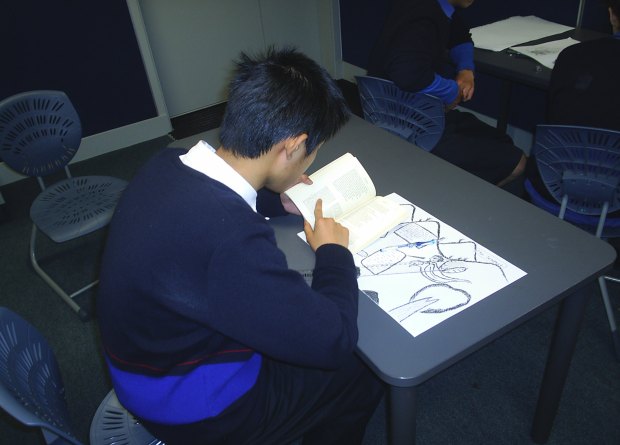
Comic book learning in action at Alfriston College
Comic book learning in action at Auckland’s Alfriston College

More recently, I’ve spent a few years encouraging learners to genuinely take control of the creative process, exploring creativity through the medium of comics. The aim has been to produce original comics that are of a publishable and professional standard. I have done this within a single school environment, Alfriston College. A potted history of our programme follows.

Read more

Dirty Library Trilogy, part 2: Readers’ advisory at the World’s Freakiest Bookstore

In the second of three features pushing the boundaries of what librarians can learn from pop culture, we take a visit to Melbourne bookstore Polyester Books and talk readers’ advisory with one of the most provocative booksellers I’ve ever met.

Polyester Books – the self-proclaimed ‘World’s Freakiest Bookstore’ – spells trouble. It did from the moment I discovered it.

I was visiting Melbourne for the first time and a friend recommended an alternative bookshop at the far end of Brunswick Street in Fitzroy.

I had no idea where this was, so on a visit to the State Library of Victoria, I asked one of the youth librarians to help me find it. She googled ‘Polyester Books’ on a State Library computer terminal and we were both immediately confronted with the store’s incredibly NSFW logo.

As Polyester proprietor Jo Emslie puts it, “If that sign upsets you, don’t look around our shop, ‘cos your head’s gonna explode!”

Polyester Books, Melbourne

Yet Polyester’s commitment to supplying all kinds of books, DVDs, zines, art, and periodicals is deeply relevant to the mission of 21st century librarians. I dropped in to the shop for a browse and was impressed to find the likes of obscure Austrian novelist Hermann Broch on the shelves alongside the more eyebrow-raising fare. 

So what can librarians learn from the World’s Freakiest Bookstore?

Read more

Dirty Library Trilogy, part 1: Drink your way to better librarianship

This is the first of three blog posts exploring the very limits of what librarians can learn from popular culture.

I often end presentations and workshops with the challenge: “What’s the naughtiest thing librarians can do to promote literacy today?”

 ‘Naughty’ doesn’t mean dangerous, inappropriate, or damaging – but in a profession sometimes misrepresented as staid and conservative, and so often at the mercy of local government bureaucracy, it’s important to remember that public librarians are firebrands – that public libraries are innately subversive institutions, born of the radical notion that every single member of society deserves free, high-quality access to knowledge and culture.

So being “naughty” in the name of literacy might involve kids smashing up fruit inside your library; or playing real-life versions of video games among the shelves; it might involve zombies besieging kids and teens within your building.

 In the ‘Dirty Library Trilogy’, I’m going to try and push the boundaries and see what libraries can learn at the far reaches of pop culture…from the battling broads of the rollerderby rink to the barrooms of the world. 

So…could we drink our way to better librarianship?

Cocktail

Read more

readitadmin's avatar

A youth event with a difference highlights the community value of libraries

There is no-one in the library when the children arrive.

Jagged letters are chalked across the door: SAVE YOURSELVES.

Blood is pooled on the front step.  Within, bookshelves have been knocked to the ground, their contents spilled across the carpet.

The air is thick with summer heat and silence.

The children suspect a prank.  They’re quick to investigate, eagerly picking over the vandalised interior, quizzing their teachers:

“Is it a murder mystery game?”

“Did you fake a burglary?”

Before the adults have time to answer, a terrible cry comes from the street outside.

The children run to the library doors.

They see figures approaching: gruesome, deformed individuals from the ranks of the walking dead. Zombies attack!  The children scream as the teachers hurry them inside and barricade the doors.

Only the library can save them now…

View original post 540 more words