Librarians in comic book stores – Free Comic Book Day and Star Wars Day in Auckland, New Zealand

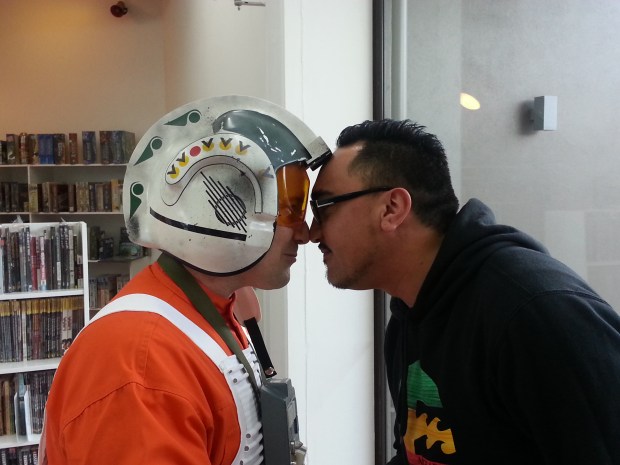
A hongi with the Rebel Alliance

Librarians in Auckland ventured into comic book stores to celebrate Star Wars Day and Free Comic Book Day by issuing memberships and loaning items from their collections. More soon, but in the meantime here’s Twitter coverage via Storify.

[View the story “Auckland Libraries goes mobile for Star Wars Day/Free Comic Book Day” on Storify]

Why are New Zealand libraries letting their enemies write “the final chapter”?

A local politician in Marlborough, New Zealand, has suggested ditching the district’s libraries in favour of distributing e-readers to residents.

The Kiwi TV show Breakfast on One reported this news in a piece titled “The final chapter for libraries?”

Although Kiwi librarians are attempting to push back with the Twitter hashtag #morethanbooks, responses have tended to focus on the fact that libraries use e-books too, and include other items like music in their collections as well.


The simple truth is, libraries aren’t about books on shelves, or compact discs, or even e-readers. Those are tools, mere means to an end.

Libraries are about helping the public to explore the world of knowledge and culture on their own terms. That might mean performance art in British libraries, bringing books to life through gaming in Toronto, or holding teen zombie battles in Auckland.

A library isn’t just a storage space for books on shelves – it’s also a place where musicians perform; where computer software is written; where teens get to wrestle a zombie-bitten police officer to the ground while debating the ethics of surviving a disaster scenario.

Yet one local politician has said “Why not replace libraries with e-readers?” and Kiwi librarians are on the defensive, letting their enemies set the terms of the debate. Read more

Zombies at Tupu Library, South Auckland

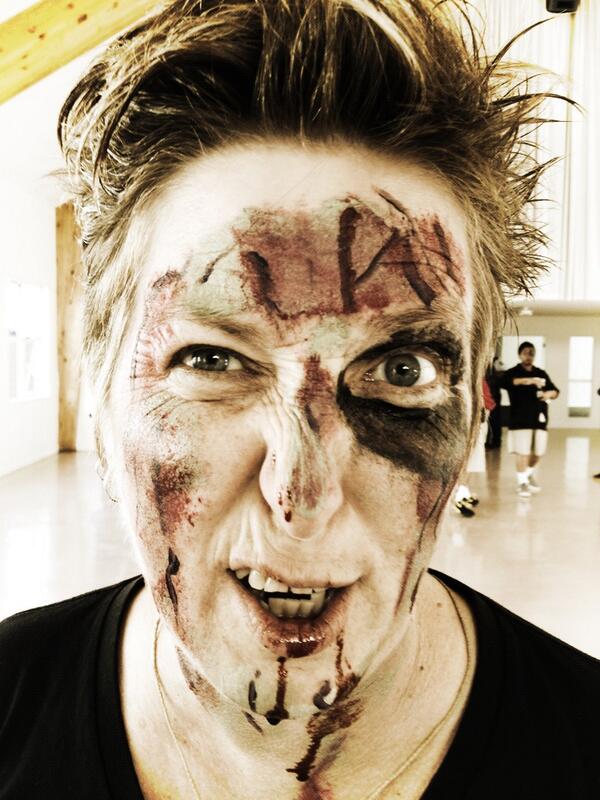
Auckland Libraries' Anne Dickson in zombie makeup
Auckland Libraries’ Anne Dickson led teen zombie hordes against a group of survivors in Tupu Youth Library

Last Friday in Tupu Youth Library, South Auckland, I ran an interactive live-action zombie event for teens on their school holidays.

The ‘survivors’, aged from 12 to 18, found themselves besieged in a meeting room while zombies feasted on hapless victims outside. Teens made barricades from furniture, used library resources to plan their escape from South Auckland, and faced special challenges including detecting potential zombie victims and even wrestling with a zombified police officer!

See the Tupu Zombies on New Zealand’s TV3 News and find more coverage at New Zealand’s Stuff.co.nz website.

Library Chat Podcast – on Nerf guns, literacy and boisterous play

This week you can find me talking about libraries, literacy, and immersive play on Corin Haines’ Library Chat podcast.

Corin is head of digital services with my current employers at Auckland Libraries in New Zealand, where I’ve been encouraging youth librarians to embrace play, performance, and forms of literacy which needn’t involve books on shelves.

One of the first things I did on arrival in Auckland is arrange for the library to purchase a number of Nerf guns – toys which shoot foam darts – with the aim of encouraging librarians to create activities which combined literacy with more boisterous forms of action and adventure.

The message I’ve been trying to get across is that roleplay and activities which immerse you in a story are just as valid for libraries as anything involving books on shelves.

UNESCO’s Missions of the Public Library don’t even use the word ‘book’ once – but they do mention providing access to cultural expressions of all performing arts, stimulating the imagination and creativity of children and young people, and providing opportunities for personal creative development – alongside reading!

Corin has been, to his credit, an early adopter of the Nerf gun in Auckland – that’s him in the final frame of this YouTube video, which shows staff getting to grips with the toys:

But Corin did ponder the moral implications in a blog post on gunplay and libraries at his own website, concerned that we were encouraging children to celebrate violence through this kind of activity.

This is the kind of problem that keeps a decent librarian awake at night – especially in the light of recent news from the US.

When creating Heroes and Villains activities for the school holidays, how scary should we dare to go?

Should we be allowing kids to identify with explicitly villainous figures? (Somewhere in my mum’s house there is a photo of me dressed as Darth Vader – but I alternated that costume with Spider-man pyjamas and my favourite hero outfit, Batman).

If kids use play to make sense of the world, do we have the right – or the power – to stop them thinking through violence and its consequences using play?

In the light of recent events, I’ll be following up on these questions after a pause for contemplation and acknowledgement of the tragedy in Massachusetts.

In the meantime, you can hear Corin and I chat about literacy and immersive play over at Library Chat.

Profile in Australian Books + Publishing

Forgive the shameless self-promotion, but I’ve just been featured in the latest edition of Australian Books & Publishing, speaking about community outreach, daring to be different, and why rural Australia proved one of the most exciting places to create children’s and youth events for libraries.

It’s a subscriber-only link, but there is the option to sign up for a free trial.

You can read my profile piece in Australian Books & Publishing Online.

I believe in Space…and Desire: Jessica Begley on library design

A guest post by urban planner turned librarian Jessica Begley. What can libraries do to help users make the most of their spaces?

Like the Pixies, I believe in Space.

I have been fascinated by how and why people use space, and how subtle design can influence behaviour, for as long as I can remember.

As a teen, I merged this interest in social geography with psychology and came up with a degree in Urban Planning and Design.  I was going to change the world. Improve open spaces. Create spaces people felt happy in.  The reality I found was far from my planned dream. Rows of brickwork, overshadowing, trellis screens, and complaints all dominated my day.  Not even I liked the spaces I was approving.  Approving, not designing.

Fast-forward fifteen years.  I am still an urban planner, but only in my mind.  I have been trained to look at spaces, movement of people, land use, all in a certain way.  I can no longer look at a space like an ordinary person. Taking my kids to the shops, the park, the library, I analyse the flow of movement through space.  When I see conflicting uses, I see a design-based solution. When I see desire lines – the unplanned paths naturally taken by people in any setting – I read them.

Read more

Libraries learning from retail: Interview with Oxford’s indie music mecca, Truck Store

This is the third in a loose trilogy of blog posts exploring libraries and music: previous features include a guest post by Stewart Parsons of Get It Loud in Libraries and an interview with rapper-educator Professor Elemental. Today, we’re joined by Carl Smithson, the manager at Truck Store, an amazing indie record shop in Oxford, England.

Truck Store, Oxford
Truck Store, Oxford

After attending the Foyles Futures workshop on next-generation book retail in London, I’ve become increasingly concerned with design and atmosphere in libraries. Great service and effective presentation of collections are vital for any 21st century public library.

Read more

Keeping things fresh: Steampunk rapper Professor Elemental on hip-hop and education

Today we’re joined by Paul Alborough – a witty British rapper who “hosts, performs and teaches hip-hop in more ways than you can imagine” in the guise of steampunk cleverclogs Professor Elemental.

Paul’s been interviewed many times about his music, but as I’ve recently started working in South Auckland, with its strong hip-hop culture, I was especially excited by his former career as a special needs educator, and his ongoing commitment to youth development through hip-hop workshops.

I began our interview by asking about Paul’s time as a teacher.

The truth is that I stumbled into it, having realised that I hated or had been fired from every other day job that I could possibly think of. That, and a natural affinity with children, who always seemed a lot more fun to hang out with than adults, led me to the world of  education.

Read more

“I much prefer it when libraries are less about archiving the past, and more about presenting culture today”: Stewart Parsons on “Get It Loud in Libraries”

Marina and the Diamonds getting loud in libraries!
Marina and the Diamonds – image (c) Frances Ross

Libraries are utterly thrilling places. At least they ought to be. They should wow the pants off people. Shouldn’t they? All that free stuff. All that culture. All that Keatsian poetry to woo the ladies, and bomb-like knowledge to help pave your way in the world. What’s not to like?

I have long held the belief that a library user should leave a library a more enlightened, brighter, happier, braver, more empowered individual compared to the same person that first went in. In modern TV-land, the romance of people “going on a jouney” is increasingly paramount.

People go on journeys in libraries every day. Maybe we just don’t shout about it enough?

But for that to happen, for that surging flood of the imagination to take place, for the journey to take place at all, the original resources often need to be re-imagined. To be presented in a way that is fresh and appealing and meaningful. Especially to the young.

Read more

My 2012 Zombies in the Library event in rural New South Wales has just been featured as an online ‘how-to’ feature at The Library as Incubator Project – http://www.libraryasincubatorproject.org/?p=8939 – a U.S. scheme highlighting the way that libraries and artists can work together.
Last month, British playwright Fin Kennedy wrote a compelling piece for the Oxford Culture Review on the value of arts collaborations with the higher education sector. He writes:
“When these sorts of collaborations work well they’re a brilliant two-way street; arts organisations get a share of Universities’ physical resources and manpower, Uni students get professional experience and links with industry, and inner city young people get friendly and accessible contact with Higher Education. And it all costs hardly anything – the ingredients are all there. It just takes a creatively-minded individual to bring them together. I’m a big advocate of artists taking that role. As freelancers we’re in a strong position to broker those relationships between organisations we all already have links with anyway.”

theoxfordculturereview's avatarThe Oxford Culture Review

Following a meeting with Culture Minister Ed Vaizey, award-winning UK playwright Fin Kennedy is running a campaign to raise governmental awareness of the effects of arts funding cuts upon theatres. I spoke to him about the project and the importance of the arts in Britain.

To anyone who doesn’t know about your campaign – what are you trying to achieve, and who can get involved?

Last month I met Culture Minister Ed Vaizey at a Writers’ Guild event at Parliament. He claimed that the recent round of swingeing cuts to public investment in the arts were having no impact at all on the development of new plays in the UK. I knew from my own experience of seeing the theatre industry I work in contracting all around me that this wasn’t true, but there are surprisingly few facts and figures available. Vaizey said he would look over any evidence I could…

View original post 1,676 more words