After Orlando

If you work in a cultural institution, what do you do in response to a tragedy like the shooting in Orlando last week?

You see a lot of rainbow flags on social media and there’s a hashtag going round, #LoveIsLove. There have been gatherings in major cities, showing solidarity with Florida and letting each local LGBTQ community know they are celebrated and cherished.

These are wonderful things but I wanted us at the State Library of Queensland to do more.

On Monday morning, we fast-tracked a project to acquire a major piece of Australian LGBTQ oral history – the final interview tapes of Bernard King.

King was the flamboyant, gay, notoriously acid-tongued pioneer of Aussie TV cookery and talent shows. We discovered the tape as part of my weekly newsletter Marvellous, Electrical when I interviewed King’s biographer Stephanie Clifford-Smith.

You can read the Bernard King edition of Marvellous, Electrical here.

This is a major acquisition of materials from a forgotten Queensland icon whose work was under-represented in the state’s libraries and archives. You’ll see more about it through official channels in coming weeks.

The interviews will now be digitised by the library’s Queensland Memory team. State Library oral histories currently available online include the LGBT Lives: Oral Histories collection and the Greg Weir collection.

I have to say massive thanks to Dianne Byrne and Gavin Bannerman of Queensland Memory for helping us to pursue this acquisition.

I also spent my evenings this week investigating Queensland’s Panic Defence – a lingering clause of the state legal code which seems to allow killers to claim they were provoked to manslaughter if their victim made a homosexual pass at them.

Alongside celebration and solidarity, it’s important to look to our own doorsteps and recognise where prejudice and injustice can be found right before our eyes. Discussion of the Panic Defence led to some uncomfortable truths about murder and straight male privilege in Australia’s Sunshine State.

You can read Marvellous, Electrical: The Panic Defence here.
A Speaky Week

On Tuesday, I’ll be over at the University of Southern Queensland, giving talks and workshops to staff and students across faculties. You can follow them online via this livestreaming link – the fun kicks off at 11am Australian Eastern Standard Time.

Then on Thursday I’m joining the Broadband for the Bush Conference on rural and regional access to digital technology and communications, running a presenterless workshop session on planning for the future. I’ll be drawing on science fiction, Afrofuturism, and comics alongside debates around copyright, government policy, and the presentation of financial data.

You can follow via the hashtag #BushBroadband on social media. I feel like non-Aussies are going to think that’s something far more salacious than it actually is…

The Library Ghost

During #BlogJune, workers in galleries, libraries, and museums Down Under commit to writing daily blog posts about their work.

One of my favourites is The Library Ghost, written by Kyla Stephan of Gold Coast Libraries in Queensland.

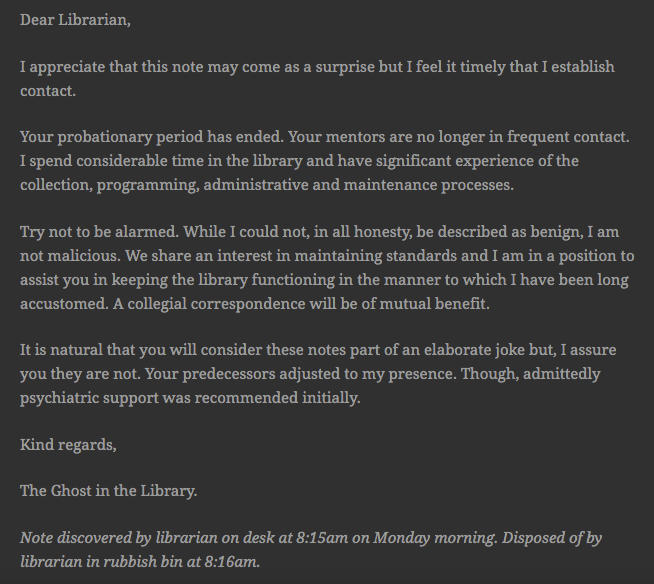
The blog, which has run intermittently for several years now, records the correspondence left at a librarian’s desk by the ghost which haunts her building.

Library Ghost Episode 1

We only ever see the ghost’s side of the conversation, but follow the progress of their relationship over the months and years, as the icy spirit – “I could not, in all honesty, be described as benign” – develops a certain affection for the mortal whom they haunt.

I love that Kyla invites us into a tender and wryly mannered fiction, invoking library magic to share the world of her imagination. Go check out the Library Ghost this #Blogjune.

Beyond Panels

Here’s the ever-thoughtful Justin Hoenke on conference presentations:

We’re thinking about similar things down under…last month, the State Library of Queensland experimented with a Presenterless Workshop format, as part of a wider campaign by science communicator David Robertson, called Beyond Panels.

Read more

Keynote speaker for SWITCH 2016

I’m pleased to announce that I’ll be a keynote speaker at the New South Wales Public Libraries Association’s conference SWITCH 2016, 22-25 November in Ulladulla, NSW.

Here we are on the shore, on the edge of some adventure. Have we been deserted or let loose?

How do we move away from centralised, broadcast-based models of discussion, creation, and debate in favour of democratised, distributed approaches?

When libraries around the world are fighting to thrive and everyone has co-opted the language of innovation and community engagement, what does great public librarianship look like and how do we do it?

See you in November!

Where Do You Find Yourself? Space, Play, and Duty in the Australian Digital Library

Are there still cultural backwaters in the digital age? Three months in to my year-long residency at the State Library of Queensland, I’ve written about Australian libraries, regional engagement, and digital literature for The Writing Platform.

I’m very interested in the vogue for locative literature, where texts are linked to physical spaces through digital or conventional media. But there are questions still to be asked: not just whether we add a virtual layer of story and literature to physical spaces, but who gets to create the content in that virtual layer.

Forest comic for Fun Palace

If writers are having a creative and critical conversation about the world, and in the locative age we are venturing outside of traditional venues, we still need to ask: who are “we” having those conversations with? And how could a simple online comic maker start expanding that circle of storytelling, literary production, and critical discussion?

You can read the full article, ‘Where Do You Find Yourself? Space, Play, and Duty in the Australian Digital Library’, at The Writing Platform.

Future Libraries: Towards a presenterless workshop?

This week I spoke at the Future Libraries two-day event at the State Library of Queensland. It was an opportunity for public librarians from across Australia’s Sunshine State to discuss plans, dreams, and schemes for the coming year.

There’s always a tension at such sessions, though hopefully it’s a productive one. On one hand, people like to be engaged, inspired, and provoked by speakers who they might not otherwise get a chance to hear or question. On the other, Powerpoint preachers don’t always make a lasting change, they don’t necessarily listen to the experience and creativity already in the room, and all too often those voices broadcasting from the stage are drawn from the same pool.

So, at Future Libraries, with just seventy-five minutes in the “naptime slot” straight after lunch, I tried to give Queensland librarians the best of both worlds.

We made comics together, but I also shared stories of the Lambeth library siege and Birmingham’s library cuts alongside the threats faced in Australia. We celebrated how public librarians are at their best under pressure, from Christchurch to Ferguson, but then it was time to get the whole room talking.

So we tried a version of the Presenterless Workshop.

This is an activity I’ve piloted with various groups, including library staff development sessions in London and regional England. Participants are each given one sheet of instructions from a set of five. By following the instructions on their sheet, they form groups which discuss what libraries should and can do from a range of perspectives. Those groups then share their discussion as a presentation or exhibition, and even the ways in which they interpret the instructions can be provocative and productive.

Rebel Rebel

As libraries evolve to meet today’s needs, and transform their own institutional processes and bureaucracy, we so often hear the mantra “Don’t ask permission, beg forgiveness”. Even I’ve said it in presentations, but I now I see that the spirit of the phrase is not quite right.

Although it encourages people to be less hesitant about trying new things, and has a rebellious ring to it, it also forces innovators into the position of the naughty schoolboy, breaking the rules but still ultimately desirous of, and dependent on, the institution’s resources, support, and long-term approval.

Instead, this presenterless workshop encourages participants to consider that organizational rules are more like guidelines to be interpreted than rules to be either obeyed or broken. A lot of the work I do is finding ways to marry up bright ideas and inspiring fun – like zombie sieges or time travel workshops – with the policies, plans, and success measures of big bureaucratic organizations. There’s almost always some wiggle room somewhere for you to justify creative activities, it just takes a little negotiation.

If you want to listen to a library superstar who is not your typical rebel-posing white bloke, I recommend Wellington Libraries’ Adrienne Hannan, a reservist combat medic and children’s librarian who compares library policies to military rules of engagement – not laws to be transgressed, but a framework within which soldiers must make serious practical decisions, under pressure, in a timely way.

Presenterless Workshop Resources

If you fancy running a presenterless staff development workshop in your library, I’ve included the relevant worksheets as free, Creative Commons-licensed PDF files in this blog post. Download them, play with them, give them a go — and let me know how you get on.

Presenterless Workshop Organizer Notes – PDF download

Presenterless Workshop Participant Sheets – PDF download

Libraries: the seven-fingered fist?

Last week saw the first of my guest columns for Library as Incubator in the US, following my experiences as Creative in Residence at the State Library of Queensland, Australia.

This first piece explores libraries as gateways to other worlds, showcases the work of Queensland’s Signature Team, and explores the challenges of working with a cultural institution that serves a region three times the size of France.

You can read my guest column over at Library as Incubator.