Key 23 and the Nth Degree, part III: Your words in the real world

This is the third part of a blog series giving a personal take on librarianship, archives, and the powers of words. Start here for the first post in the series.

Key 23 is something I only discovered because, working in Auckland for six months, I am using a public library like a regular reader for once – borrowing books simply because they interest or excite me.

A lot of the books I’m borrowing are comics – I love the economy of storytelling and really believe, as I was telling the State Library of New South Wales last year, that this medium might hold the future of space, word, and image. Among the comics I’ve been reading is Grant Morrison’s The Invisibles, which chronicles the adventures of a secret society battling extradimensional forces in the run up to the year 2000.

In The Invisibles, there’s a drug called Key 23 which makes the user experience whatever they read as real. It’s a lovely conceit, which Morrison also flips by adding the notion of a ‘fiction suit’ which (I may have got this wrong…) allows characters to travel through the world of discourse.

Panel from Grant Morrison, The Invisibles
Dream, reality, self and other are breaking down in Grant Morrison’s The Invisibles

Read more

Key 23 and the Nth Degree, part II: Libraries for kids

This is the second of three more personal blog posts reflecting on librarianship, archives, and the power of words. You can also read part one of Key 23 and the Nth degree here.

Captain Britain #1 Front Cover
Captain Britain – now with added Dalek Killer!

Training as an infant school teacher brought me back to public libraries for the first time in ages. I’d stopped using them since the Internet had supplanted the local library as my source for obscure music, and I guess before that my last memory of a library was being brutally mocked by some badass teenage girls drinking round the back of one, the first time me and my best friend tried to get served in a pub underage!

As a teacher, school trips to the library were pretty anodyne – the best bit was the forced march three blocks or so from the infant school, the kids’ faces full of wonder as they held hands in pairs and went on a five year old’s adventure into the Big World of grocer’s stores and banks and traffic lights…then, the library.

It was an old building in sore need of refurbishment, overlit within by fluorescent striplights, walls painted the blank cream colour of a hospital corridor, and fitted with that curious, bristly tiled carpet forever associated with Britain’s more dismal civic spaces – probably not even the same colour throughout, with a patch of grey lingering in one corner where the fitters had run out of brown.

Read more

Key 23 and the Nth Degree, part I: My life in library archives

This is the first of a more personal series of blog posts reflecting on librarianship, archives, and the power of words.

My PhD was about the lives of refugees in their adopted countries. I learned a thing or two about libraries then – sending a mate to rummage around in the Library of Congress, visiting the archives of a working German mental hospital, and spending days amid the pungent must of London’s Senate House, where you could still find a corner to sit untroubled on the sixth floor on a November afternoon, walled in on three sides by shelves, books spread across your desk – only half of them really relevant to your topic, the others picked up on impulse or passing interest, looking down on a gloriously cold and lonely darkening winter London.

Senate House, London
Senate House, London – The inspiration for Orwell’s Ministry of Truth, allegedly earmarked as Hitler’s headquarters in the event of a Nazi invasion of Britain…

That intense sensory experience, synonymous with loneliness and hard work for me, is a memory so strong that for all its ambivalence it has taken on the quality of beauty. I can smell the vile rows of shelving which Senate House devoted to Hansard as I write this…and I kind of miss it. Read more

Show Me the Awesome: Immersive play in the 21st century library

Show Me the Awesome Banner by John LeMasney at lemasney.com.
Banner by John LeMasney at lemasney.com.

Hello! Some of you visiting today will be regular readers of this blog; others may be here as part of Show Me the Awesome: 30 Days of Self-Promotion for libraries and librarians, a great project to help librarians around the world to celebrate their work.

So if you don’t know me, this is the Big Secret: I’m not actually a librarian myself, but currently an adviser to Auckland Libraries, the largest public library system in Australasia. (My wayward career is best described on my ‘About Me’ page). I make up fun stuff for people to do in public spaces, and so today I’m writing about immersive play in libraries. By ‘immersive play’ I mean activities which physically draw your library patrons into the world of a book, artwork, or other piece of media – whether through craft, gaming, roleplay, or content creation.

The big revelation for me came when running a workshop to decide the future of Auckland’s collections management policy – not, frankly, the sexiest task in a public library service, but most rewarding in the long run. Not just because we had a cathartic Nerf gun shoot out as part of the activity, but because I discovered the UN’s Missions of the Public Library.

(I go on a lot about this document, but it’s something really worth hammering home).

The mission statement doesn’t even use the word “books”. It talks about reading, sure – but this is not a manifesto for shelves. Instead, the focus is on activities like stimulating imagination and creativity, providing access to cultural expressions of all performing arts, supporting the oral tradition, and providing opportunities for personal creative development.

That’s an especially big deal in New Zealand, where a lot of the discussion about future branding of libraries revolves around their historic association with books. Wherever you are in the world, that “libraries = books” equation comes up a lot, especially when libraries’ enemies want to imply that they are outdated and can be supplanted by digital means, as happened in the Huffington Post last week.

So, how do we bring those missions of creativity, play, independent learning, and performance to life while remaining true to libraries’ heritage of literacy and reading? Let’s see if we can do it in six bullet points… Read more

City of Souls: Gaming and Augmented Reality in Auckland Libraries

Auckland Libraries has just launched its first online game, City of Souls – an interactive zombie adventure for ages 14 and over.

City of Souls game
City of Souls – click the image to play!

Written by my colleague Danielle Carter using the free Twine game design software, City of Souls takes place in the same universe as both our Tupu Youth Library zombie siege and the recent Apocalypse Z interactive theatre event in Auckland’s CBD.

Read more

Matt and His Week of Wonders

I alluded to my busy Auckland week in Friday’s post announcing my New Zealand Book Domino Challenge – for which the prize is cake, so if you are a Kiwi librarian and feeling adventurous, please join in.

Portal Cake
The Cake Is Not A Lie

Last Saturday saw Auckland Libraries take their services into the city’s comic stores for Free Comic Book Day, as part of my project to expand librarianship beyond the walls of individual institutions into the wider community.

I was then interviewed by the erudite and wonderfully geeky Emmet O’Cuana for his podcast The Momus Report, with the discussion ranging widely from the educational value of pop culture to the Kierkegaardian implications of the 1978 movie Star Crash.

This week also included a visit to Auckland Libraries from Tracie Mauro of Parkes, NSW – a daring and innovative librarian whose work appeared on Monday’s Library as Incubator Project. Tracie and I travelled the Far North District in New Zealand, exploring library services and programmes in rural areas far from my usual Auckland beat.

Yesterday I was quoted in the New Zealand Herald, in a satisfyingly positive article which recognises that the 21st century library is about so much more than just shelves…and I also took some time out for a trip to the Christchurch vs. Auckland roller derby match, which reminded me of this neat guest post on roller derby and librarianship from Melbourne’s Jordi Kerr.

If you’ll excuse me all, it’s Sunday evening, so I will now go for a lie down…

sleepy

The Great Kiwi Book Domino Challenge

Lots of adventures to report this week, but it will all have to wait until Monday.

For now, I want to repeat a challenge I’ve set New Zealand’s librarians on Twitter.

A couple of years ago, the amazing Arizona retail chain Bookmans made a promotional video with an elaborate sequence of book dominoes.

There’s been a lot of discussion in New Zealand this week about the mission of libraries and how to share it with the public in the 21st century.

I’m lucky enough to work for Auckland Libraries, the largest public library system in Australasia. Their strategy document Te Kauroa – Future Directions posits libraries as “your space of imagination, learning, and connection.” A public institution whose value in connecting us all to the sum total of human culture and knowledge goes beyond books on shelves into the realms of play, performance, and interactive digital outreach.

Bookmans, in Arizona, do wonderful community outreach work which puts many libraries around the world to shame, with some especially inspiring youth programmes. I interviewed Bookmans staff about their work last year.

That book domino video captures the blend of charm, creativity and outright cheek which I think lies at the heart of the best public libraries – so I challenged Kiwi librarians on Twitter to do as well as Bookmans, or go one further, and post the results on YouTube.

I’ll personally bake a cake for the first librarian in New Zealand who, in my judgment, matches or outdoes Bookmans’ stirling online effort.

From paints to puddings – Art and sensory play in Parkes Library, New South Wales

Aussie kids become little Michelangelos in a Sistine Chapel library activity!

“Libraries need to understand literacy in the broadest sense – exploring all of the senses in the way kids and teens relate to the diverse services they have to offer.”

There’s coverage of some amazing work from my colleagues in Parkes, New South Wales over at the Library as Incubator Project.

Librarians in comic book stores – Free Comic Book Day and Star Wars Day in Auckland, New Zealand

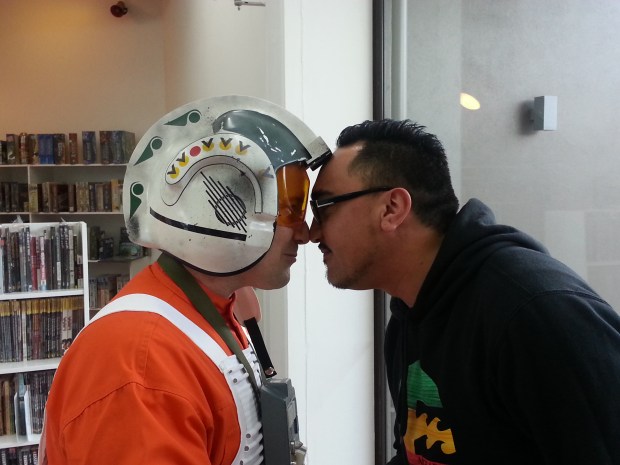
A hongi with the Rebel Alliance

Librarians in Auckland ventured into comic book stores to celebrate Star Wars Day and Free Comic Book Day by issuing memberships and loaning items from their collections. More soon, but in the meantime here’s Twitter coverage via Storify.

[View the story “Auckland Libraries goes mobile for Star Wars Day/Free Comic Book Day” on Storify]

Why are New Zealand libraries letting their enemies write “the final chapter”?

A local politician in Marlborough, New Zealand, has suggested ditching the district’s libraries in favour of distributing e-readers to residents.

The Kiwi TV show Breakfast on One reported this news in a piece titled “The final chapter for libraries?”

Although Kiwi librarians are attempting to push back with the Twitter hashtag #morethanbooks, responses have tended to focus on the fact that libraries use e-books too, and include other items like music in their collections as well.


The simple truth is, libraries aren’t about books on shelves, or compact discs, or even e-readers. Those are tools, mere means to an end.

Libraries are about helping the public to explore the world of knowledge and culture on their own terms. That might mean performance art in British libraries, bringing books to life through gaming in Toronto, or holding teen zombie battles in Auckland.

A library isn’t just a storage space for books on shelves – it’s also a place where musicians perform; where computer software is written; where teens get to wrestle a zombie-bitten police officer to the ground while debating the ethics of surviving a disaster scenario.

Yet one local politician has said “Why not replace libraries with e-readers?” and Kiwi librarians are on the defensive, letting their enemies set the terms of the debate. Read more