Respect, innovation, and cheeky pancakes: thoughts on the future of bookstores and libraries

Central City Library, Auckland

So, a big announcement has been in the works for some time: from 25th February I begin a six-month contract as adviser to Auckland Libraries, the largest public library network in the southern hemisphere. The mission is to extend and enhance Auckland’s already superlative library offerings for children and young people with creative, challenging, and sustainable activities for the future.

I feel confident that we’re entering an era of swashbuckling literacy adventure Down Under. Auckland is the city where kids play a Kiwi-themed version of Angry Birds in their libraries; the city whose librarians already talked Bryan Lee O’Malley into letting them use Scott Pilgrim as the face of their comic book events and wooed Amanda Palmer into giving an impromptu Get Loud In Libraries-style guerilla gig.

Before Auckland beckons, I’ve been looking at the latest developments in the UK and US. The Future Foyles workshop held on Monday of this week brought together publishing, retail, and literacy professionals seeking a vision for London’s next great flagship bookstore – you’ll see me quoted in The Bookseller’s report of the event –  and finding much food for thought from a wider community outreach perspective.
Read more

Guest post: Steve Saville on comics and creativity, part 2

In the second part of his guest post for Books and Adventures, Steve Saville of Alfriston College in Auckland, New Zealand, discusses the lessons to be learned from his pioneering comics in the classroom workshops.

Most educators currently involved in secondary schools in New Zealand would agree that creativity is a good thing and that it needs to be encouraged; that we need to nurture and encourage the creative young people who will solve the problems posed by our ever changing world.

We can all look to our own school environments and proudly detail how creativity is nurtured, encouraged, and celebrated in our schools. We provide ample opportunities for writing, artistic expression, the creative use of digital technologies, dance, and drama. Our schools have bands, singers, sculptors. We offer classes in creative writing and philosophy. It can be argued that we have countless opportunities for young people to express and develop their creative skills.

We can also think of numerous teachers that we would classify as creative in their approaches, talented educators who find new and exciting ways to get their learners thinking. Teachers who challenge thinking by making learners ask questions and by asking learners to seek the relevance and authenticity of material studied.

All of this is totally correct – but is it enough?

It may be creative to enable a learner to write a story, to perform in a play or to design a web page but who chose the play and who decided the topic and who wrote the brief?

There is a difference between asking a learner to produce a creative response to something on a particular day, as part of a particular programme of work, and allowing an individual to be creative.

More profoundly, how can creativity flourish in schools, which are essentially non-creative environments?

Read more

Guest post: Steve Saville of Alfriston College, Auckland, on comics in the classroom

Today, we’re joined by Steve Saville, deputy principal at Alfriston College in South Auckland. For four years, Steve has championed the use of comics in the classroom through a series of innovative workshops which have allowed students to develop and publish their own high quality comic books. In the first of a two-part guest post, Steve tells the story of Alfriston’s unique comic book education project.

See more on comics in the classroom via the “comicsedu” tag on this site.

Like most teachers, I can think of numerous times that I have attempted to encourage or develop creativity with students, both in and out of the classroom. Like most teachers, my in-class efforts have fallen firmly in the realm of teacher-directed, and therefore dictated, creativity.

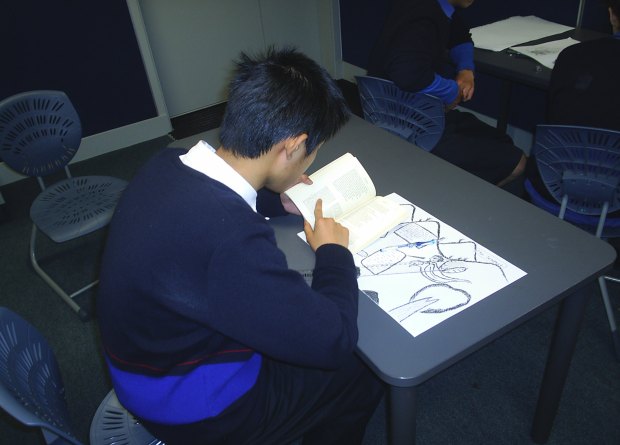
Comic book learning in action at Alfriston College
Comic book learning in action at Auckland’s Alfriston College

More recently, I’ve spent a few years encouraging learners to genuinely take control of the creative process, exploring creativity through the medium of comics. The aim has been to produce original comics that are of a publishable and professional standard. I have done this within a single school environment, Alfriston College. A potted history of our programme follows.

Read more

April update: Science tattoos, teen bloggers, copywriting, and comics

It’s been a little quiet on the blog lately as I ploughed through a swathe of writing assignments and tried (only partly successfully) to stay clear of the Internet.

I have a couple of articles out later this year for the Australian science magazines ScienceWise and Australasian Science, profiling scientists who featured in Carl Zimmer’s book Science Ink. Carl uncovered the weird and wonderful world of researchers who have their work tattooed on their bodies after he spotted a DNA helix inked on the arm of a respected neurobiologist at a pool party in the States. This led to a great book collecting photos of striking, beautiful and downright bizarre science tattoos from around the world.

Read more

New Zealand Libraries: Quiet Innovation

Over on my Tumblr page there’s a new post with a brief interview.

Corin Haines of Auckland Libraries – whose Central Library recently hosted an impromptu gig by alternative cabaret act The Dresden Dolls – took the time for a quick chat about notions of what libraries, and literacy, can be.

See the post here: http://matthewfinch.tumblr.com/post/16633129913/new-zealand-has-a-reputation-as-a-remote

Comics in NZ Education: Kiwi Batman and his good-humoured NZ Commissioner Gordon

After my discussion with New Zealand Educational Gazette and our recent features on NZ’s use of comics in education, it pleased me to see one Kiwi don the Caped Crusader’s cowl for a light-hearted prank during the Rugby World Cup.

TVNZ reports that a man in full Batman regalia visited a Christchurch police station demanding to see the commissioner and know why the “Bat-signal” – the White Lights of Hope commemorating the recent earthquake – had been lit. He’s not even the first Kiwi Batman, as the name has apparently already been applied to a 91-year-old community patrol volunteer in Waipawa.

The quakes’ impact on the Christchurch community is discussed from a literacy and outreach perspective in the recent Books and Adventures interview with Carolyn Robertson of the city’s library services.

Wonderfully, the Kiwi police appear to have responded to the Batman prankster with good humour. I’ve no idea if it’s deserved, but they’ve been building a reputation for tolerance and light-heartedness ever since an officer appeared on TV reminding a suspected carjacker to “always blow on the pie” when eating hot food from a late night convenience store.

You can find all the recent Books and Adventures posts on Comics in New Zealand Education here:

https://booksadventures.wordpress.com/category/nz-comics-education/

Comics in NZ Education: Auckland Libraries’ Comic Book Month 2011

Auckland Libraries Create a Character Competition featuring Scott PilgrimAs September comes to an end, Auckland sees the grand finale of Comic Book Month, a celebration of graphic literature across the 55 public libraries of New Zealand’s Super City. Books and Adventures joins them for another in our current series on comic book education in New Zealand. You can find my original piece for the New Zealand Education Gazette here.

Auckland’s Comic Book Month events have ranged from dress-as-a-character days to a city-wide prize draw for readers borrowing 6 comic book items in September. Libraries ran illustrator workshops, comic-book-themed performances, dress-up storytimes for younger readers and cosplay contests for older participants. Local businesses including comic stores Heroes For Sale and Gotham Comics became partners with the scheme and New Zealand’s major comic convention, Armageddon, also got on board with organiser Bill Geradts providing free passes as prizes.

Comic Book Month co-ordinator Pip Henderson from Auckland Libraries’ Youth Service Development explained why she and her colleagues chose to focus on comics for this month-long celebration:

“Our customers like to immerse themselves in stories in different ways other than purely print; there are many ways to tell a story!

“Comics were once thought of as an easy read with little substance. Parents, especially, were keen to move their kids away from them but many are now seeing the value. Comics can be just as challenging for young readers, and just as beneficial in terms of concept comprehension and vocabulary extension as a chapter book.

Read more

Comics in NZ Education: Guest Post by Raymond Huber

Today as part of our ongoing feature on comics in New Zealand education, we’re joined by the New Zealand children’s author, editor and educator Raymond Huber. You can find out more about him and his great books, including the Ziggy Bee stories, at http://www.raymondhuber.co.nz/

Here’s Raymond on ‘Comics in the Classroom.’

The thought of comic books in the classroom is frowned upon by many teachers and parents. Comics still have an image problem with many adults – a mistrust of the comic format based on suspicions about quality, content, and most of all, literary value. There might be a grain of truth in the first two: comics used to be cheaply produced, and they can contain offensive material. Some comics do take the Readers Digest approach to literature, but there are also many that now take the comic form to its own artistic heights, especially comic picture books and graphic novels.

Why use comics in the classroom?

Perhaps the best reason is that children love reading stories in the comic form. Consider the Tintin books, selling over 120 million copies, and public libraries often put a limit on withdrawals of the books. Given a choice in class, many children will grab comic picture books before novels. And most of these readers will be boys – another great reason for using comics in class.

Read more

Comics in New Zealand Education – Interview with Steve Saville of Alfriston College

Alfriston College is a Decile 3 school in South Auckland, serving a mixed population of Maori, Pacific Islanders, pakeha and other immigrants.

Working with Jeremy Bishop of DMC Comics – interviewed here on Books and Adventures – Alfriston has produced some striking comic book work thanks to a pioneering project that empowers students and gives them a platform for their creative expression.

Today we’re joined by Deputy Head Steve Saville to discuss Alfriston’s work as part of our ongoing feature on comics in New Zealand education.

Set out in the South Auckland suburbs, Alfriston College is determinedly non-traditional – it’s referred to, by critics and fans alike, as “that place where they play music instead of ringing a bell Comics from Alfriston Colllegebetween lessons”. The school’s philosophy is to use the latest research to deliver education for the 21st century. Innovations include a timetable of three 100-minute lessons a day, and termly ‘Three Day Episodes’, when students are given time to work on a self-selected project.

As Deputy Head Steve Saville puts it, ‘We’re trying to cultivate things a little bit outside the box. Authenticity and imagination are our watchwords. Traditional schooling was failing disadvantaged communities, and particularly the Maori, so why use it in a brand-new school?’

A British-born teacher with experience in both schools and universities, Steve arrived at Alfriston four years ago as Deputy Principal with responsibility for curriculum, bringing with him a lifelong comic-book obsession.

Read more