Curious, Mysterious, Marvellous, Electrical: Move

The people who made me came to England from Germany, Ireland, Scotland, Italy, and other places besides. My parents met in Spain, a country where I would work in my early twenties. From my first year of life, Germany and Spain were as important to our sense of family as the green fields of England.

I was born in London, that great world city, and I moved straight back there from the country when I turned eighteen. I was a student and a barista at the Soho YMCA. The people around me were from Finland, Austria, Colombia, Ireland, Brazil. I kept studying: my doctorate looked at refugees, exiles, and émigrés who came to Britain fleeing the Nazis, and from that I went on to work with asylum-seeking children.

Since then, I’ve been lucky enough to travel and work overseas.  I’ve been made welcome in communities thousands of miles from where I was born, found new family, found new friends; I hope I’ve done that, in turn, for people who have come to live and work alongside me.

It wasn’t so much a choice as a vocation. Everything in my life has involved crossing seas, crossing borders. So much of who I am is founded on a sense that our lives and identities are about routes more than origins; time more than territory. That freedom of movement is vital.

This week’s Marvellous, Electrical finds hope and horror and secret identities in an ordinary-looking Queensland cafe.

Science, Arts, and Community Engagement: Not Just For Wizards

A new interdisciplinary literacy is the only hope for finding a way to square our current arrangement of life with the continuation of human and planetary life as such. Scientists, philosophers, anthropologists, politicians, political theorists, historians, writers, and artists must gather their wisdom, develop a level of mutual literacy, and cross-pollinate their severed lineages.

Beth Povinelli, Interview for The Signal In Transition

I think there’s a lot of merit in Beth Povinelli’s words about science and the arts and different ways of knowing.

I’ve been thinking about this a lot as momentum builds for this October’s Fun Palaces, the international community-led celebration of arts and sciences.

Fun Palaces can look like cuddly fluffy things, but they’re also events which are serious about acknowledging the talents and understanding which local communities already have. They’re very serious, too, about exploring what it means to say, as their motto does, “everyone an artist, everyone a scientist.”

Those two terms can seem intimidating sometimes. “Artists” and “scientists” sound like privileged, elevated folk compared to you and I – so the way I always put it is this:

If a two-year-old ever handed you an imaginary phone and said “Ring ring”, and you answered it, you’re an artist – because you joined in their creative play.

And if you ever made soup from a recipe, tasted it, and said “needs more salt”, then added some, you’re a scientist – because you revised your belief in the face of evidence.

Eating soup!

Read more

Advancing Queensland’s Public Libraries: A Report

What are libraries trying to achieve? What’s helping them, and what’s getting in their way? What should a big organisation like the State Library of Queensland (SLQ) be doing for its smaller siblings across the country?

Advancing Queensland's Public Libraries report cover

These are some of the questions discussed in Advancing Queensland’s Public Libraries (PDF download), a research report prepared by SLQ and the PwC Chair in Digital Economy at Queensland University of Technology.

It tells us:

Results indicate that local governments, who own and manage libraries, do not always see the positive impact libraries have on the community, and this limited awareness keeps governments from investing more resources and giving the libraries free reign.

However, free reign and resources are the primary things libraries need to make an impact. Strategies that help overcome this challenge include proving impact through evidence, gaining freedom in communication, using innovative methods to circumvent red tape, and acquiring resources locally.

Pointing out that many non-library-users and even library staff are unaware how much libraries have changed and what they can now do, the report’s authors encourage librarians to connect with peer organisations, source skills and resources from their local community, and identify “low-cost yet high impact marketing techniques.”

The report recommends that Queensland’s State Library builds “an inspirational network of equals to stimulate mutual exchange…develop and realise visions together, and share success stories and mistakes”; it warns that “combining services should only be pursued if there really is insufficient funding to offer services separately […as] combining services primarily means that library services suffer”; and it tells us that in Queensland,

the community’s appreciation for their library seems to be highest when, on top of preserving and guiding access to collections, libraries also stimulate and guide

  1. Access to newly emerging technologies,
  2. Creativity,
  3. Community exchange,
  4. Connection, and
  5. Fun.

And you know what THAT makes me think of.

You can download a PDF of the full report, Advancing Queensland’s Public Libraries, now.

Human Library at State Library of Queensland

Human Library books from the State Library of Queensland

Saturday saw the State Library of Queensland (SLQ) host its first Human Library as part of the Big Day of Belonging festival.

After a member of the public approached our team asking about a “scheme where you could borrow people like library books”, I contacted the global Human Library organisation in Denmark and also Toronto Library’s Linda Hazzan, who runs one of the world’s most outstanding Human Library programs. Linda in Toronto, Ronni Abergel in Denmark, and Greg Watson of Human Library Australia all provided advice and mentoring to us.

Human Libraries let you borrow people instead of books for a short conversation with someone you might not ordinarily meet in your day-to-day life: people with unusual life experiences or special skills, people who are marginalised or stigmatised in society, people who are – as we all are – well worth listening to.

Read more

Thinking the future through toys

Evil begins when we begin to treat people as things.

– Terry Pratchett

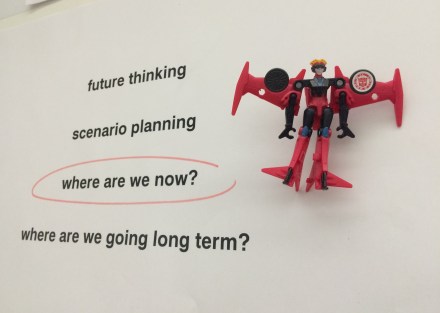
I bought a toy at the weekend. It was a cheap little thing, an impulse buy in the supermarket queue. Although I’m a very geeky man, I don’t normally buy toys. I’m not a keep-it-mint-in-the-box sort of person; nor am I interested in filling my house with pop-culture statuettes.

Windblade toy on the planning wall at State Library of Queensland

Read more

After Orlando

If you work in a cultural institution, what do you do in response to a tragedy like the shooting in Orlando last week?

You see a lot of rainbow flags on social media and there’s a hashtag going round, #LoveIsLove. There have been gatherings in major cities, showing solidarity with Florida and letting each local LGBTQ community know they are celebrated and cherished.

These are wonderful things but I wanted us at the State Library of Queensland to do more.

On Monday morning, we fast-tracked a project to acquire a major piece of Australian LGBTQ oral history – the final interview tapes of Bernard King.

King was the flamboyant, gay, notoriously acid-tongued pioneer of Aussie TV cookery and talent shows. We discovered the tape as part of my weekly newsletter Marvellous, Electrical when I interviewed King’s biographer Stephanie Clifford-Smith.

You can read the Bernard King edition of Marvellous, Electrical here.

This is a major acquisition of materials from a forgotten Queensland icon whose work was under-represented in the state’s libraries and archives. You’ll see more about it through official channels in coming weeks.

The interviews will now be digitised by the library’s Queensland Memory team. State Library oral histories currently available online include the LGBT Lives: Oral Histories collection and the Greg Weir collection.

I have to say massive thanks to Dianne Byrne and Gavin Bannerman of Queensland Memory for helping us to pursue this acquisition.

I also spent my evenings this week investigating Queensland’s Panic Defence – a lingering clause of the state legal code which seems to allow killers to claim they were provoked to manslaughter if their victim made a homosexual pass at them.

Alongside celebration and solidarity, it’s important to look to our own doorsteps and recognise where prejudice and injustice can be found right before our eyes. Discussion of the Panic Defence led to some uncomfortable truths about murder and straight male privilege in Australia’s Sunshine State.

You can read Marvellous, Electrical: The Panic Defence here.

Marvellous, Electrical: Adventures of a Wandering Cook

Angela Hirst of Wandering Cooks tends the garden at her Brisbane food incubator

Brisbane is just shading into winter now, and while it doesn’t get too cold in subtropical Queensland, you still need to make a little effort if you want a place to feel cosy.

On the fringe of the cultural quarter, entrepreneur Angela Hirst is doing just that, as she plays host to the city’s most adventurous chefs and diners at her “food incubator” Wandering Cooks.

In this week’s newsletter, Angela explains the links between philosophy, architecture, permaculture, and her attempt to create a special place for culinary innovators in the heart of Brisbane.

You can read this week’s Marvellous, Electrical here.

Beyond Panels: The Presenterless Future?

Our quest to mitigate guest speakers’ privilege, plus include audiences as participants in workshops and panel discussions, continues.

Last week I spoke at USQ – where audience members were invited on stage as part of my live-streamed presentation – and I also delivered a workshop “Are we asking the right questions of our digital future?” at Broadband for the Bush.

For the latter, I wanted to create a way of talking about the future that was open to all and could even be held in venues with limited access to technology.

I put together twelve provocations: 400-word texts, followed by questions which served to prompt discussion. Workshop participants were invited to choose one or two of the twelve provocations, read them, and then discuss them with their tablemates.

Read more

Dimestore Futurism

This week I spoke at both the University of Southern Queensland (USQ) and the national Broadband for the Bush Forum. The Forum is an annual gathering of people working to improve access to digital communications in remote and regional Australia. You can watch the USQ talk above.

Both events aimed to get people questioning their assumptions and exploring what they exclude or overlook in their visions of the future.

Read more

No Longer at Ease / The Life of Lines – Interview with Beth Povinelli

Frontier Imaginaries Poster from QUT/IMA exhibition in Brisbane

Frontier Imaginaries is an exhibition currently being held across two sites in Brisbane: ‘No Longer at Ease‘ in the Institute of Modern Art and ‘The Life of Lines‘ at Queensland University of Technology.

Beth Povinelli is one of the artists featured in ‘The Life of Lines‘  – she is also Franz Boas Professor of Anthropology at Columbia University.

Beth’s research forms a critique of late liberalism – she dubs it an ‘anthropology of the otherwise’ – which I find vital to current debates about Australian identities and our visions of the future, both here and around the world.  At the launch of Frontier Imaginaries, she argued that Australia is on the front lines of a crisis in Western thought, brought about in part by the pressures of climate change and the rise of digital technology.

Originally a philosophy student, Beth’s love of Australian movies led her to visit the country on a grant application in 1984. She eventually found herself working as an anthropologist and advocate for Indigenous communities. As she says, her career has been less about “explaining” Indigenous culture and society to others, more about helping to analyze how late liberal power appears from an Indigenous perspective.

Read more