New chapter: Crisis and Body Politics in Twenty-First Century Cultural Production

Title of the Routledge edited volume Crisis and Body Politics in Twenty First Century Cultural Production

My 2023 conference paper “The ghosts we see from the mountains: Scenario planning and the territorial body in time” will be published next year in Routledge’s edited volume Crisis and Body Politics in Twenty-First Century Cultural Production, as a co-authored chapter with Marie Mahon of the University of Galway.

Marie and I collaborated on the foresight elements of the IMAJINE project, a Horizon Europe-funded programme exploring spatial justice and regional inequality across Europe.

We look at how scenario-based thinking can inform strategic conversations and policy decisions around territorial inequality: Do citizens have equal rights and opportunities regardless of wherever they live? Are different places treated fairly? Is your ability to realise your rights compromised by where you live? How will the answers to these questions vary as contemporary uncertainties unfold?

See more at the Routledge website.

Climate action and the vantage point of imagined futures: a scenario-based conversation

npj Climate Action has today published a new article, “Climate action and the vantage point of imagined futures: a scenario-based conversation“, co-written by Marie Mahon, Malka Older, David Robertson, and myself.

Drawing on the example of the IMAJINE project, the peer-reviewed piece explores how scenarios can provide the basis for discussion across disciplines and offer fresh ways to nourish our thinking about climate action.

It covers topics including: the nature of climate change and our understanding of it in different scenarios; questions of risk and responsibility now and in times to come; the use of scenarios to identify current blind spots and stimulate creative thinking; and the possibility that scenarios might offer fresh perspectives which allow us to reevaluate our notions of the sustainable “good life” and identify vulnerabilities which are overlooked in the present day.

Read the whole piece at npj Climate Action.

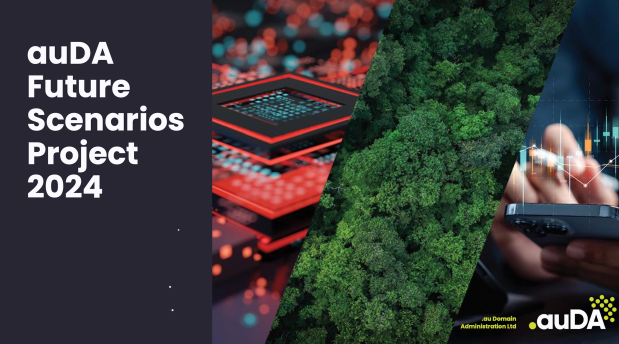
auDA Future of the Internet Scenarios Launch, 7 May 2024

How might global Internet governance change in times to come? What uncertainties surround our networked world, and how might they play out in ways that challenge the assumptions underpinning “business as usual” today?

Together with Australia’s auDA and a wide range of international stakeholders, I’ve worked to develop a set of scenarios for the future of the Internet in 2044.

They invite all of us who work with digital technologies to consider plausible, challenging, and relevant futures that offer fresh vantage points on the issues we face today.

Join auDA’s CEO Rosemary Sinclair AM, myself, and the team next month for the launch of these scenarios online. 7th May, 1pm AEST – with a recording to follow.

Scenario Planning Blog at BMJ Medical Humanities

“Though it’s just a trick of the calendar, as the new year begins our thoughts inevitably turn to the future. Yet we cannot gather data from events that haven’t happened yet, and forecasts drawing on precedent can flounder when situations are unstable.”

For the BMJ Medical Humanities blog, I cover a few scenario planning basics as we make our way into 2024.

Jay Huang from Pleasanton, USA – Low Fog Sunrise @Golden Gate Bridge, CC BY 2.0.

The Conversation: How activity in outer space will affect regional inequalities in the future

My latest piece in The Conversation explains how the IMAJINE scenarios used plausible futures to explore the relationship between European regional inequalities and activity in outer space.

You can read “How activity in outer space will affect regional inequalities in the future” here.

Photo by Pixabay on Pexels.com

SexTechLab: Foresight, Justice, and the Territorial Body in Time

On Wednesday May 10th, I’ll be speaking at the New School’s SexTechLab on “Foresight, Justice, and the Territorial Body in Time”.

How can we explore what lies at the future intersections of gender, race, sexuality, culture, technology, AI, ethics, social justice, and intimacy?

Given that we can’t gather data or evidence from events which haven’t happened yet, how can exploring times to come usefully inform issues we face in the here and now?

What lies beyond hope, fear, expectation, and prediction when we look to what tomorrow holds?

Find out more at the New School event page.

Oxford Answers: Using scenarios to understand the changing face of Europe’s cities and regions

The landscape of our cities and regions today is characterised by turbulence, uncertainty, novelty, and ambiguity – the so-called ‘TUNA’ conditions. Forces that lie far beyond the places where we live and work influence choices close to home.

In our search for security and prosperity, where should we be looking when the future of our cities and regions is so uncertain?

For the Saïd Business School’s ‘Oxford Answers’ blog, Michael Woods, Marie Mahon, and I wrote about using the IMAJINE scenarios to explore the changing face of Europe’s cities and regions.