Oxford Scenarios Programme 2024

In an uncertain world, scenario planning equips you with skills and tools to deal effectively with potential opportunities, threats and challenges.

This new video from the team at Oxford’s Saïd Business School showcases the latest cohort from the award-winning Oxford Scenarios Programme, which helps participants learn how to develop robust strategies in the face of numerous plausible futures.

As one graduate of the programme puts it, “I always come to Oxford expecting to have my mind really stretched…the thing that surprised me most this time was that I’ve come away with a feeling of confidence that I can take what I’ve learned and really apply it in my day job.”

(It’s also a tremendous amount of fun).

Enrolment is now open for April and October 2024. Find out more here: https://www.sbs.ox.ac.uk/programmes/executive-education/person-programmes/oxford-scenarios-programme

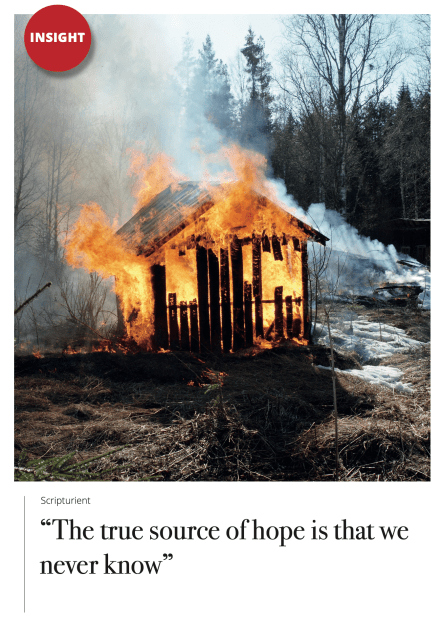
“The True Source of Hope Is That We Never Know”: Scripturient x Design by Fire, with Brett Milligan

The latest edition of Scripturient, my quarterly column for Information Professional magazine, is out now and can be downloaded here.

In it, I interview UC Davis’s Brett Milligan, who together with Emily Schlickman is the author of Design by Fire, a new book exploring our relationship to wildfires.

A transcript from the interview underpinning my column can be read below.

Matt: What was your first ever encounter with fire in nature?

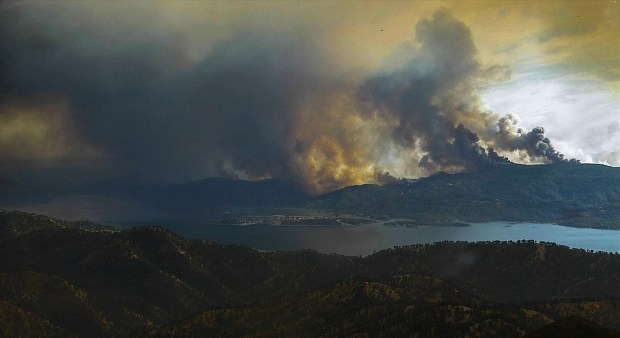
Brett: It would have been the hearth at home, or campfires; my dad took me, sometimes the whole family, camping a lot as a kid and would be very clear about taking care to extinguish it properly. I wasn’t exposed to wildfires until my time in California, decades later, and my first close-up experience with a large wildfire, the smoke, the immediacy of it, came with the LNU (Sonoma-Lake-Napa Unit) complex fires a few years back.

By Dripwoods – Taken of the LNU Hennessey Fire, CC BY-SA 4.0, https://commons.wikimedia.org/w/index.php?curid=93869076
Read more

Climate action and the vantage point of imagined futures: a scenario-based conversation

npj Climate Action has today published a new article, “Climate action and the vantage point of imagined futures: a scenario-based conversation“, co-written by Marie Mahon, Malka Older, David Robertson, and myself.

Drawing on the example of the IMAJINE project, the peer-reviewed piece explores how scenarios can provide the basis for discussion across disciplines and offer fresh ways to nourish our thinking about climate action.

It covers topics including: the nature of climate change and our understanding of it in different scenarios; questions of risk and responsibility now and in times to come; the use of scenarios to identify current blind spots and stimulate creative thinking; and the possibility that scenarios might offer fresh perspectives which allow us to reevaluate our notions of the sustainable “good life” and identify vulnerabilities which are overlooked in the present day.

Read the whole piece at npj Climate Action.

Peat Hub Ireland: 2050 Scenarios

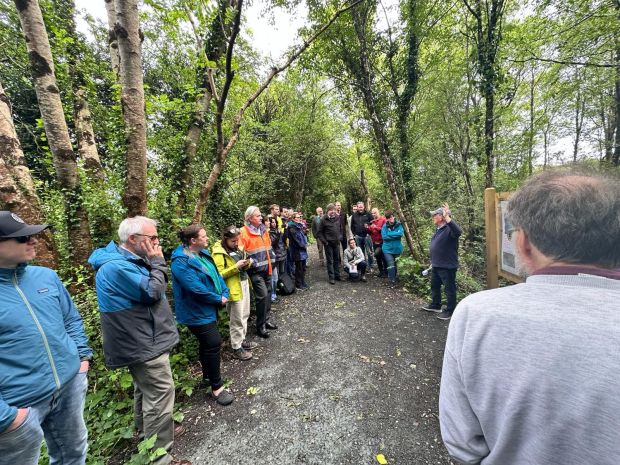
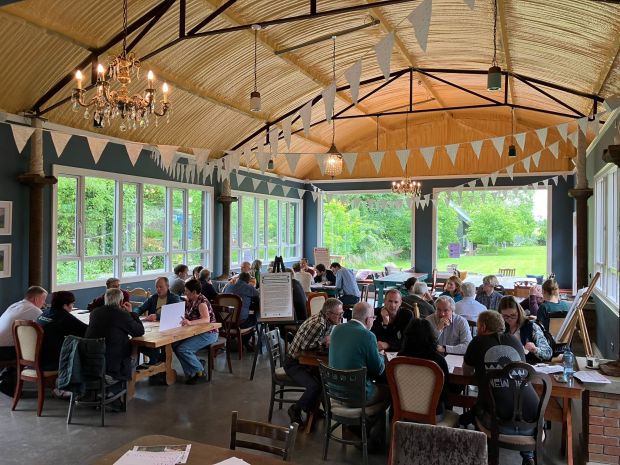
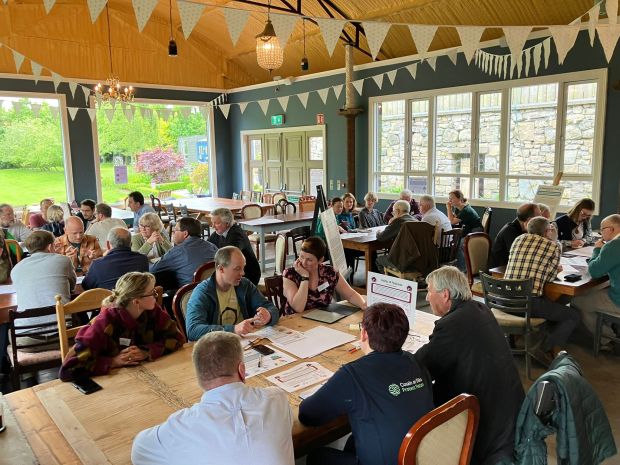
I’m just back from collaborating with the Peat Hub Ireland team on a scenarios workshop which invited participants from across the communities and institutions involved in Irish peatlands management to explore three visions of the world in 2050.

Historians, scientists, community members, officials, archaeologists, educators, researchers, activists, and businesspeople all gathered to find new ways to think about sustainability and custodianship, suitable for times of turbulence and unpredictability.

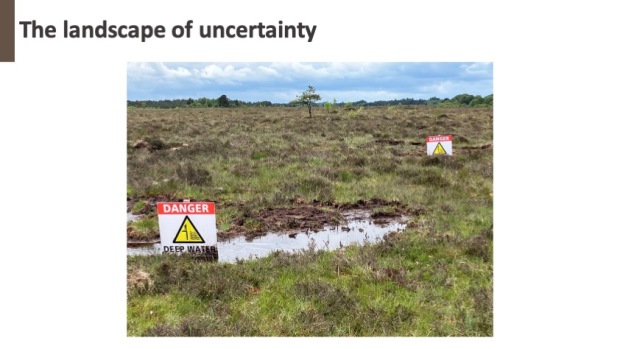
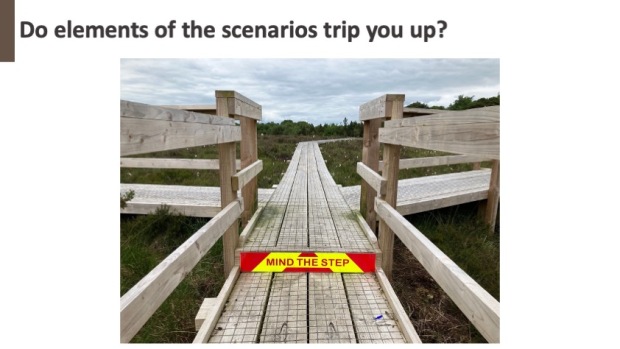
It was quite unique to run a scenarios day incorporating a two-hour break for a lunchtime country walk – but being out on the bog gave us a shared experience of the landscape whose future we were exploring, and some useful metaphors for dealing with conditions of uncertainty.

Our work built on the scenario elements of the Horizon Europe-funded IMAJINE project, which were led by the University of Galway’s Marie Mahon and myself. Peat Hub Ireland’s Florence Renou-Wilson, David Wilson, and Kate Flood worked with me to develop IMAJINE materials into a fresh set of scenarios for the world of peatlands management in 2050. We were supported in delivering the workshop by colleagues including Elena Aitova and Liz Bruton.

You can find out more about Peat Hub Ireland at their website – and there’s an account of the day from the Department of the Environment, Climate, and Communications’ Dave Dodd here. Stay tuned for more about the scenarios, too.

Futures of the networked world – auDA Internet governance scenarios

Australia’s Internet domain name self-regulatory body, the .au Domain Administration (auDA), has released a public version of its scenarios exploring the future of Internet governance. I’m pleased to have supported auDA in this process, and you can find the full scenario set here.

auDA is endorsed by the Australian government to administer the .au domain, with a mission to ensure it is a secure, accessible, and trusted asset for Internet users. In addition to its domestic duties, auDA also advocates for the .au domain and participates in global Internet governance processes. The organisation’s Future Scenarios Project provides a basis for wider strategic and policy conversation about our networked world and its governance, and how they might evolve in times to come.

You can read auDA’s own blog introducing the scenarios here – and there’ll be more to come, from auDA and myself, in due course.

Scenarios, cinema, and the horizon of dreams

“…of all forms of art, only film could show the remote horizon of dreams as a habitable country and, at the same time, could turn familiar landscapes into a vague scenery fit only for dreams.”

Gerald Murnane, The Plains

The word scenario came into strategy thanks to Leo Rosten, the humourist and screenwriter who also did work for the RAND Corporation during the mid-20th century. Rosten took a term, already slightly outdated in Hollywood, which meant “an outline for a proposed film”, and applied it to RAND colleagues’ future projections which invited Cold War policymakers to “think the unthinkable”. (If we go a little further, the word’s etymology takes us back to an Italian theatrical term meaning a stage set, scenery, or backdrop).

Even in the age of TikTok and bite-sized streaming video, the cinematic metaphor still has power. As Gerald Murnane’s words suggest, plausible yet challenging visions of the future context can enable us to imagine what it would mean to dwell in a place that once seemed to linger on the far horizon. In turn, that experience allows us to recognise that everything we take for granted in the here-and-now is in fact as malleable and overdetermined as the stuff of a dream.

Read more

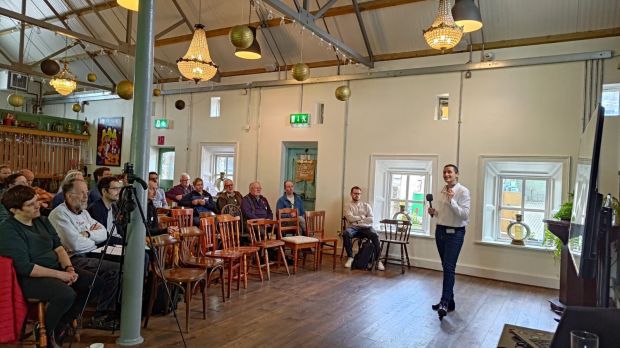
auDA Future of the Internet Scenarios Launch, 7 May 2024

How might global Internet governance change in times to come? What uncertainties surround our networked world, and how might they play out in ways that challenge the assumptions underpinning “business as usual” today?

Together with Australia’s auDA and a wide range of international stakeholders, I’ve worked to develop a set of scenarios for the future of the Internet in 2044.

They invite all of us who work with digital technologies to consider plausible, challenging, and relevant futures that offer fresh vantage points on the issues we face today.

Join auDA’s CEO Rosemary Sinclair AM, myself, and the team next month for the launch of these scenarios online. 7th May, 1pm AEST – with a recording to follow.

The View from Fourth Place

The concept of practising failure perhaps prompts us to discover our inner dweeb, to be underachievers, to fall short, to get distracted, to take a detour, to find a limit, to lose our way, to forget, to avoid mastery, and, with Walter Benjamin, to recognise that “empathy with the victor inevitably benefits the rulers.”

– Judith Halberstam, The Queer Art of Failure

It’s a funny thing, foresight work.

You help people to build pictures of the future context for a given entity or issue — but you’re not saying what you think is going to happen.

We’re not in the prediction business, nor even that of saying what we want the future to be.

Instead, we’re looking at ways in which today’s uncertainties might play out over time, challenging current assumptions and expectations, even current hopes and fears.

The scenarios we create together can offer unique vantage points on the issues of the here-and-now: manufactured hindsight. You know, as a scenario user or learner, that you’ve done a good job if you see something strategically useful which you couldn’t see at the outset of your work.

That sense of going beyond what you could already perceive, or conceive, is sometimes called the “a-ha” moment: a realisation, not always comfortable, that things could be otherwise.

This is why scenarios should be built with people, not for them. Re-perception of our current situation comes as much from the process as the end product; you can’t outsource the thinking that lets you see the world anew.

Still, as my Oxford colleague Gerard Drenth points out, there’s a danger of “So what?”

The work can’t just be interesting, it has to be useful.

Some people think that what’s useful is to “get it right” – to correctly forecast what the future will bring.

But the job is not merely to guess what happens next. Rather, it’s to see what we’re missing in our understanding of what’s already around us, right here and now.

Read more