I’ve done a fair bit of work with libraries over the last few years. Most of it has involved encouraging play of all kinds. I had previously worked with schools and other organisations, but I became convinced of public libraries’ importance after visiting Christchurch in the wake of the 2010 earthquakes. Carolyn Robertson and her team showed, through their actions in that period, that libraries were never more important than in times of grave crisis. When I think about librarianship as a heroic vocation, I think of people like Carolyn, and Penny Carnaby of the National Library of New Zealand, who did their profession proud in a difficult moment.
“We understand the word “library” in the widest possible sense.” – Carolyn Robertson, Christchurch City Libraries
The following key missions which relate to information, literacy, education and culture should be at the core of public library services:
creating and strengthening reading habits in children at an early age;
supporting both individual and self conducted education as well as formal education at all levels;
providing opportunities for personal creative development;
stimulating the imagination and creativity of children and young people;
promoting awareness of cultural heritage, appreciation of the arts,
scientific achievements and innovations;
providing access to cultural expressions of all performing arts;
fostering inter-cultural dialogue and favouring cultural diversity;
supporting the oral tradition;
ensuring access for citizens to all sorts of community information;
providing adequate information services to local enterprises, associations and interest groups;
facilitating the development of information and computer literacy skills;
supporting and participating in literacy activities and programmes for all age groups, and initiating such activities if necessary.
I think this is an incredibly strong mandate which gives librarians clear freedom to engage in all kinds of play, performance, technological and cultural activity. The missions have been around for twenty years, and yet so many library conferences and professional discussions still revolve around debating what libraries should or should not be doing in the 21st century; so many public discussions about libraries reveal that people still think of them largely as “shelfy”, book-storing institutions.
Part of my eclectic scholarly career was spent as an intellectual historian, so these are the questions that occur to me:
What happened in librarianship in the 1980s/1990s to lay the ground for such a radical, positive, and future-proofed global mission statement?
Why didn’t the missions gain more traction?
What lessons could we learn for today from the history of these missions, and the process that led to their writing?
I love the author bios on books. Reading a good one is like reading old-time liner notes on records. The texts have an eccentric politeness, their formality spiked with unexpected jabs.
I first noticed this when my mum introduced me to The Day of the Triffids. John Wyndham’s bio on old Penguin paperbacks stated that he “decided to try a modified form of what is unhappily known as science fiction.” That adjective, that adverb, inflected everything that you read and thought about the man and his words.
'…and decided to try a modified form of what is unhappily known as "science fiction."' pic.twitter.com/B7nIbvgK6Z
I got a similar feeling from the author bio of Alice Munro, one of my favourite writers. When I discovered her in my first year at university, the bio included this comment:
I guess that maybe as a writer I’m a kind of anachronism…because I write about places where your roots are, and most people don’t live that kind of life any more. Most writers, probably, the writers who are most in tune with our time, write about places that have no texture because that is where most of us live.
I love that quotation. It is wry and quietly, Canadianly, contrary. At once it marginalises the speaker and humbly suggests that there might be a value in being out of tune with one’s time.
(And is there any better way of positing Alice Munro, of all people, as a science-fiction writer, than to suggest she is out of tune with our time, a fantastic voyager to the lost chronotopes of ordinary life, what she describes as “deep caves painted with kitchen linoleum”?).
Aimee Bender’s The Particular Sadness of Lemon Cake, which I’ve just finished reading, deals with one of these archetypal “places that have no texture”, white suburban Los Angeles. But the central conceit of Bender’s novel is not the absence of texture which Munro describes. What troubles young Rose Edelstein is texture in excess.
Turning nine years old, Rose develops the power to taste the emotions of the people who make the food she eats. It begins when she detects hidden despair in her mother’s lemon-chocolate cake, but Rose is equally overwhelmed by food in the school cafeteria, her friends’ lunchboxes, or the restaurants she visits. Gradually she becomes able to taste the origins of each individual ingredient. She can read the story behind the apparently “effortless” business of putting food on her plate.
This is timely magic for an age when food production and consumption has come, for many in the developed world, to seem effortless. Supermarket ready meals seem not to have a history, but Rose can detect where the ingredients were grown, and in which factories they were produced, as well as the moods of the people involved in their making.
Bender doesn’t let this become a straightforward search for authenticity. Rose’s mother, the cook whose food triggers the trouble, is on a jittery quest for just such a thing, some deeper and more authentic sense of how to live. She treats Rose’s standoffish brother as a kind of guru, but comically misreads his signals. When he closes his eyes at dinner to avoid eye contact with the family, she thinks it is an unspoken directive to focus on the sense of taste above all others, yet she never detects any of the sensations that bother Rose’s palate. After flitting from one pastime to the next, Rose’s mother devotes herself to woodwork, yet her own daughter’s existence gently mocks the pursuit of traditional craft: Rose finds herself dependent on junk food and industrially produced snacks to survive. (Rose gives a paean to the Dorito: “What is good about a Dorito […] is that I’m not supposed to pay attention to it. As soon as I do, it tastes like every other ordinary chip. But if I stop paying attention, it becomes the most delicious thing in the world.”).
Rose is living in the world Alice Munro imagines, the world without texture, not because the world has been drained of meaning, but because she has become overly sensitised to the inescapable meaning of everything she consumes. Rose’s brother, who begins to disappear intermittently from the family home, faces a similar struggle. He fades away from a world that is too much, not too little.
It’s significant that Lemon Cake is set in Los Angeles, a city whose texture is dictated by the superficial blandness of suburbs and freeways. (A recent LA Review of Books piece on the historic home of sci-fi writer Ray Bradbury captures the complications of LA’s real estate battle between the past, present, and future).
It’s also important that Lemon Cake is set during Rose and her brother’s coming-of-age. As Bender puts it in her entry to Book Club Cookbook, Rose’s talent means that “what is normally one of the most lovely and innocent parts of childhood comes packed with complication.” In my previous discussion about the literature of adolescence, I focussed on a line which appeared first in Buffy the Vampire Slayer and then in Doctor Who, articulating the idea that a character, in coming to know who they are, is “still cooking.”
BUFFY: I’m cookie dough. I’m not done baking. I’m not finished becoming whoever the hell it is I’m going to turn out to be.
The magic at the heart of Bender’s novel complicates this metaphor. Cooking is what undermines Rose’s straightforward growth to adulthood. She is an outsider, compared to the “Downhill Girls” she sees coasting their way through their teens, precisely because of what she tastes. Cooking reveals her mother’s secret sadness, and beyond that a wider, more complex world, with which Rose must learn to live. Rose’s struggle to understand her power leads to companionship, solace, and the truth about a family history of uncanny talents. It also leads to irrevocable loss, and the disappointment that Rose’s father has been unwilling to explore his own inherited abilities, for fear they would make his life a misery.
By the end of the novel, Rose comes to an accommodation with her ability which moderates its worst excesses. She even finds a way to use it for the good of others. Nonetheless, her compromise with the world remains imperfectly satisfying, and therefore “adult”. Rose remains, in a sense, as “out of tune with her time” as Munro. Perhaps we’re not yet done cooking, as we progress from adolescence to adulthood; but sooner or later, Bender seems to say, we will have to sit down to the meal we have prepared.
He looked slick, fought bad guys, and lived in luxurious style in a train caboose with his pal Artemus Gordon—every week a new location and a new adventure.
But more than that, the look: that snugly fitted suit, short jacket, broad shoulders and black boots. Sure, he did spend a lot of time shirtless and tied up, too. Somehow at the advent of the androgynous glam rock look of the 70s and the nascent punk scene, anything at all seemed possible—at least until my body betrayed me with the double-whammy of adolescent hormones and a thyroid that tipped over into overdrive, hitting my rangy frame with unexpected curves and a bewildered loss of identity.
That surge of hormones denying the androgynous dream brings us back to adolescence. I’ve never quite had that feeling of being forced into a category that didn’t fit me. As I sit fairly unproblematically within the straight white male box, coming to understand my identity has been more about what Eula Biss describes as “the need to acknowledge myself as dangerous.” It’s a slow and inconsistent process of learning how harmful, and how boring, we might be when our identity oppresses others. I read Biss’ words in a Harper’s interview about her book on vaccination; I’m now keen to pick up Biss’ Notes on No Man’s Land and give her thought further attention.
Still, I remember the feeling Laity describes at the tail end of my teens, before my body made the definitive shift away from androgyny.
As a kid, dressing up had been everything to me. Spaceman, spy, Indiana Jones, whatever could be cobbled together from party masks and old clothes in the attic. My earliest memory is jumping off the (very low) roof of our back garden’s buried World War II bomb shelter dressed as Batman. I remember going to school for Hallowe’en dressed as a witch; my mum had a moment of inspiration, cut through the point of the plastic hat to make a flip-top lid, and filled the insides with exposed “brains” made from red paper and bubble wrap. It was my all-time favourite dress-up and I’ve loved Hallowe’en ever since.
Mum stayed cool with this proto-drag as the years went on. There’s a photograph somewhere of my little brother and I in her old clothes, lip-syncing and pretending to be the girls from ABBA.
In my teens this sense of dressing up and trying on new identities became more my own, not just play shared with a parent. The stakes grew higher as adulthood bore down on us.
I remember being in the pub, brown suede jacket, satchel, a metal Miss Selfridge heart from a girl’s sandal pinned in the lapel; a kind of lingering Indiana Jones get-up. I remember a guy from school telling me that with my hair worn long, I looked just like Heather Graham. I savoured the conflicted feeling that showed in his eyes.
Some of us at the all-boys’ school cultivated an air of camp, deciding which girl you’d have been in The Craft and having earnest discussions about whether Madonna’s voice coaching for Evita, which seemed to have affected her vocals on Ray of Light, had spoiled the Material Girl’s vulgar edges. The gym I went to had stacks of magazines for people to read while on the cross-trainer. Men had FHM and Loaded, women had stuff like Vogue. I would make a big show of reading copies of Marie Claire; the women were hotter and the articles better.
Some of my campness was protective camouflage; a lonely teenager’s fear of socialising, a way to hide from the supposed obligations of being an eighteen year old boy. Some of it was the late 90s trend for androgynous indie musicians. Some was using a performance to keep from saying what you really felt. But it was also a feeling of potential, exultant display, the feeling that Laity reminds us of when she quotes RuPaul: “We’re born naked, and the rest is drag.”
Such a useful, powerful line that. Drag is every choice of clothes. It is signification, is language, is the art of conveying meaning. Think of Roland Barthes: “Language is a skin: I rub my language against the other. It is as if I had words instead of fingers, or fingers at the tip of my words. My language trembles with desire.” (LH Johnson writes beautifully about her love for that quotation). Drag is everything that we use to communicate with the world.
The years go by, the body thickens and changes, the clothes I choose now speak a more conventional language. At thirty-four, the space marked masculinity is, in some ways, an increasingly comfortable – or at least taken-for-granted – fit.
Hell, one of the lads in the “Being A Girl” video grew up to be Danny Dyer.
Just whacked me tree up…..it's looking slightly camp this year…..can't work out how 2 give it a pair a bollocks. pic.twitter.com/6OHRpGm0GK
As I grew up, I had the luxury of nestling within a category which society more or less gives licence to behave as it wishes, straight, white, and privileged. If I stepped outside to play dress-up, I could always step back if things got scary. Hence why exploring identity can mean recognising oneself as vulnerable as well as dangerous.
I still savour the fact that all dressing is drag. That there is potential for expression, subversion, art, and play in every choice we make. But I also hope that getting older means listening better, and noticing when people are being hurt by the categories life imposes on them. It means remembering that RuPaul line not just as a manifesto for exultant display, but also one that guides compassion.
So you’ll have seen the announcement that Marvel is finally going to give us a female-led superhero film in Captain Marvel, due July 2018. I’m pleased, of course, that they’re making space for a badass, awesome woman to be the lead in a Hollywood superhero franchise, especially one tied to the current Marvel money train. But also because Captain Marvel – then Ms. Marvel – is one of the first superhero comics I read.
Back in the mid-eighties, the department store chain British Home Stores put out a hardback annual called The Superheroes Special Edition, filled with old Marvel reprints. My mum bought me a copy as a present; I read it over and over, put a glittery name label on the inside cover, and took it into school. I remember the X-Men facing off against Sentinels, the Fantastic Four pitted against alien dopplegangers, and the Silver Surver fighting the Abomination – all supremely awesome to the five-year-old mind.
But my very favourite story came from Ms. Marvel #5. In it, New York magazine editor Carol Danvers has a premonition that a “Super-Truck” of radioactive cargo is going to be attacked. Carol has to transform into Ms. Marvel, an alien alter ego with a separate personality from Carol’s. Not only is she at war within, but when she goes to protect the truck, Ms. Marvel is mistaken for a villain and attacked by another superhero, the Vision.
I remember being captivated by this story. A superhero who was at war with her secret identity; a superhero who had to fight “proper” heroes who didn’t trust her; a superhero who uses trickery to triumph – as in the page at the top of this post, in which Ms. Marvel sets a trap for the Vision. With stories like this, I took it for granted that of course girls could be superheroes too – not just token characters, but strong protagonists facing complex challenges. Ms. Marvel was unquestionably cool in the same way that Mildred Hubble from The Worst Witch and Dinah from the Demon Headmaster books were. I have to thank my mum for buying me all of these books and introducing me to all of these awesome characters. Thanks Mum!
I’m really pleased that kids who grow up with the next generation of Marvel movies, boys and girls alike, will also see Carol Danvers battling baddies and saving the world.
Louie Stowell, who contributed author videos to the Parkes Library Fun Palace earlier this month, has written about the experience of being a Big Evil Head, projected across continents and timezones in the name of fun and supervillainy.
Boys’ hate was dangerous, it was keen and bright, a miraculous birthright, like Arthur’s sword snatched out of the stone, in the Grade Seven Reader. Girls’ hate, in comparison, seemed muddled and tearful, sourly defensive. Boys would bear down on you on their bicycles and cleave the air where you had been, magnificently, with no remorse, as if they wished there were knives on the wheels. And they would say anything.
[…]
The things they said stripped away freedom to be what you wanted, reduced you to what it was they saw, and that, plainly, was enough to make them gag. My friend Naomi and I told each other, “Don’t let on you heard,” since we were too proud to cross streets to avoid them. Sometimes we would yell back, “Go and wash out your mouth in the cow trough, clean water’s too good for you!”
– “Changes and Ceremonies”, in Alice Munro, Lives of Girls and Women
Alice Munro is the most important writer in my life and that makes her hard to talk about. I’ve been trying to find the words since just before she won the Nobel Prize last year. They’ve been piling up in my hard drive, my inbox, in blog drafts and the Notes app on my phone.
Things came to a head when the recent debate about adults reading Young Adult (YA) fiction flared on the Internet. I had no sympathy for people who think YA unworthy of adult readers. But it was almost too easy to take up cudgels against literary snobs without acknowledging the strangeness of a world in which it’s all the rage for adults to read books explicitly not aimed at them.
In the ensuing squabble, I felt that other questions were barely touched.
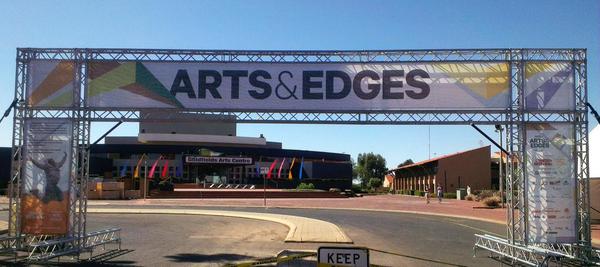
Arts and Edges – from the Regional Arts Summit @raasummit on Twitter
I was sad not to be able to attend the Regional Arts Summit in Kalgoorlie, Western Australia this year – despite best efforts, we couldn’t square it with all the projects currently on the go at Parkes Library.
Earlier this year, I was privileged to keynote at VALA, the biennial culture, libraries, and tech conference which took place in Melbourne. I spoke about opportunity and equity in Australian libraries, trading my Hugo Boss for a miner’s uniform on stage to make a point about arts access outside Australia’s big cities.
Working in Parkes has opened my eyes to the challenges that rural, regional, and marginal communities in Australia still face in gaining access to arts and culture – both as audiences, and as creators in their own right.
In Parkes, we’ve designed events like the Central West Comics Fest to reach out beyond an arts-event circuit that focusses on state capitals, and give regional creators, fans, and audiences their due.
Some of the Twitter coverage from Kalgoorlie was relevant to this work in Australian regional libraries, especially contributions from Curtin University librarian Teresa Bennett – @kalgrl on Twitter.
The Regional Arts Summit in 2016 will take place in Dubbo, just down the road from my friends at Parkes Library. It’s going to be a great time for Central West New South Wales. I look forward to seeing an Australia where the culture scene goes further in embracing the sharp edges and strange delights of life at the margins.
If you are not living on the edge, you are taking up too much room Panel 4#raasummit
It’s a beautiful Sunday morning in Parkes, and life is grand, so I thought it might be a good day to share three great writers with you. These are all pop-culture pundits whose essays make excellent weekend reading.
Emmet O’Cuana – Challenger of the Unknown
“The Suburbs” by O’Cuana, Rinehart, and Switalski
Emmet is a Melbourne-based comics writer, critic, and occasional radio host who has interviewed me on a couple of occasions. Each time he forced me to question my opinions and raise my thinking to a new level. The first time our chat ranged from Star Crash to Kierkegaard; the second he asked smart and challenging questions about the live-action zombie games I’d been running in Australia and New Zealand.
My favourite pieces by Emmet are still forthcoming – he wrote an insightful chapter on comics creator Grant Morrison in Darragh Greene and Kate Roddy’s Grant Morrison and the Superhero Renaissance, plus a great essay for the comics site Sequart which made me re-evaluate James Robinson’s Starman, a comic which I love and thought I knew everything about. Watch out for them next year.
Carol has featured on my site a few times before. She quietly produces meticulous, poetic criticism, taking apart icons from the past and present to examine what it means to be human. I’ve previously raved about her writing on Mario Bava’s Danger:Diabolik (“If we had a lesbian cinema that took Danger: Diabolik as its starting point, I, for one, would be much happier”) and on Superman as a positive burlesque of masculinity:
I’ve come to see Superman’s greatest powers as not his strength or heat vision, but his restraint and his theatricality both in restraining that power while pretending to fight as hard as he can and in passing as Clark Kent. As I see him now, Superman is always performing one way or another.
Frank Collins – May Not Be Used Where There Is Life
Frank writes on classic television for British site MovieMail, and at his own site Cathode Ray Tube. I’ve long had a fondness for old television shows, but through Frank’s chronicle of twentieth century telly I discovered obscure gems like the fourth-wall-breaking Strange World of Gurney Slade.
Frank’s current MovieMail series tracing the history of British TV sci-fi showcases his critical strengths: erudition, insight, and elegance. Frank can capture the essence and wider resonance of a TV show in a single descriptive paragraph, as he does here for the wildly different Red Dwarf, Space:1999, and Sapphire and Steel:
This slideshow requires JavaScript.
That’s all for today: three clever souls thinking out loud about the stories we tell ourselves on the page and screen. Go check them out, if you’re looking for a Sunday read. And have a great weekend!
I’ve just finished working on a Fun Palace in Parkes, New South Wales – Australia’s first. Taking place in public venues like museums, theatres, and libraries, Fun Palaces invite people to explore art and science on their own terms. In Parkes, that meant letting the community try their hand at games devised by local kids and teens.
Much like our zombie, time travel, and giant monster events, all the effort was in the preparation. If you set up the activities right, participants don’t need much from you on the day. Their own fascination draws them in – and keeps them engaged.
Preparation for something like this includes obvious stuff – admin, logistics, testing the games. Last year, we even managed to boil down the process to six bullet points. What gets missed in that brief version is the inspiration and writing phase, which involves a lot of long walks, daydreams, and listening to music. As David Mamet once said, writing is to hanging out as tasting food is to cookery.
I’ve always cherished that line. It’s one reason why, alongside Fun Palaces, I recorded a podcast about Transformers with Neill Cameron and Daisy Johnson this month. It let me hang out in the world of pop culture while planning for Parkes. That kind of thoughtful immersion is a vital underpinning of the events I run, because in many ways pop culture is the folk culture of this mediatized world. I think very hard and probably way too much about how to mine the media for ideas when creating events and opportunities to play in public spaces.
Today I want to talk about how action-adventure, that most popular and often least profound of genres, can be a fruitful source of inspiration. That’s not just because even the dumbest slam-bang narrative drips with messages about gender, society, power and culture. It’s because the very business of action-adventure is problem solving.






 matt finch / mechanical dolphin