The Ghosts We See from the Mountains: IMAJINE at the Territorial Bodies Conference

I’m pleased to say I’ll be presenting at the Territorial Bodies Conference held at the University of Warwick in February 2023.

My paper, “The ghosts we see from the mountains: Scenario planning and the territorial body in time”, will explore the intersection between bodies and territories via the questions of spatial justice explored by the IMAJINE scenarios for the future of European territorial inequality, and consider how scenario planning can give insights into the ways we understand the relationship between bodies and territories over time.

Find out more at the University of Warwick conference website or via the Territorial Bodies account on Twitter.

Scenarios for the future of civil protection in Germany

I served as an expert respondent on the pro bono scenarios for the future of civil protection in Germany created by the team at CapGemini Invent.

German speakers (or those of you possessed of a decent machine translation option) can read more about the Katastrophenschutz 2035 scenarios here.

IMAJINE: Behavioural insights and interventions with Stefan Kaufman

A.I. that is better at exploiting behavioural science than humans are; transformations in land management that enhance the value and sustainability of natural resources; defence of “cognitive sovereignty” in a world of dark patterns and malevolent nudges; the weaponisation of behavioural insights in the service of “socio-technical Darwinism”…

A new response to the IMAJINE scenarios for European spatial justice from BehaviourWorks Australia’s Stefan Kaufman offers a foresight perspective on behavioural science, insights, and interventions in the Europe of 2048.

PUSH SUMMIT Podcast with Rowan Drury, Malin Leth, Anders Mildner

Altitude Meetings’ PUSH Summit on climate and democracy is currently taking place in the Swedish city of Malmö and online.

I joined sustainability consultant Rowan Drury, Malin Leth from Håll Sverige Rent – the Keep Sweden Tidy organisation, and Altitude’s own Anders Mildner to discuss issues of system change, futures thinking, strategy, and sustainability.

You can listen to the half-hour podcast here and watch my short online presentation to PUSH SUMMIT here.

TAFTIE x IMAJINE: Scenarios, productivity, and innovation policy

For the Asian Productivity Organization, Alex Glennie of the Innovation Growth Lab discussed the role of innovation agencies in Europe.

Alex’s presentation drew on the collaboration between the TAFTIE network of innovation agencies and the IMAJINE project looking at the future of European regional inequality.

You can watch Alex’s presentation on YouTube, and read more about “TAFTIE x IMAJINE” at the website of the OECD’s Observatory of Public Sector Innovation.

PUSH SUMMIT in Malmö and online

To launch Altitude Meetings’ PUSH SUMMIT exploring issues of democracy and sustainability in times of uncertainty, I spoke with Anders Mildner about scenarios, foresight, and some of the findings from the IMAJINE project.

See more from the PUSH SUMMIT, which takes place in Malmö, Sweden, and online, here.

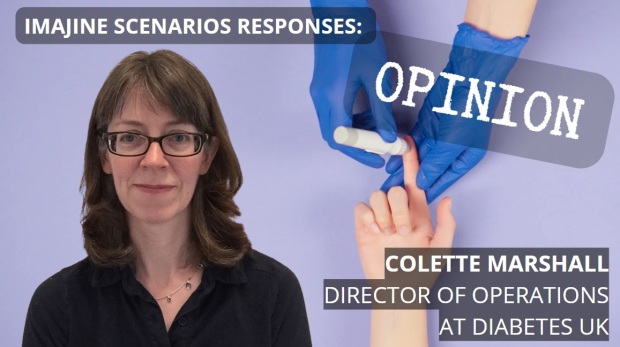
IMAJINE scenario response – Colette Marshall, Director of Operations at Diabetes UK

“Diabetes is an interesting condition to explore in these scenarios because it’s like the canary in the coal mine. Type 2 diabetes, in particular, tells you the general population health, while Type 1 diabetes tells us about how society is dealing with a smaller group of people who have a condition which is eminently curable or preventable with the right level of research over the next 20 years… So diabetes becomes an interesting bellwether for social inequalities in each scenario, and for good sharing and rollout of the latest advances in healthcare.”

At the IMAJINE project website, Colette Marshall of Diabetes UK explores the future of diabetes, its treatment and management, in each of IMAJINE’s four scenarios for European regional inequality in 2048.

I especially liked Colette’s definition of trust as “confidence that partners will not exploit each other’s vulnerability”. There’s something there that takes us beyond trust in expertise: it’s about mutual recognition of vulnerability, and the motive for action, whether it’s exploitative or not, the power dynamic, which seems highly relevant.

Read more at the IMAJINE website.

Scripturient: Interview with Trish Hepworth

In the latest instalment of my column for Information Professional, I interview Trish Hepworth, Director of Policy and Education at the Australian Library and Information Association, ALIA. You can find the column here and read the full conversation below.

MF: What was your journey to libraryland?

TH: I originally did a law degree. I was admitted as a practitioner to the Supreme Court of the Australian Capital Territory (ACT), was working as in-house counsel for a government department, and I fell into libraries by complete accident.

I joined the precursor to today’s Australian Libraries and Archives Copyright Coalition, who look after copyright policy and training for the entire library sector, and the Australian Digital Alliance, a cross-sectoral group advocating for fair copyright reform, with members ranging from libraries to tech companies, education institutions, and organisations like Vision Australia which support people in getting access to media and materials. These groups were looking at some of the fundamental values which hold the library sector together: equitable access to knowledge, information, and culture.

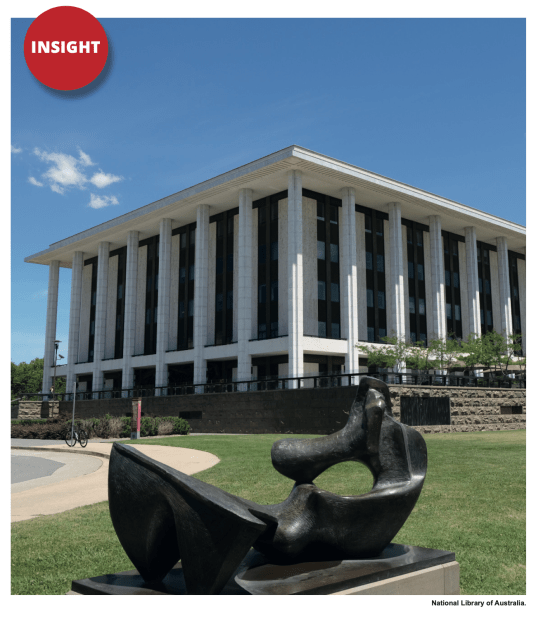
I found myself suddenly based at the National Library of Australia, in this wonderful institution, surrounded by amazing library and information professionals, delving deep into the intricacies of the copyright act. This is a confusing, often quite antiquated patchwork of legislation, which sometimes doesn’t even make sense; one of the greatest achievements in our copyright reforms has been that it’s no longer an offence to file document delivery request slips in chronological order!

We were looking at ways to make life easier for libraries and information services, when this act from 1968, which has since been amended in various ways, still doesn’t really sit very well with the changes which have been brought by digital. We faced, and still face, frustrating situations where there is an amazing wealth of archival materials, and no legal way to make these accessible to people. There are still obstacles, for example, to people accessing materials remotely – which, during a pandemic, has basically cut off access to huge swathes of knowledge and culture. Even when we’re not under conditions of COVD and lockdown, it still disproportionately favours people who live in large metropolitan centres and close proximity to the physical collections. Why should people who live in rural areas, or whose disabilities make travel difficult, be disadvantaged relative to people, say, who live in the centre of Melbourne? With all of the technologies and capabilities that we have, it’s slightly ridiculous that this is even an issue.

Read more

Tomorrow’s Inequalities: Discussion with Mattia Vettorello

The designer and foresight practitioner Mattia Vettorello generously allowed me to join him for the final instalment of his podcast The Briefing Today.

During the episode, we talked about questions of foresight, changing social values, inequality, and injustice, using the IMAJINE scenarios as a case study.

You can hear previous instalments of the 22-episode series at Mattia’s website.

Time to ask some magical questions? Exploring the future of Europe’s innovation agencies

Over at the blog of OPSI, the OECD’s Observatory for Public Sector Innovation, Alex Glennie of Innovation Growth Lab, Marie Mahon of NUI Galway, and I have written about our work using the IMAJINE scenarios with TAFTIE, the European network of innovation agencies.

At the OPSI website, you can read our discussion of what happened when we used IMAJINE’s four visions of Europe in 2048 to help innovation agencies ask ‘magical questions’ about what lies ahead and the implications for innovation strategy & policy today.