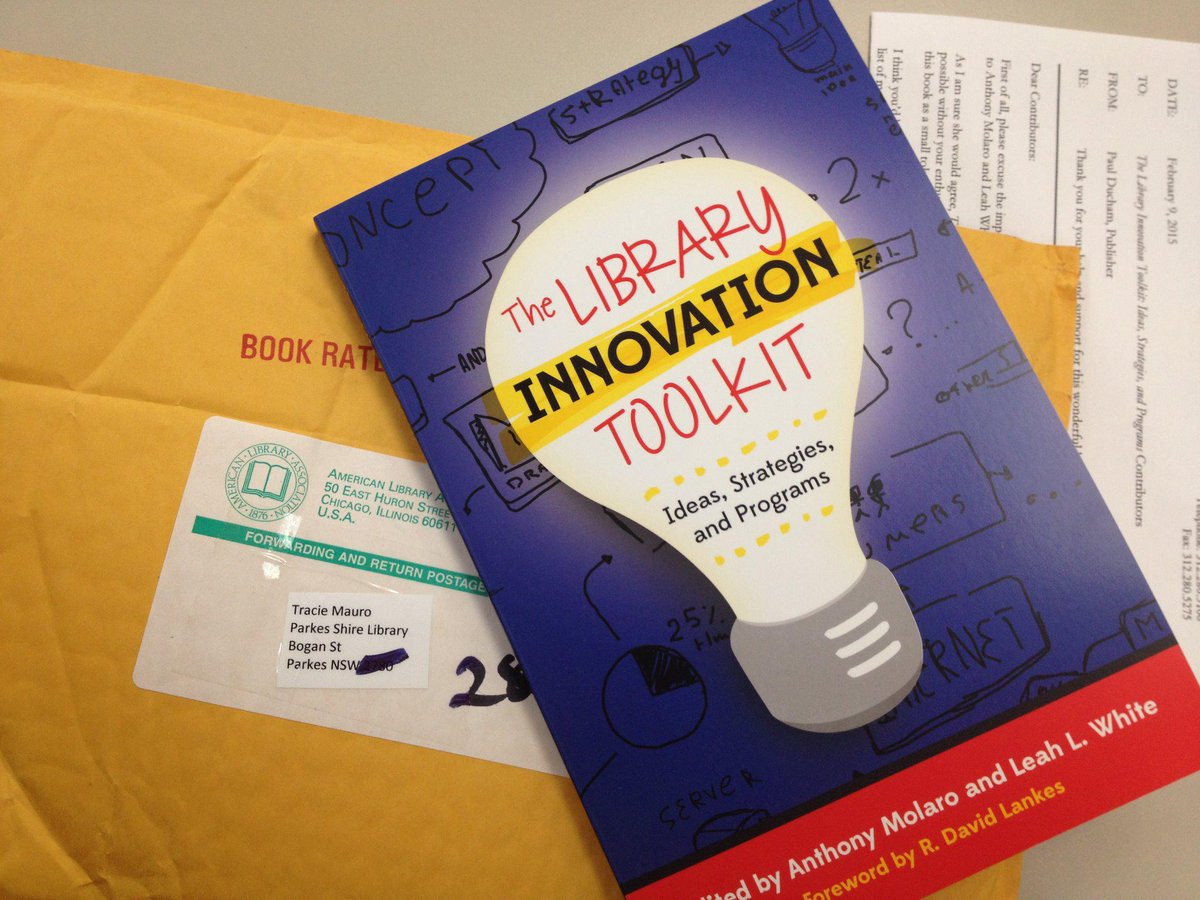
The book “encourages readers to take big risks, ask deeper questions, strive for better service, and dream bigger ideas”, with practical examples and suggestions for 21st century library services.
I wrote “Monsters, Rockets, and Baby Racers”, the chapter on working with children and young people, together with Tracie Mauro of Australia’s Parkes Library.
Working with Parkes High School and Parkes Shire Council, our team arranged for local writers’ stories to be printed on takeaway cups used by cafés and venues throughout the town. This empowered local voices and gave people who might never enter the library a chance to enjoy new writing by their own community. Locals and out-of-towners all got a hit of Parkes’ literary scene with every drink they bought. This was part of my role as the town’s Reader-in-Residence. You can see TV news coverage of the project at the Prime7 website.
Our coffee cup stories chimed with the values of the ongoing Fun Palaces project, launched last year. Fun Palaces aim to give local communities a chance to take part in the arts and sciences. Parkes hosted Australia’s first ever Fun Palace last year, to great success.
I was trying to find the words to look back on an eventful season with Parkes Shire Libraries, culminating in this year’s Australian national award for innovation in library youth services. I could have talked about how the country stereotypes have yielded to reveal a town of tough and funny and mad and passionate people. I could have recounted how all the amazing things we’ve done were really about a community that was ready for change, and a bunch of smart librarians who recognised that fact, and who drafted in an outsider to provoke and support and sustain that change.
Instead, I wanted the last word to come from someone else. One of our local writers, but one who – like me – came to Parkes a stranger and a foreigner.
Santhoshi Chander of the town writers’ group Author-rised kindly allowed me to share her thoughts about the experience of finding a new home out in the Aussie regions. “Ex-city-slicker” San divides her time between Sydney and Parkes.
A Country Fling, or A Love Letter to Parkes
It seemed from the beginning the stakes were against us. I’m not claiming our story has Romeo and Juliet status. But in our own way, we started as star crossed lovers.
Parkes High School’s teacher librarian Tracy Dawson has an article in the latest SCAN magazine about the Reader-in-Residence role which I held in Parkes across late 2013 and early 2014.
The role was designed to link the school and wider community in a celebration of storytelling, literacy, and culture in all its forms. Events included teen publishing workshops, our biggest ever zombie roleplay, urban myth writing, and the inaugural Central West Comics Fest, which will be returning in 2015. I also mentored high school students, led sessions for the Parkes writers’ group, and worked with the school’s special needs unit.
Tracy gives a teacher’s perspective on how trying new things, pushing boundaries, and reaching out to a wider community also yielded great benefits to students at the high school. You can also read her guest posts on this site about Auckland’s XXUnmasked project and the work of a teacher librarian.
SCAN magazine is a refereed journal published by the New South Wales Department of Education, focussed “on the interaction between information in a digital age and effective student learning.” You have to subscribe for recent issues, but the archive is publicly available – I’ll let readers know when the current issue moves into the free archive.
Debbie Gould is one of the librarians I work with in Parkes, New South Wales. She creates and delivers library programmes for the Currajong Disability Group. Currajong clients are people who require some degree of care. They are diverse in ability, with some who are nonverbal, some needing 24/7 care, and others who have learning disabilities. Debbie created a game for Parkes’ Fun Palace last month and was then able to share it with her clients in the group on one of their weekly visits.
Here’s Debbie talking about her work with the Currajong group, and how she brings Parkes’ philosophy of fun and open-ended learning to library users with disabilities.
At Parkes Library, we believe that libraries are about so much more than books and shelves. Our job is helping our whole community to learn, explore, and have fun on their own terms.
I started working with the Currajong Disability group at the start of 2012. I’ve been doing it for almost three years now, but the clients change and so I’m always adapting my programme to suit them.
In the early days, it was trial and error. I wasn’t concerned about not being able to relate to the clients, but I was concerned that I wouldn’t be able to provide a programme that worked for everyone, all the time. I wanted all the clients to enjoy their library time. As the weeks passed, I could see that the group did enjoy themselves. Their needs were met even though I was experimenting as I went along, finding out what was going to work best. That was part of the experience!
Building a relationship with the clients took time. It was important to watch and listen as well as present to the group. Clients have different ability levels, and my sessions had to take that into consideration.
In the group, we explore books and stories as well as practical and playful activities. I have found that the world of my clients is very factual. The world of fiction relies on imagination and a sense of “let’s pretend” which can be difficult for my clients. Concepts such as animal characters in books taking on human characteristics aren’t always understood. Quite often clients don’t get the punch line at the end of a story because it isn’t a “real” experience.
Clients work better with non-fiction and real life activities, where as many of the senses can be engaged as possible. Simple science experiments and activities are often popular. Each session I try to incorporate sight, hearing, touch, smell. Taste is explored sometimes but I have to be mindful that not all clients are able to take food by mouth and some have special dietary needs.
This slideshow requires JavaScript.
When I designed a game for Parkes’ Fun Palace weekend, I chose to make a maze based on old sideshow games. Players had to drop a ping-pong ball into a slot and try to land on a high score. Age and ability was not a hindrance to playing the game I created. I saw the joy people had playing it at the Fun Palace, and knew that my clients would have a good time with it.
Watching the Currajong group play my game was interesting. They all interacted with it in different ways, but they were all excited to see the end result. They loved the mystery of just where the ball would land. Each of them played their own version of the game – even if it wasn’t quite what I’d intended, they still achieved the goal of landing a score with the ping pong ball.
Relationships are key to making this group work. Without a solid relationship between clients, carers, and the library, our sessions would not be successful. There is no way a programme could run and meet the goals set if the presenter was not mindful of the clients and their needs.
All relationships take time to develop; they need genuine interest, concern, and respect. A little bit of yourself has to be given in each session you present. If it isn’t, then you aren’t presenting effectively. Working with disabled adults is a privilege and it has been exciting to see each client share a bit of their personality in the sessions. The joy and reward from the sessions is priceless and being able to expand the world the clients live in is amazing.
Meanwhile at Zoe Toft’s Playing By The Book site, Tracie is interviewed by Zoe about the “Wonder-based library programmes” she creates for children and families. Tracie explains how you can create similar activities at home, school, or your own local library.
The Parkes team are among the most daring and resourceful librarians I’ve ever worked with – no project daunts them, from live action zombies to wading through chocolate pudding swamps. Stay tuned, because there’s much more to come from these amazing Australians.
Louie Stowell, who contributed author videos to the Parkes Library Fun Palace earlier this month, has written about the experience of being a Big Evil Head, projected across continents and timezones in the name of fun and supervillainy.
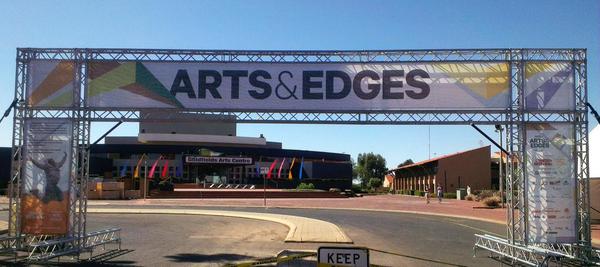
Arts and Edges – from the Regional Arts Summit @raasummit on Twitter
I was sad not to be able to attend the Regional Arts Summit in Kalgoorlie, Western Australia this year – despite best efforts, we couldn’t square it with all the projects currently on the go at Parkes Library.
Earlier this year, I was privileged to keynote at VALA, the biennial culture, libraries, and tech conference which took place in Melbourne. I spoke about opportunity and equity in Australian libraries, trading my Hugo Boss for a miner’s uniform on stage to make a point about arts access outside Australia’s big cities.
Working in Parkes has opened my eyes to the challenges that rural, regional, and marginal communities in Australia still face in gaining access to arts and culture – both as audiences, and as creators in their own right.
In Parkes, we’ve designed events like the Central West Comics Fest to reach out beyond an arts-event circuit that focusses on state capitals, and give regional creators, fans, and audiences their due.
Some of the Twitter coverage from Kalgoorlie was relevant to this work in Australian regional libraries, especially contributions from Curtin University librarian Teresa Bennett – @kalgrl on Twitter.
The Regional Arts Summit in 2016 will take place in Dubbo, just down the road from my friends at Parkes Library. It’s going to be a great time for Central West New South Wales. I look forward to seeing an Australia where the culture scene goes further in embracing the sharp edges and strange delights of life at the margins.
If you are not living on the edge, you are taking up too much room Panel 4#raasummit
We’ve had an amazing start to the Fun Palaces weekend here in rural Australia. So far, since our doors opened, over 260 people have come to try their hand at the challenges we devised together with local kids. That’s great numbers for a small rural community.


 matt finch / mechanical dolphin