Last month, I went up to Townsville in North Queensland with a team of staff from the State Library.
I worked with Townsville staff on strategy and innovation for a couple of days, then we invited around sixty people from across the region – and across the culture sector – for a day of workshops focussed on service innovation and professional development.
We discussed everything from robotics to scrub turkeys, David Bowie’s creative process to President Obama’s response to Muhammad Ali’s death, all the while thinking about how our organisations could better serve the communities we’re part of.
Library Journal calls me an “Australian librarian”; I’m neither of those things, but will let them off as the project was devised for a creative residency in public libraries Down Under.
The Worst Song I Ever Loved was based on a university task created by Daniel Nester.
On my last trip to Rockhampton in Central Queensland, I was interviewed by Chrissy Arthur of ABC Capricornia. We talked about some of my projects in Australia and New Zealand, the role of public libraries in 2016, and this year’s upcoming Fun Palaces across Queensland and worldwide.
The best part was talking about how creativity isn’t determined by your pay grade – anyone can have a bright idea, and a role like mine is as much about listening to organisations and their communities as it is ‘thinking up cool stuff to do’.
The Pokémon Go game is bringing crowds of players to all kinds of public spaces, so of course museums, galleries, and libraries are working to attract these people, get them through the doors, and engage them.
It feels like every cultural institution worth its salt has used social media and friendly signage to let Pokémon players know they’re welcome. The smart team at Queensland Art Gallery / Museum of Modern Art, just next door to where I work, put out Pokémon lures at the weekend to attract extra players to the South Bank. Read more →
On Saturday 10th September from 4-5pm, I’ll be at Queensland Art Gallery speaking on “The Rules of Engagement“, a panel with Kate Pullinger and Caroline Keins exploring the changing ways that artists, institutions, and communities interact.
Then on Sunday 11th September, I’ll help a panel of scientists and science-fiction writers to explore science, imagination, and identity. Join Dr Maggie Hardy, Prof Tamara Davis, Ellen van Neerven, and Dr Maree Kimberley for “Science and Belonging“, which I’ll be moderating from 11.30am-12.30pm at The Parlour in the State Library of Queensland.
The Brisbane Times has just published a story on the State Library of Queensland’s acquisition of the last ever interviews with Aussie celebrity chef Bernard King.
Back in May, I led a couple of sessions for Queensland’s Heritage Leaders Workshop, exploring ways to turn audiences into participants and expand the conversations we have at panels, keynotes, and other events.
“We believe in the genius in everyone, in everyone an artist and everyone a scientist, and that creativity in community can change the world for the better.
We believe we can do this together, locally, with radical fun – and that anyone, anywhere, can make a Fun Palace.”
– Fun Palaces Manifesto
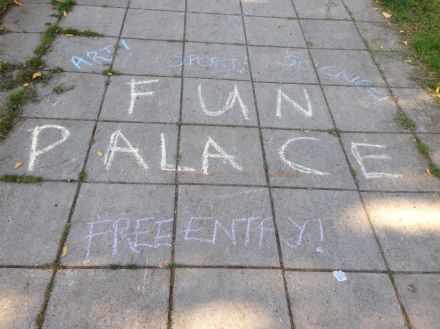
October might seem far off, but plans are underway for Fun Palaces across the Sunshine State in 2016.
What’s a Fun Palace? It’s the opportunity for a community to come together and explore the arts and sciences for free.
From fancy inner-city venues to radio stations, theatres, websites, suburban parks, swimming pools, remote tropical islands, people’s back gardens, and, yes, libraries, Fun Palaces are a way for people to get together with friends, family, neighbours, workmates, and strangers in their community, to celebrate the artist and scientist in all of us.
Theatre director Joan Littlewood and architect Cedric Price came up with the idea of Fun Palaces back in the 1960s. They imagined “a laboratory of fun” that would serve as a pop-up community venue for both art and science.
Today, Fun Palaces take place all over the world on the first weekend in October, allowing communities to be part of something bigger, setting off sparks of inspiration and connection which lead to lasting benefits for the people involved.
In 2015, I was co-producer to 11 simultaneous Fun Palaces across a 13-mile stretch of South London. Football clubs and firefighters, jewellers and businesspeople, comic stores and kickboxers, university students and lecturers, plus many more all joined forces to celebrate the arts and sciences in the London Borough of Lambeth. London’s 2015 Fun Palaces also included an online comic maker built for us by the State Library of Queensland, where I’m currently based.
If you’re a Queenslander who’d like to get involved with Fun Palaces this year, our team at the State Library can give advice and support, or connect you to venues which are already running Fun Palaces across the state – including every single public library in the city of Brisbane. We’re also equally excited if you just want to make a tiny Fun Palace in your office or your garden or your kitchen, with your mates or your neighbours or your family.
We all have something to offer, we all have something we’d like to learn or explore. If you’d like to join the adventure in Queensland, either contributing to a Fun Palace on the weekend of 1-2 October, or helping Fun Palace organisers in the run-up to their event, contact the State Library’s Signature Team.
What are libraries trying to achieve? What’s helping them, and what’s getting in their way? What should a big organisation like the State Library of Queensland (SLQ) be doing for its smaller siblings across the country?
Results indicate that local governments, who own and manage libraries, do not always see the positive impact libraries have on the community, and this limited awareness keeps governments from investing more resources and giving the libraries free reign.
However, free reign and resources are the primary things libraries need to make an impact. Strategies that help overcome this challenge include proving impact through evidence, gaining freedom in communication, using innovative methods to circumvent red tape, and acquiring resources locally.
Pointing out that many non-library-users and even library staff are unaware how much libraries have changed and what they can now do, the report’s authors encourage librarians to connect with peer organisations, source skills and resources from their local community, and identify “low-cost yet high impact marketing techniques.”
The report recommends that Queensland’s State Library builds “an inspirational network of equals to stimulate mutual exchange…develop and realise visions together, and share success stories and mistakes”; it warns that “combining services should only be pursued if there really is insufficient funding to offer services separately […as] combining services primarily means that library services suffer”; and it tells us that in Queensland,
the community’s appreciation for their library seems to be highest when, on top of preserving and guiding access to collections, libraries also stimulate and guide





 matt finch / mechanical dolphin