I’m pleased to announce that Auckland Libraries’ XXUnmasked media literacy project for teenage girls has just won an award for community outreach. This week on the blog, Tracy Dawson of Parkes High School Library in Australia reports on the project led by Ali Coomber of Auckland Libraries and Dr Pani Farvid of Auckland University of Technology.
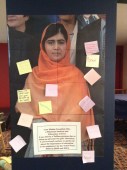
Poster display from XXUnmasked
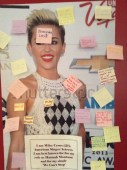
Poster display from XXUnmasked
Goody bags for XXUnmasked participants!
XXUnmasked – double the power, not the standards!
Something that always amazes me is when young girls say “I’m not a feminist.” When any woman says it, actually. I remember several years ago, in my previous guise as an English teacher, talking to a group of top senior English students studying what was then called 3 Unit English in New South Wales. We were discussing the brilliant Margaret Atwood’s The Handmaid’s Tale, and despite that horrific and unsettling story of the loss of female identity, voice, independence, none could see the value of feminism.
Now when feminism is often seen as a dirty word at the same time that all-pervading media images of women are more blatantly misogynistic than ever, how do we help our young women avoid being active participants, let alone passive observers, in their own diminution? Read more →
Last week I gave a keynote at VALA in Melbourne. It’s a biennial conference for people who work in galleries, museums, and libraries. The text below builds on key ideas from my speech – you can see a full video at the VALA website.
Think of the public library as the TARDIS on your streetcorner…a local gateway to human knowledge and dreams
The robot warriors from Parkes’ BIG BOX BATTLE assemble on the eve of conflict!
Regular readers of this blog will be aware that it’s been an intense season over here in Australia, creating new programmes, training librarians and writers in the arcane arts of roleplay and immersive storytelling, and even taking up cudgels on behalf of libraries everywhere.
This talk is the culmination of a season advocating for libraries to challenge their own boundaries and reach out in new ways, to new communities and new partners.
It has also involved pushing back against voices in the arts who sideline local libraries as venues for all forms of culture and knowledge – see the recent debate about e-books and community outreach for more on that. Serving marginal communities is one of the things librarians do best, and it is vital that the profession advocates for itself in this time of dramatic change.
It’s never been more important for libraries to demonstrate, on a practical, grassroots level, their relevance to every member of the community. I’m pleased that library organisations and senior managers are addressing questions of branding and strategy, but it’s also vital that we make a difference on the front line, in grassroots settings and customer-facing roles.
A great essay by Adrienne Hannan of Wellington City Libraries in New Zealand – probably the single best piece about libraries I’ve read this year – sets out how librarians of all ranks should act strategically, working with integrity and immediacy as a fighting force on behalf of the forces of culture, literacy and knowledge. Read ‘The Strategic Librarian‘ here…and prepare for battle.
What is interactive storytelling and how can immersive narratives enhance the storytelling experience?
Interactive storytelling means creating an event where all participants shape the outcome of the story. It breaks down barriers between the teller and the audience, so that people work together to develop a shared narrative. In some ways this is very traditional – oral storytelling always involves taking account of your audience, and even a book is never interpreted in quite the same way by different readers – but immersive narratives incorporate aspects of theatre, gaming, and play so that you can step into the world of a story and make choices with consequences for your character.
What makes a successful storytelling event? Is there one that you’re particularly proud to have created?
A successful interactive storytelling event brings satisfying outcomes which the organisers didn’t design or foresee. The recent zombie siege in Tullamore, NSW saw eighty people including police, firefighters, librarians and high schoolers immersed in a four-and-a-half hour survival scenario. Individual players took the outline they’d been given and came up with smart, in-character ways to carry out their roles, leading to moments of high drama which we never could have scripted – on one occasion, a zombie-bitten police officer had to be wrestled to the ground and restrained with his own handcuffs before he “turned”!
Your work uses popular culture to great effect, and you’ve run some diverse events, involving comics, time-travel, and zombies, among other things. What draws you to a narrative and makes you want to share it with others?
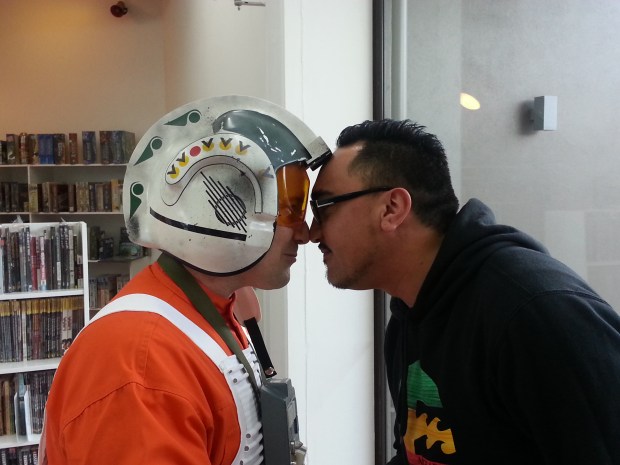
I like finding unexpected connections between the everyday world and the universe of dreams, stories, and fantasy. There’s an image from an event I ran in Auckland which captures this beautifully – a Rebel Alliance pilot from Star Wars greeting a man in a hoodie with a traditional Māori hongi – connecting the here-and-now of New Zealand’s multicultural traditions with Hollywood’s “galaxy far, far away”.
I’m just back from Manila after flitting around Australia and the Philippines for a couple of weeks, running various events for libraries and art galleries. 7 flights in 8 days…that’s more than enough!
Zombies are people too – a survivor tries to escape the zombie hordes in Tullamore with a disguise and some pro-zombie sentiments
On the 10th and 11th of October, Parkes Shire Library ran our biggest and best zombie roleplay event to date, working in collaboration with three local schools, police, firefighters, and student volunteers from Charles Sturt University. We had two days of around 70 people taking part in a 4 1/2 hour unbroken zombie-fighting roleplay with real emergency services. You can see video from the news coverage at the ABC website.
That event was the culmination of about a month’s work creating immersive theatre and learning activities in country libraries; you can find out more under the Finding Library Futures tag at this site. As the zombie dust settled, I spent a week training librarians around the region before flying to Sydney during the bushfires, which give the city a rather unnervingly apocalyptic skyline:
Sydney skyline – image via @peteresho’s Twitter account
Teens make comic book storytelling dice at Manila’s MCAD art museum
The kids were very cool but it was pretty intense work – in fact, just walking down the street was pretty intense! Tho’ I’ve been to bustling cities in Peru and Indonesia, this was another level of wild traffic, wealth disparity, and sheer volume of humanity. Five minute taxi rides generated impressions that will take a long time to process. I felt privileged to be invited to work with the talented staff at MCAD and the youth museum Museo Pambata.
On my last night in the city, I went to a gallery launch but ended up sneaking off with another artist, Leeroy New (designer of a Lady Gaga dress, not the infamous meat one), to see his exhibition Gates of Hell, which I found utterly wonderful:
Leeroy New as Buddha encased in expanding foam
Leeroy’s transgressive, playful, pop-cultural take on the sacred had an impact as soon as you entered the room, yet when you ventured beneath the carapace of oozy foam which encased many of his holy subjects, there was a serious engagement with the numinous and transcendent. Gates of Hell reminded me of one of my favourite novels, Toby Litt’s troubling, surrealist fairytale-for-adults Hospital. With its psychopomps and defiantly rebellious bodies, its unyielding but indefinable laws of magic, It’s one of those flawed yet lingering novels – see this Telegraph review for a decent skewering of the flaws – which, despite it all, I can’t recommend enough.
This slideshow requires JavaScript.
I loved Leeroy’s work for recalling the grotesquerie of Bosch as much as the claymation splurge of the British 1980s cartoon Trap Door. Gates of Hell marked a perfect balance between pop culture and traditional spirituality, those two rival paths towards a world beyond the everyday. No wonder Lady Gaga had Leeroy make wearable art for her.
After escaping the Gates of Hell, I chaired an evening panel on monsters in children’s literature for the New South Wales Writers’ Centre (you can see a great write-up here from panellist Nyssa Harkness) before finally flying home (my 7th flight in 8 days)…
To recover from all that adventure, I spent a long weekend in a darkened room with too many comics and now I’m back in the game. Stay tuned for tomorrow’s big interview/discussion piece on e-books, publishing, and the future of libraries…
In my travels, I’ve met some incredible and inspiring library leaders. Managers and specialists delivering incredible stuff: people like Hamish Curry, the Melbournian library superhero who gets kids making Ned Kelly armour in his library, or Adrienne Hannan in the New Zealand capital Wellington, a children’s and youth specialist whose role outside traditional management structures gives her freedom and flexibility to innovate. But sometimes libraries’ own bureaucracy impedes them: sometimes, even when the media, local communities, and local politicians, too, are supporting libraries’ attempts to be audacious, internal process can be an obstacle. So – here’s three thoughts on a style of leadership which will let libraries be the sword-hand of literacy and the major cultural player they so clearly ought to be in the new Information Age.
1. Library leaders need to be librarians.
Don’t get me wrong; I’m not talking my role out of existence – outsiders to library service have a value in stirring the pot, bringing in new ideas, cross-pollinating between librarianship, education, theatre, creative writing, marketing, etc – but I truly believe that the people at the head of a library organisation need to have walked the floor, stacked the shelves, held their own on a desk shift, and put contact plastic on a few books in their time. Read more →
In part one of this blog series, I took a look at TimeQuest, the citywide programme which I devised for Auckland Libraries’ school holiday programmes – an opportunity to embed storytelling, adventure, and literacy into the life of an entire city.
The TimeQuest team created a simple storyline which all Auckland’s library branches could use as a leaping-off point for their own activities over the holidays. We might have been imposing a half-dozen lines of text, but there’s a real difference between this imposition and the various ‘One Book, One City’ programmes which have gained ground around the world.
I wrote the recent Auckland Libraries school holiday programme TimeQuest as a love letter to the city – a science fiction romance with time-travelling heroes using libraries to save the heritage of New Zealand’s largest conurbation. Creating the activity, I thought about what I might go back in time to save from Auckland Libraries. My experience with both the library system and the city itself was intense, challenging, and ultimately rewarding – but along the journey, there were days where I might not have been sad to see Auckland blown into the time vortex!
Even in those toughest times, I found things to make me cherish the city. Places and people and even items on the library shelves. In one such case, it wasn’t a book, but a song. A song which belongs to pop culture in general, and Auckland in particular: that Australasian underdog which is still only slowly recognising how awesome it is and how much greater it could yet be.
This song, set on Takapuna Beach, alludes to the death of songwriter Don McGlashan’s brother at the age of 15. In it you find pop, melancholy, honesty. It belongs to specifc people, and specific places; it speaks of birthday parties and city politics, but also reaches out to touch something beyond everyday life. In four minutes, it gives me everything I love in a piece of art.
So…if you were on Auckland’s TimeQuest, saving your cultural heritage in the face of apocalypse, what one item would you rescue from your library?
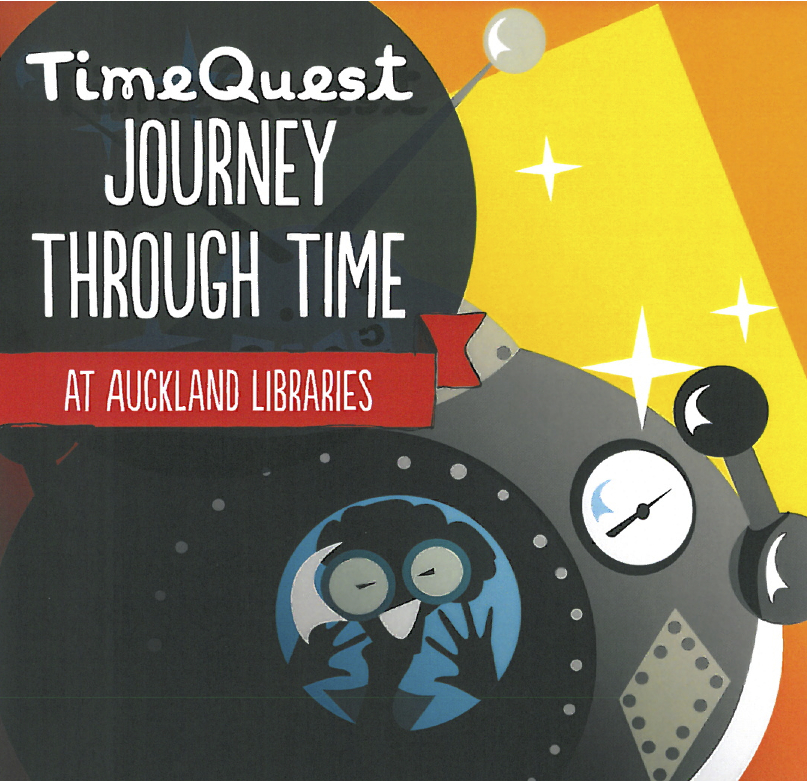
This school holiday season has seen Auckland’s library branches join forces to deliver a programme of activities built around a single citywide storyline, “TimeQuest.” Working with the city’s Service Development advisers Anne Dickson and Danielle Carter, I wrote the short text which frames the whole season:
Auckland, 2379. It’s the end for planet Earth – a red sun burns in the sky and the ground is parched of life.
The last survivors are preparing to leave for a new home on the other side of the galaxy, when the scientist Maia completes her greatest invention – a time portal that can take you to any moment in Auckland’s history.
Her plan: to send you back in time to recover the best books, art, and objects from New Zealand’s past.




 matt finch / mechanical dolphin