Comics in the classroom: the artists’ perspective

As a writer with the shaky draftsmanship of a toddler on Red Bull, I tend to avoid discussing the visual aspect of comic book literature – this despite holding a Ph.D. which looked at the lives of many 20th century art historians!

I really struggled with art in high school. The only recognition a teacher ever showed for my artistic talents was at the age of 13, when I decorated the interior and exterior covers of my maths book with an epic stick-figure comic depicting the escapades of Jimmy Joe the Spew Surfer as he battled his way to a Ramones gig.

At the bottom of that week’s homework, Mr. O’Grady wrote: ‘7/10, some corrections to be made. Please kindly cover over the adventures of Jimmy Joe et al, or purchase a new exercise book.’ He then made me collect litter from the campus after school.

Jessica Abel, self-portrait
Self-portrait from 2007’s Life Sucks, by Jessica Abel

In this blog post, I want to redress the balance and hear artist-educators’ thoughts on using comics in the classroom. From the USA, we’re joined by acclaimed graphic novelist Jessica Abel, co-creator of the Drawing Words, Writing Pictures comics textbook. In London, Kel Winser works with children and young people creating Egyptian-themed superhero comics at the Petrie Museum of Egyptian archaeology, while Australian writer and illustrator Steve Axelsen runs workshops for young people in Western Sydney via the Westwords programme.

Read more

New article at ScienceWise

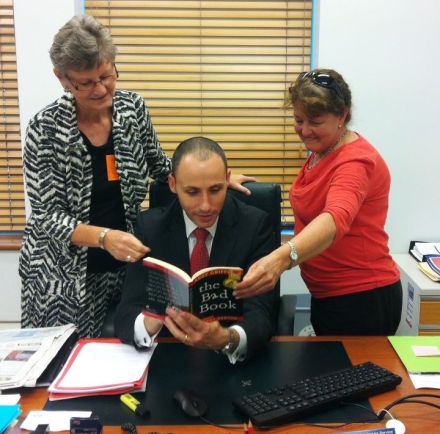
Australian venom expert Dr. Bryan Grieg Fry

My latest article for ScienceWise, on Australian scientists who have tattoos of their own research, appears in print tomorrow, with an online copy visible today – visit the ScienceWise website to read more.

Dr. Bryan Grieg Fry, venom expert at the University of Queensland, is pictured above. He appears in another piece on science tattoos, also coming soon in the Aussie science press.

April update: Science tattoos, teen bloggers, copywriting, and comics

It’s been a little quiet on the blog lately as I ploughed through a swathe of writing assignments and tried (only partly successfully) to stay clear of the Internet.

I have a couple of articles out later this year for the Australian science magazines ScienceWise and Australasian Science, profiling scientists who featured in Carl Zimmer’s book Science Ink. Carl uncovered the weird and wonderful world of researchers who have their work tattooed on their bodies after he spotted a DNA helix inked on the arm of a respected neurobiologist at a pool party in the States. This led to a great book collecting photos of striking, beautiful and downright bizarre science tattoos from around the world.

Read more

NaNoWriMo in New South Wales: Australian Update from the Office of Letters and Light

Stars from Tracy Dawson's NaNoWriMo project in Parkes, Australia

Last year, I ran a number of writing workshops for teenagers in Parkes, New South Wales. I had the privilege of working in a high school with an inspirational teacher librarian, Tracy Dawson. She was willing to let me try unconventional approaches for reluctant writers, like a 6-hour course on “How To Con Your Way to a Million Dollars.”

When I wasn’t light-heartedly promoting the grifter mentality among Australian youth, I encouraged the young writers to sign up for NaNoWriMo, the awesome challenge that sees contestants committing to write a complete first-draft novel in the month of November.

The Office of Letters and Light, organisers of NaNoWriMo, have just interviewed Tracy for their blog:

http://blog.lettersandlight.org/post/18151281043

You can also find Tracy’s recent guest post for my site here.

A drought stricken billabong…or an oasis of cool? News from Australian High School Libraries

This week we have a guest post from Tracy Dawson, teacher librarian at Parkes High School in New South Wales, Australia.

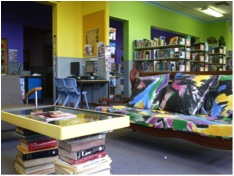
I first visited Tracy’s library last year while working with the literacy scheme Paint the Town REaD. I was impressed by the vibrant, witty and hip vibe of this rural high school library – a real oasis of unconventional thought and inspiration for local teens.

Tracy did heroic work in 2011: she encouraged a group of teen writers to participate in NaNoWriMo’s Young Writers Program. In that program, young people commit to writing a long piece of fiction in the month of November. Parkes lacks a tradition of writing and writer’s groups, so Tracy’s success in shepherding four of her students through to completing the challenge is exceptional – especially as November is exam season for Aussie teens! See media coverage of Tracy’s young NaNoWriMo participants here.

Now over to Tracy:

Parkes High School LibraryI’ve taught English here at the same Australian state high school for seventeen years and was so passionate about my subject; I never imagined I would change focus.

But a period of time in which I became disillusioned with the education system and society’s attitude to education in general made me rethink my career, and retrain as a Teacher Librarian. I’ve ended up in the same school – the same school I attended as a teenager! – which some people would say is like being stuck in a drought stricken billabong. But a move up the stairs and out of the classroom has invigorated me, my relationship with colleagues and students, my love of literature and my belief that teachers make a difference.

Read more

Australian National Year of Reading launches with Paint the Town REaD

Barbie Bates and Rhonda Brain of Paint the Town REaD visit David Bradbury MP in Canberra
Paint the Town REaD comes to Canberra - Barbie Bates & Rhonda Brain visit David Bradbury MP

Australia’s National Year of Reading 2012 was launched today, 14 February, in the capital city, Canberra.

My colleagues Barbie and Rhonda of Paint the Town REaD were on hand to celebrate the launch with David Bradbury, MP for Penrith.

Read more

Diane Wolkstein – Storytelling across cultures from Australia to NYC

Is the universe made of stories? Human beings can’t keep from telling tales, or listening to them – whether it’s creation myths or the “grand narratives” of science and politics, flights of fantasy or just an answer to the question, “So what did you do today?”

For more than four decades, one woman has sustained the tradition of oral storytelling in the heart of Manhattan. In 1968, Diane Wolkstein began an official role with New York’s Department of Parks and Recreation which has brought stories from around the world to life through her passion and craft.

Diane Wolkstein

Diane caught up with me recently to discuss her career, the challenges of drawing on stories from other cultures, and the business of telling tales in the modern metropolis.

Read more

We Don’t Know How Lucky We Are: Community Outreach and Australia’s Mining Boom

“We think we are the lucky country, but what we really have is…too much luck, more luck than we know what to do with.”

-Paul Cleary

The first thing an overseas visitor notices on arriving in Australia today is the relative prosperity which its citizens enjoy. While the British government preaches austerity and American protestors Occupy Wall Street in response to the global financial crisis, the café culture on Sydney’s sidewalks bears testament to the boom Australians are currently experiencing. Though Manhattan itself now struggles to fill its shopfronts, even Australia’s smallest service businesses seem to thrive despite the GFC.

Much of the current boom can be ascribed to Australia’s mining sector, which plays a vital part in national life. Whole towns exist to service the resource industry and mines, as major employers and resource users, bear a substantial community responsibility.

Read more

Guest Post: Lee Castledine on Storytelling for Young Children, Part 2

Today on Books and Adventures, we have the second part of a guest post by Lee Castledine, the Australian storyteller, youth librarian and secretary of the Australian Storytelling Guild.

You can find the first part of this post on Storytelling for Young Children using Props and Audience Participation here.

Props aren’t suitable for all stories and shouldn’t be used to prop up a bad story!  It is important to choose simple props that enhance the telling.  Don’t overwhelm the story by trying to use too many props or props that are difficult to manoeuvre, as they can distract the audience’s attention from the story.  Once you choose your props, it is important to practise using them until you are comfortable handling them without constantly looking at what your hands are doing.  Remember, it is vital to maintain eye contact with your audience.  Props can help a storyteller to remember the sequence of the story, but if you become distracted with handling the props, you can lose your audience.

Many storytellers are of the opinion that the use of books in storytelling isn’t true storytelling.  I agree somewhat, as there is considerable difference between story reading and the art of story telling.  But to me, and to many other children’s librarians, a picture book can either be read to an audience, or it can be used as a visual prop for the audience.  If a storyteller knows the book well, they don’t read it, they tell it, whilst showing the pictures to the audience to invite audience participation at certain parts of the story.

Read more

Guest Post: Lee Castledine on Storytelling for Young Children, Part 1

Today on Books and Adventures, we’re joined by Lee Castledine, an Australian storyteller, youth librarian and secretary of the Australian Storytelling Guild.

I was lucky enough to see Lee’s workshop on storytelling with young children at the Annual Paint the Town REaD Convention this month. Lee demonstrated her accomplishments as a performer, educator and storytelling maven, and today, Saturday 17th September, I’ll be venturing over to the New South Wales Writers’ Centre to see a Storytelling Workshop Day organised by Lee. Therefore I’m very pleased to present a timely guest post from her on Storytelling for Young Children using Props and Audience Participation.

A candle, a book, an apron, a string, a puppet, a piece of paper….Props used in storytelling for young children can be anything the storyteller can think of, that enhances the story.  Some props are useful for encouraging audience participation, and manipulation props enchant the audience.  Not all stories need a prop – sometimes actions are the prop.

Read more