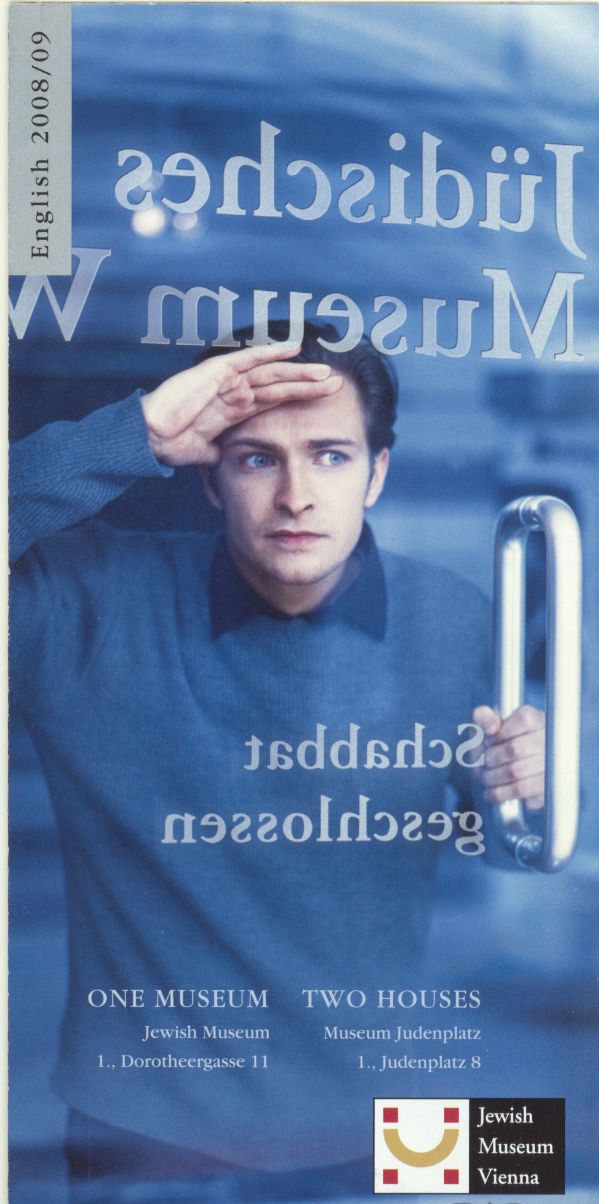
I think this might be the greatest museum ad of all time – it’s from the 2008-2009 season at the Jewish Museum in Vienna, a superlative institution which I’ve written about before.
Rather than present Austria’s Jewish community or Jewish material culture as the object of mainstream scrutiny or fascination, it focusses on the sense of wonder and discovery that visitors to the museum will experience.
I love that a minority identity within a nation, especially one with as fraught a history as that of Austrian Jews, refused to be exoticised or presented as ‘the Other’ in the museum space, and instead turned the tables on the Austrian mainstream with this neat image.
The museum has a great record as an institution which treats a rich, harrowing, and difficult history with verve, courage, and creativity. This includes the work of their marketing team as well as their excellent curation and events.
The 2008-9 ad demonstrates how the ways in which an institution markets itself to the world can be as sophisticated, political, and compelling as anything done with that institution’s spaces, services, or collections.
Check out the Jewish Museum Vienna, one of the greatest cultural institutions I’ve ever visited, online: http://www.jmw.at/en
Thanks to the archive team at the Jewish Museum for locating the image based on my vague memories of seeing this ad a decade ago…
Next month, I’ll be joining European library luminaries like Spain’s Ana Ordás, the Netherlands’ Jeroen de Boer, and representatives of Denmark’s Dokk1, to help reimagine the future of Portugal’s public libraries.
The municipalities of Albergaria-a-Velha and Ilhavo are hosting an international event focussed on games & makerspaces in the public library, with a range of workshops, presentations, round tables, and lectures to stimulate curiosity and help librarians to start building the public library service of the future.
Imagine a place on your average street corner: ordinary on the outside but bigger within, and ready to take you anywhere you could imagine – or a few places beyond even that. Sounds like science fiction? Well yes, and no…. I’ve spent the last few months talking with librarians finding new ways to frame the mission of the library in the 21st century. This video, and the text below, is the result.
When I was a kid, I was a massive fan of this British TV show called Doctor Who.
It featured a mysterious figure, the Doctor, who could travel anywhere in time and space.
The Doctor would take ordinary people on adventures beyond their wildest imagining in a machine called the TARDIS.
On the outside, the TARDIS looked just like a blue telephone box – but inside it was impossibly huge, perhaps even infinite. It could take you anywhere you wanted to go, and even places you didn’t intend. The past. The future. Distant worlds and parallel dimensions. Even the Land of Fiction.
I especially remember the last Doctor Who show of my childhood – it came out in 1989. The Doctor and his companion battled creatures who were marauding the streets of Perivale in suburban London. It was amazing and intense, because it wasn’t set on a far-off world. The adventure took place on an ordinary street with people washing their cars and going to the grocery store and living their everyday lives.
The show made you feel like the TARDIS might be on your streetcorner: ordinary on the outside but bigger within, and ready to take you anywhere you could imagine – or a few places beyond even that.
Best feeling ever.
That’s what libraries are to me. They are the TARDIS on your streetcorner: a magical place, maybe a little ordinary on the outside, which can take you anywhere in the universe of information, knowledge, and culture. Facts and fiction, maps and make-believe, movies and comics and even information about what day the city collects your bins, all jostling alongside one another, tended by the librarian.
You don’t have to have watched British children’s TV to get it: a library can take you anywhere you want to go in the universe of information, knowledge, and culture.
If you were going to write out a library’s mission, you might put it like this:
A library empowers communities to explore information, knowledge, and culture on their own terms.
And if I were trying to say the same thing to a 9-year-old? I’d put it like this:
A library lets people find stuff out for themselves.
Once you start looking at libraries that way, a lot of things about them become very simple.
Walls, books, and physical things
The library might be a physical building with walls and a roof, or it might not. A librarian could carry out that mission of empowerment in the streets, or another building, or on the back of a bus. A librarian could be embedded in a team, group, or organisation to support their goals. A great librarian could be parachuted into a community they didn’t even know, with nothing more than the clothes on their back, and they’d find ways to address that mission of empowerment and exploration.
The library might have books, it might not; it might offer experiences or workshops or digital services, it might not. Exploration of information, knowledge, and culture doesn’t just mean reading, viewing, or learning; it can mean making, experimenting, performing.
Finding stuff out for yourself isn’t always like checking the weather forecast or looking up the capital of Peru. Sometimes discovery is an act of creation. Think of a sculptor, pondering the stone before them, trying to find the sculpture within: “I saw an angel in the marble and carved until I set them free.”
Your community might want or need maker technology, Internet access, loanable tools and hardware, art supplies, an in-library recording studio. There are many ways to fulfil libraries’ mission and the medium is not specified.
A great librarian could address their mission and serve their community whether they had a library with vast collections, or nothing more than a smartphone in their hand.
That’s not an excuse to leave the librarian standing on a streetcorner with nothing but a smartphone — the institution will always need funding and resources sufficient to meet the community’s information needs — but rather to say that no one medium, no one gadget, no one physical object is necessary for a library to be great. People are libraries’ greatest resource.
Who is this library for anyway?
The library might serve a specific community such as students and staff at a college, or medics and health workers at a hospital. It might only serve registered users with library cards, or it might serve anyone who visits it. The mission can encompass tiny specialist libraries or wide-open public institutions.
Whatever kind of library it is, there’ll almost certainly be debate about the definition of its community, and what service is owed. Should non-students be able to use the college library? Does the hospital library need to serve patients too? In the public library, what welcome and support should be given to homeless people? To drug users? To new migrants, or people who don’t speak the majority language?
Questions of inclusion and exclusion will challenge any library, and must be wrestled with by staff, stakeholders, and the wider community. The voices of public librarians, who serve the broadest communities with the most diverse information needs, should be at the forefront of this debate across the profession.
“Exploring all information, knowledge, and culture on the community’s own terms” is a pretty lofty goal. Libraries must recognise that their services are inevitably built on imperfect systems and policies, riven with histories of power and prejudice which must also be addressed.
“On the community’s own terms” means also recognising libraries as institutions in need of decolonisation, institutions which may have histories of complicity in abuse and exclusion.
It means respecting Indigenous traditions of knowledge management, and understanding that some forms of cultural knowledge are not to be shared by all.
Great librarians recognise that for the community to have equity in exploring knowledge, information and culture, they will have to make extra effort to help some groups and curb the acts of some users if they impede the goal of access for all. They recognise that the negotiation of inclusion, exclusion, equity, and justice is dynamic, local, and held in dialogue with peers, stakeholders, and the community they serve.
What’s more, great libraries recognise that they require a diverse workforce. Information, knowledge, and culture are things which are lived, felt, and experienced by all of humanity. The wider the range of experiences and identities represented by the library staff, the better understanding they will have of the diversity of human information, knowledge, and culture, and the more ways they will have of relating to the communities they serve.
Not teachers, not preachers
Empowering communities to explore on their own terms means getting out of the way of those communities’ explorations whenever possible.
Libraries are places for surprise and discovery, not predetermined outcomes. Even when engaged in an unserendipitous act like seeking an item from a college reading list, or revisiting a book read once before, a reader has the capacity to surprise themselves and others: they are seeking something which they do not know or fully recall.
Serendipity is less magical than it sounds – it occurs within systems built on the largely unseen labour and tacit values of people who acquire, catalogue, and maintain the collections. Yet there is still wonder to be found in browsing. You can always stumble on something new in a library, or come up with a new idea based on what you discovered there.
Great librarians are not teachers or preachers, inflicting lesson plans, assessments, doctrines, and dogmas on those they serve – they avoid the instructional paradigm wherever possible, surrendering command and control to the user if they can.
The exception to this is when an aspiring explorer of information, knowledge, and culture requires instruction in exploration techniques. That might mean kids learning how to use an animation app, a lawyer learning how to search a new legal resource, or a senior citizen getting help with their new iPad. Sometimes, before you dive into an ocean of knowledge, someone needs to teach you how the scuba gear works and check you out on it before you depart.
Librarians may devise learning opportunities to help the explorers they serve – approaching the territory of the teacher via the middle ground of educational design – but they are distinct from teachers, and that distinction lies in the power dynamic between the librarian and the learner.
Librarians are proactive
None of the above means that library workers are passive. Great librarians venture out into their community and collect new material to reflect the changing times. They are as interested in popular culture and marginal forms of knowledge as they are official or esteemed items. They stay abreast of how society is interacting with information, and reflect on what that means for their own work.
Great libraries devise new opportunities to celebrate, provoke, challenge, and pique the curiosity of their community. They acquire, preserve, and develop collections to serve their communities’ needs; they negotiate with peer institutions and publishers for access to more information; they devise systems and procedures to share their collections and borrow from others as needed.
And great librarians are not separate from the communities they serve: they, too, are library users who freely explore the oceans of information, knowledge, and culture as they work
The one big question
Everything a library does should be assessed against the question:
How does this empower the communities we serve to explore information, knowledge, and culture on their own terms?
This question should inform every act, large and small. It should be the command intent of your library’s every single action, project, programme and policy.
It should be the question burning in the hearts of the security guard, janitor, board members, and volunteers too.
Try putting it in the language of a 9-year-old:
How is this helping people to find stuff out for themselves?
If what you are doing is not serving that wider intent, it’s time to stop and change.
It’s time to become that magic place, ordinary on the outside, which can take your community anywhere in the universe of information, knowledge, and culture.
Thanks to everyone who discussed “Anywhere in the universe” with me in its earlier drafts. Their inspiration, criticism, and feedback – including some lively disagreement – was vital. Of course, responsibility for anything you don’t like in the final text rests with me, not them!
I’ll be at next month’s Bibliothekskongress in Leipzig, a gathering of German-speaking librarians and information professionals. If you’re attending, come say hello and talk Library Island – or catch me online.
Ändern sich Bibliotheken zu schnell oder nicht schnell genug?
Was bieten wir einer Welt, die sich schnell und radikal zu verändern scheint?
Wie sieht gute Führung in der Bibliothek des 21. Jahrhunderts aus?
Library Island simuliert fünf Jahre im Leben von Bibliotheken in einem kleinen Land. Die Spieler übernehmen die Rolle von Bibliothekaren, Regierungs- und Gemeindemitgliedern.
Die Spieler verhandeln politische Konflikte und soziale Herausforderungen (oder sogar Naturkatastrophen!) und passen das Spiel dann an ihre eigenen lokalen Probleme.
Es ist ein einfaches Spiel, das nur mit Papier und Stiften gespielt wird, aber es ermöglicht den Spielern, komplexe Szenarien und unbequeme Themen zu besprechen.
Ich habe Library Island entwickelt, um Organisationen zu unterstützen, ihre Vision und Mission für die Zukunft zu definieren und umzusetzen. Library Island schafft Raum für die Erkundung einer ungewissen oder schwierigen Zukunft und hilft Mitarbeitern, Führungskräften und Trägern einen strategischen Standpunkt zu entwickeln.
Man kann Library Island als eigenständigen Workshop oder als Teil eines umfassenderen strategischen Prozesses nutzen. Es ist spielerisch, belebend, zum Nachdenken anregend und macht sogar Spaß!
I’m pleased to announce I’ll be joining the team at Oxford University’s Saïd Business School (SBS) as a facilitator on the upcoming Oxford Scenarios Programme.
‘Dreaming Spires’, by Flickr User JJBullock – Copyright JJ Bullock 2010
It’s been a while since the last #NotEnoughSciFi, an occasional series looking at works of science fiction and fantasy which I think might be useful for organisations, institutions, companies, and communities which are trying to get ready for the shape of things to come. See previous entries here.
I had a glorious time with a book last week. Something that hadn’t happened since I was a kid.
I was busy at work and didn’t have much time for leisure reading. So when I started Ian Tregillis‘ novel The Mechanical, I only expected to manage a half-hour or so a night before falling asleep.
Instead, I stayed up through the night to finish the book. The next evening, I started the second volume of the trilogy which The Mechanical begins. On the third night, bleary but compelled, I finished Tregillis’ series. I spent my nights lost in his world. It was heaven on earth.
The series – called The Alchemy Wars trilogy – is a work of fantasy, not science fiction. It is set in an alternate version of the year 1926 which owes as much to the 17th century as the 20th, where the Dutch and French are the warring European powers whose conflict has shaped global history.
So why does it have anything to teach us in 2019? Read more →
I talked about the Library Island activity, which helps people and organisations to build strategic awareness and think differently about the communities they serve, with Chris DeCristofaro of the Library Pros podcast. Watch the video here, or on YouTube.
American podcasters Chris DeCristofaro and Robert Johnson invited me to join them for a discussion on their show The Library Pros, exploring issues of interest to librarians and information professionals around the world.
Chris and Bob did an excellent job taking us through a discussion of libraries’ strategy, mission, and community service, with a few laughs along the way. It’s one of the best conversations I’ve had on these topics in the past year.
Murder. Mayhem. Family strife. Gateways to other worlds. Stories that the audience shapes, and that might run for months or even years.
In a corner of Michigan, one library worker and her colleagues are bringing all these things to life.
I first met Audrey Huggett in 2017, while working with Ann Arbor District Library on the Wondrous Strange event. Library technician Audrey has led a series of projects where members of the public participate in live-action storytelling, ranging from murder mystery to an epic fantasy with cosmic stakes.
Audrey joined me to talk about her work in interactive storytelling in January 2019, just as she was completing preparations for the upcoming “In Between: Quest for the Keystone”.Read more →
Riitta focusses on the playful and collaborative aspects of the activity. Library Island allows people to jointly approach difficult issues in a safely fictional setting, before taking the lessons learned back into the real world, where they may be applied to achieve practical goals.


 matt finch / mechanical dolphin