I was the guest reader at this month’s QUT Literary Salon at the Queensland University of Technology. The theme of the night was “Upside Down”.
You can hear my piece, “Going Under”, on YouTube.
I was the guest reader at this month’s QUT Literary Salon at the Queensland University of Technology. The theme of the night was “Upside Down”.
You can hear my piece, “Going Under”, on YouTube.
Jane Cowell, who hired me as Creative in Residence at the State Library of Queensland 2016-2017, has five reasons why your organisation should create such a role over at her Medium account.
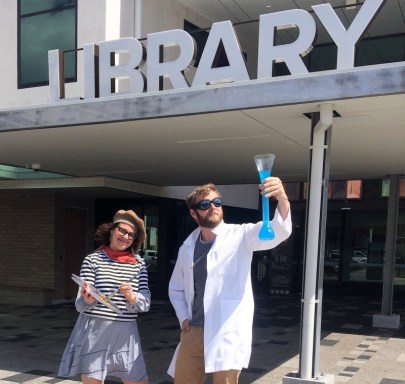
In turn, I wanted to share five tips for people who might want to take on a role like mine.
1. Be passionate
Your job is to make good use of the unexplored gaps in an institution’s existing procedures; to be opportunistic, inventive, and positive about the merits of innovation. Like a catalyst in chemistry, your presence reduces the energy required for new reactions to happen. Your passion for the role and personal commitment to constructively challenge the status quo will play a large part in determining your ultimate success.

Human Library at State Library of Queensland
That might mean midnight phone calls across timezones to pick Canadians’ brains about Human Library projects; or driving a State Library web team to devise, develop, and then share the code behind an online comic maker. Caring enough to go that extra mile is a huge part of this role.
2. It’s not about you
I always remind my clients that your pay grade doesn’t determine how creative you are; it just reflects your responsibilities. Great ideas can come from anywhere in an organisation and we need a diversity of perspectives, from client-facing staff to policymakers, ancillary workers, and digital specialists, when we help our organisation respond to changing circumstances. A Creative-in-Residence role is also about paying attention, brokering partnerships, and supporting others in putting forward proposals like the FaceSwap Lab pitched by a State Library project officer.
I always made a point of spending time with as many different work units as possible in the State Library. I wanted to hear new ideas, spot potential innovators, understand both the organisation’s pressure points and also its areas of opportunity. I also put in the hard yards serving others, spending time on the set-up and pack-down for events both on- and off-site, or supporting project officers with some of their routine duties.
I spent one of my first weekends in Brisbane setting up and demounting gazebos for a partnership event involving our Indigenous team kuril dhagun and Brisbane’s rugby league stars, the Broncos. It was invaluable in getting to know the team, seeing exactly what services we offered, and showing that I wasn’t just going to waft around in a cushy role making others do the onerous stuff.
3. Be tenacious
Change is rarely straightforward, and bureaucracies aren’t always comfortable with creative or messy pursuits – yet a degree of messiness is necessary if we’re to avoid merely repeating the outcomes of the past. Institutions often seek out my skills because they have discovered the path to change is rarely smooth. As an outsider, you will face people who say, “But we’ve always done things this way” and “What’s the point of playing about with the status quo?” Their concerns need to be listened to and respected, but you must also be tenacious enough to serve as a role model when the going gets tough and the process of change starts to bite.
Remember, too, that some teams will already regard themselves as innovators or even feel that it is impossible to improve on their existing offer. They may not welcome the attention of a critical friend. Again, patient listening reaps enormous rewards. Common ground almost always exists: don’t give up on the quest to find it. Initiatives like the multi-team task forces established by State Library’s CEO Vicki McDonald in 2017 helped with this, encouraging staff members from across work units to collaborate for a specific strategic goal.
4. Allow yourself to be surprised
Given that your job is to serve the organisation, the best ideas and collaborations could come from anywhere – see point two above. One of the most satisfying parts of this role is the element of surprise.

Australian TV icon Bernard King
When I joined the State Library of Queensland, I’d rarely worked with archivists or conservators. I figured they’d be timid souls, fond of procedure and loath to change or respond nimbly to events. Yet when I located the forgotten final interviews of gay Australian celebrity Bernard King, not only did our Queensland Memory team move swiftly to acquire them from their owner in Sydney, they also agreed to fast-track the process as a gesture of LGBTQ solidarity in the wake of the 2016 Orlando shooting.
Their conservator colleagues, whose job is to look after our physical collections, also proved to be more playful than I had expected: they are scientifically minded problem solvers with a stronger future focus than almost any other division, always mindful of how later generations will encounter the objects in their charge. They were also keen to share their expertise through public engagement events like Fun Palaces. Working with these teams proved to be an unexpected delight during my residency.
5. Tell stories
Stories turn data into something we can relate to. Stories underpin the mission and vision statements which steer an organisation, and they also help individual work units to align with that overarching vision. Stories give human context to managerial edicts and they help management to understand the concerns and experiences of staff, users, and stakeholders. As case studies, stories help others to see what is possible; but better still, when you let people tell their own stories through role-play activities like Library Island, fabulous new ideas are brought to light.
Ultimately, what makes a Creative-in-Residence role different from an Artist-in-Residence or Writer-in-Residence is that your creative work focusses on the empowerment of the institution itself; you achieve this by listening closely to all its parts, and then helping that organisation to re-tell the story of what it does in ways which make a lasting practical impact.
Who can be a Creative-in-Residence?
Creatives in this role can be drawn from the ranks of your own staff, or brought in as outsiders – both options have their benefits and drawbacks. Residencies can be long, like mine – initially twelve months, then extended twice – or they can be short “tours of duty”. I’d love to see people experiment with these short stints as a way of bringing regional and marginal voices into the heart of major institutions.
In this role, you’ll work harder than you ever thought possible, catalysing change with little more than your wits, a phone, a computer, and a desk. But you’ll also be free: free to innovate, experiment, explore, inspire, and genuinely make a difference to the lasting business of change. It’s a lot of fun. You should give it a go.
Jane Cowell of State Library of Queensland has not one, but five answers for you over at Medium.
Jane hired me back in January 2016 for a residency intended to develop staff, challenge convention, engage the wider community, and showcase the organisation’s creative practice. Now, more than a year later, we’re looking back on a successful stint embracing libraries, communities, and partner organisations across Australia’s Sunshine State.
Read more about creative residencies over at Jane Cowell’s Medium account.
In my final week with the State Library of Queensland, I managed to squeeze in a short discussion about what digital technologies might mean for communities in rural and regional Australia.
I spoke with Donna Hancox of Queensland University of Technology and Tyler Wellensiek, who works on coding & robotics initiatives for the State Library of Queensland.
Check it out:
During my time in Brisbane, I’ve been working with the School of Allied Health at Griffith University to push the boundaries of what’s possible when training occupational therapists.
We’ve used play, storytelling, and even delicious cake to explore the skills and values of therapists in both real and imagined community settings.
You can read about these collaborations over at Library as Incubator, in my piece “The Gentle Art of World Domination“.
What is the professional benefit of play? When is it better to impose an objective, and when should we learn through experimentation and happy accident? How can we “fail better” without wasting valuable resources?
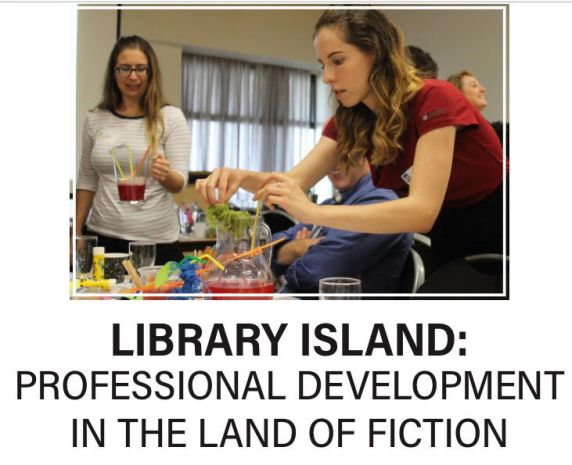
In this month’s Library Life magazine, I explore these questions through an account of the Library Island project I’ve been developing during my time at the State Library of Queensland.
Could it be that our next innovation challenge is to break down the walls between fact and fiction? Could story-based, open-ended play be as valuable for professionals as for children? Could it be physical, low-tech, and improvisational as well as digital?
You can read Library Life April 2017 here as a PDF download – my piece starts on page 12.
This is an addendum to my recent week exploring science fiction and fantasy that might help your community or organisation think about the future.
Sometimes these wayward dreams take the form of a caveat.
Blindsight, by Peter Watts, is a creepy and troubling space opera which follows a team of explorers dispatched to investigate an alien craft in the year 2082.

Watts shows us a post-scarcity Earth which is suddenly threatened by vastly superior technology; he sends us out into space with a group of weird souls who have been granted talents which estrange them from humanity; and then, far from home, he forces them into a confrontation with creatures that are smarter and more adaptable than we.
Watts is known for dark explorations of the posthuman future, and for giving his stories endings which offer little reassurance, but Blindsight merits special mention for the way in which it leaves you doubting the value of all we hold dear in the human condition.
I came across Watts’ book after reading Steven Shaviro’s Discognition, a book which aims to conduct philosophy through the exploration of science fiction. At one point, Shaviro writes:
…the nonhuman entities with which we share the world – including, but not limited to, our tools – are active in their own right. They have their own powers, interests, and points of view. And if we engineer them, in various ways, they “engineer” us as well, nudging us to adapt to their demands. Automobiles, computers, and kidney dialysis machines were made to serve particular human needs; but in turn, they also induce human habits and behaviours to change. Nonhuman things must therefore be seen as…active agents with their own intentions and goals, and which affect one another, as well as affecting us…
Shaviro’s argument that we must begin to understand our behaviours and attitudes through the viewpoint of nonhuman actors – not just everyday tools but the robot, the alien, the artificial intelligence, the monster – is something I’ve also seen explored in the art education practice of Sean Justice and even the way farmers relate to their self-driving machines in the 21st century. We tried to capture some of these relationships in the State Library of Queensland’s Ozofarm Initiative, which invited local communities to devise their own sci-fi farming scenarios using small robots.
That’s a worthy goal with clear benefits for our digital future, but I don’t want to stray too far from Watts’ bleak vision. His book isn’t a Luddite take on our future, it’s a cool-headed refusal to bet on humanity’s own heroism.
Not only does Watts neatly sketch the potential for human conflict even in a world where our material and energy needs have been met, but Blindsight does a great job of challenging our faith in precisely the capacities for imagination and awareness which allow him to write such a compelling novel.
So anytime you need your hope for the future tempered with a healthy dose of scepticism, this thoughtful reality check is the book for you.
Sometimes three sentences are a good day’s work.
I’ve been helping library leaders to refine an elevator pitch for the work State Library of Queensland does with public libraries.
RAPL, the Regional Access and Public Libraries team, has a range of duties – from administering grants to delivering professional development, fostering peer-to-peer networking, and setting industry standards. RAPL staff also promote literacy and wellbeing for children under five years old, support the digital skills of senior citizens, and advocate to local government on libraries’ behalf.
How do we condense that into something that is clear, elegant, brief, and compelling?
Well, here’s what we came up with:
Our scope, our goal, our offer:
Queensland has over 300 public libraries and Indigenous Knowledge Centres in communities from the desert to the reefs, from the mountains to the Torres Strait.
Together with local government, we ensure all Queenslanders have access to great public libraries that help communities thrive.
We advocate for public libraries, support their collections, their staff, and their programmes, and we share their successes.
Does your organisation need help telling the story of what you’re about? What you’re doing? What you have to offer? Do you want to change that story for the better?
I have extensive experience in working with institutions and communities, identifying their accomplishments, their goals, their current ways of working – and then helping them to find new, effective approaches. I listen and observe, then work with you to plan and execute the changes we have agreed on.
I help people and organisations – from publishers and media productions to healthcare providers and state bodies – to create new programmes and partnerships.
Would you like to strengthen your digital and physical offers? Your strategic vision? Or the way you explain to outsiders your history and mission?
Could your organisation benefit from professional development sessions that are unique, playful, and effective?
By listening to staff, clients, and stakeholders, I spot opportunities to make a difference and tell stories which help to shape and sustain innovation.
For the remainder of 2017, I’ll be working on community engagement with the University of Southern Queensland, after an extended stint as Creative-in-Residence at the State Library of Queensland.
You can read more at www.mechanicaldolphin.com/about – which gives you an outline of what I can do for you.
Take a look, and drop me a line if you’d like to work with me next year.
 matt finch / mechanical dolphin