I joined Kirsten Wyatt of the US Emerging Local Government Leaders’ GovLove podcast to talk about scenarios, strategy, foresight, play and the power of drawing.

You can catch our full conversation over at the ELGL website.
I joined Kirsten Wyatt of the US Emerging Local Government Leaders’ GovLove podcast to talk about scenarios, strategy, foresight, play and the power of drawing.
You can catch our full conversation over at the ELGL website.
It’s summer in the northern hemisphere, and that means holiday season for many of us.
I’m a pretty voracious reader at any time of year, but I squeeze in one or two extra books when the days run longer and vacations slow the pace of people’s work emails. And a trip to the movies takes you out of the heat and out of your head, with an air-conditioned spell in the world of someone else’s projected dream.

My summer recommendations are two very different works of art about New York, one old and one new, both offering prisms through which to look at how we live together today. Read more
Got a pen, paper, and fifteen minutes to think about the future?
The second short video in my series “Yoga for Futurists” offers some quick questions and prompts to help drive informal coffee-break conversations around strategic decision-making.
#NotEnoughSciFi is an occasional series looking at works of science fiction and fantasy which I think might be useful for organisations, institutions, companies and communities which are trying to get ready for the shape of things to come. See previous entries here.
I stumbled on an essay by the late science fiction writer Ray Bradbury recently. It covers science fiction literature and the business of problem-solving, so of course it was right up my alley. You can find the 1980 piece, “Dusk in the Robot Museums”, collected in Bradbury’s Zen in the Art of Writing – and there’s a copy of the text online right here.

Bradbury, writing in 1980, imagines a museum of the future, whose exhibits are all animatronic robots of historical figures. A boy sits with the robot analogues of Plato, Euripedes, and Socrates; they end up talking about how science fiction, a neglected genre, found favour among the teachers and librarians of the USA, “the country of Ideas on the March.”
Bradbury draws connections between science fiction and fantasy, practical problem-solving, and the history of ideas which are still useful to us in 2019. Let’s check them out together.
“Where have we been?” the librarians and the teachers asked each other […] “What’s in these books that makes them as irresistible as Cracker Jack?”
The History of Ideas.
Bradbury reminds us that “the first science-fiction writers were cavemen who were trying to figure out the first sciences — which were what? How to capture fire. What to do about that lout of a mammoth hanging around outside the cave. How to play dentist to the sabre-tooth tiger and turn him into a house-cat.”
Pondering those problems and possible sciences, the first cavemen and women drew science-fiction dreams on the cave walls. Scribbles in soot blueprinting possible strategies. Illustrations of mammoths, tigers, fires: how to solve? How to turn science fiction (problem solving) into science fact (problem solved).
My work also focuses on the business of plausible futures: the problems that may await us and the potential solutions we may figure out through play, storytelling, and discussion.
 Canadian information professionals construct future scenarios
In Toronto last month, information professionals from across Ontario created and explored plausible future scenarios ten years from the present. These scenarios were characterised by extremes of scarcity and abundance, political strife from foreign or domestic sources, and technological changes. Imagined future settings allowed participants to examine their assumptions, explore their strategic blindspots, and stress-test their plans for the future.
In other events around the world, we’ve blended science fiction, strategy, and design thinking to explore the future of professions like occupational therapy, communities like the city of Ann Arbor, and technologies as taken-for-granted as the written word itself.
As Bradbury puts it,
Everywhere we look: problems. Everywhere we further deeply look: solutions. […] That Truth again: the History of Ideas, which is all that science fiction has ever been. Ideas birthing themselves into fact, dying, only to reinvent new dreams and ideas to be reborn in yet more fascinating shapes and forms, some of them permanent, all of them promising survival.
Though his essay is nigh-on forty years old, it, too, is worthy of revival and reinvention: a reminder that we must turn to the place where people dream wildly about a changed world, about futures they can only speculate about, in order to train our imaginations on the problems of our time.
Hence #NotEnoughSciFi: turning to the literature of the fantastic to think about asking the right strategic questions, free will and machines’ autonomy, or the self-awareness of artificial intelligence, feigned or otherwise.
Bradbury’s essay also has a wise word for those of us concerned about the mix of propaganda, misinformation, and confused information-seeking which some label as “fake news”.
Bradbury writes:
Among librarians and teachers there was then, and there still somewhat dimly persists, an idea, a notion, a concept that only Fact should be eaten with your Wheaties. Fantasy? That’s for the Fire Birds. Fantasy, even when it takes science-fictional forms, which it often does, is dangerous. It is escapist. It is day-dreaming. It has nothing to do with the world and the world’s problems.
Today, once more, some people think that singular, solid facts will dispel the evil cloud which they perceive around popular understandings of political issues, from climate change to the anti-vaccination movement.
This is despite the suggestion that greater curiosity about evidence, rather than greater faith in “truthful” institutions, may be the necessary remedy.
Researchers like Australia’s Kate Davis are exploring the ways in which an empathetic, non-judgmental approach to people’s information experiences may be more useful to informed public decision making than an insistence on opposing the “true” and the “fake”.
The relationship between philosopher Harry Frankfurt’s notion of “bull” (a collapsed distinction between truth and lies) and more “nutritious” information experiences is also useful here.
Science fiction may not be factual or “true” in that sense, but it can still be nutritious: inspiring, provocative, encouraging of those who wish to solve problems and change the world for the better.
In the same way, we should not cleave too rigidly to belief in a single and authoritative Truth, but rather foster principles of critical thinking, diversity, and problem-solving. “Fake news” will not be dispelled by deeper faith in a singular truth, but by robust criticism and a refusal of political deceit.
The collection which includes Bradbury’s essay is called Zen in the Art of Writing: it emphasises the joy and zest which Bradbury experienced by understanding, and acting on, his own essential nature as a writer.
Zen also makes an appearance in the academic literature of scenario planning: in 2011’s “Feral futures: Zen and aesthetics“, Rafael Ramirez and Jerome Ravetz explore the ways in which an informal understanding of the Zen approach may benefit strategic thinkers.
The authors focus on “feral” situations, in which ill-informed attempts to address a situation exacerbate its problems. Futures which were once thought to be predictable then prove otherwise, as human actions weaken or undermine underlying systems; Ramirez and Ravetz give the Deepwater Horizon blowout and the Sub-Prime Crisis as examples.
When attempts to predict and control the future by conventional means fail, scenario planners offer an approach akin to Zen practice: mindful attention to the present situation, surrender of habitual thinking and assumptions, challenges to received wisdom and the taken-for-granted.
Ramirez and Ravetz write that “forcing people to work through a scenario that […] experienced managers consider implausible or threatening, does indeed challenge their common sense”, but in doing so “scenarios could help people bypass the defences whereby early warnings are rejected or even kept out of consciousness.”
Bradbury’s science-fiction-as-problem-solving offers a similar approach to the future, which is, after all, unknowable and impossible to gather data or evidence from.
In place of extrapolating on the basis of our assumptions, it dares us to dream more wildly.
Instead of looking at our situation through habitual lenses, it encourages us to reframe our perception of the world to come.
It encourages us to meditate on our essential nature – who are we? what do we do? what difference are we trying to make in the world? – and then challenge our responses by posing new premises on which to act in the future.
In the concluding section of his essay, Ray Bradbury reminds us that intellectual labour must include an element of fun, so that it remains lively and does not become drudgery:
I hope we will not get too serious here, for seriousness is the Red Death if we let it move too freely amongst us. Its freedom is our prison and our defeat and death. A good idea should worry us like a dog. We should not, in turn, worry it into the grave, smother it with intellect, pontificate it into snoozing, kill it with the death of a thousand analytical slices.
Let us remain childlike and not childish in our 20-20 vision, borrowing such telescopes, rockets, or magic carpets as may be needed to hurry us along to miracles of physics as well as dream.
This kind of problem-solving approach jumps with agility from science fiction to strategy, from philosophy to pragmatic decision-making, always with a focus on the plausibility of the future scenarios and their usefulness as a challenge to our deepest held assumptions. It is lively, provocative, discursive, engaging: it is fun.
Bradbury’s final injunction applies to good strategists and good leaders as much as it does to readers of science fiction, to students, or to the boy he imagines in the halls of a Museum of Robots:
[L]et Plato have the last word from the midst of his electro-machine-computerized Republic:
“Go, children. Run and read. Read and run. Show and tell. Spin another pyramid on its nose. Turn another world upside-down. Knock the soot off my brain. Repaint the Sistine Chapel inside my skull. Laugh and think. Dream and learn and build.”
“Run, boys! Run, girls! Run!”
And with such good advice, the kids will run.
And the Republic will be saved.”
Investigating potential futures as they emerge elsewhere in the world, avoiding “copy and paste” innovation, playing games to figure out the choices our organisations should make next: I talk Library Island & scenario planning with Ian Anstice over at the UK’s Public Libraries News website.
“There are two people in every mirror. The one you can see. And the other one, the one you don’t want to.”
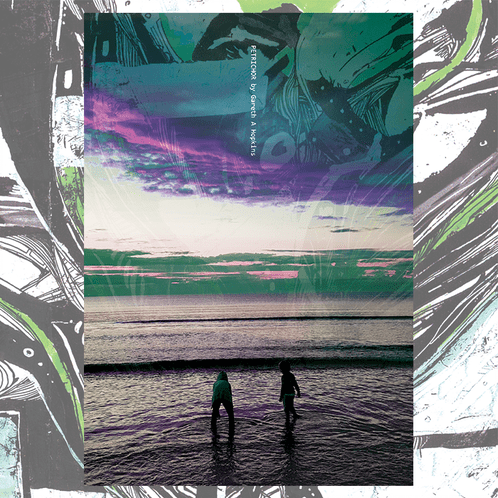
I joined Gareth Hopkins, the creator of the abstract comic Petrichor, over on his podcast Alpha Pod Flight.

Gareth’s show follows his obsession with the Canadian super heroes Alpha Flight, so we talked about their appearance in the current horror-themed series Immortal Hulk, and tried to draw some links between Marvel’s favourite big green repressed rage monster and Gareth’s new book, an idiosyncratic autobiographical comic about grief.
Our talk took place at the Lakeside Gardens of the Barbican Centre in London, a strange place which feels like somewhere the ruling class would reside in a 1970s dystopia.

While we spoke, a woman walked to the edge of the artificial lake, dropped photographs into it, and then stood over them making a gesture like flowing water.
Then a bird attacked her.
If you work in a Florida library, you can join me for a special webinar next month: “Get Started with Strategy: Practical Planning for the Future“.

On 17th July, this one-hour session for Florida librarians will introduce you to simple, quick-to-master tools and techniques for building strategic awareness and setting out your service’s plan for the future.
Find out more at the Florida Library Webinars site – you have to be a staff member of a Florida library to participate, so you’ve either got two weeks to move there and find work, or reach out to me directly for a webinar or workshop of your very own.
Library Island, the participatory activity which reaches the parts other professional development cannot reach, is here! You can read more and download your copy of the free, CC-licensed PDF file here.
I’m featuring some accounts of the island from people who have attended Island sessions, or run Islands of their own, to give you a better sense of what it means to take part in, or even organise, your own Library Island.
This week, we’re joined by Pennsylvania public librarian Justin Hoenke, who attended an Island session with colleagues from across the western part of his state in June 2019. The activity was embedded in a day-long event focussed on strategic & scenario planning for public libraries and their communities.
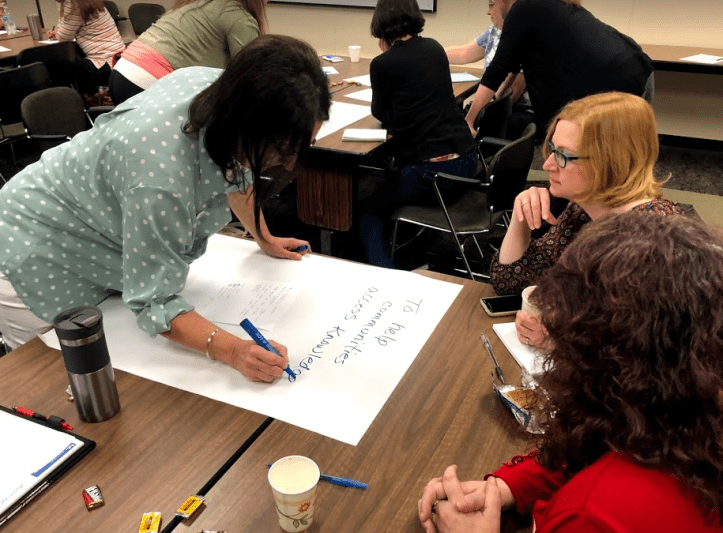
Justin writes: Read more
Got a pen, paper, and fifteen minutes to think about the future?
This short video, “Yoga for Futurists“, will help you build strength and flexibility in the ways you or your organization looks at the future.
You can also read more about one of the activities featured in this video, “Arrows of Time“, on this blog.
So if you feel like stretching your sense of the world to come, and the ways by which you might choose your future, grab something to write with and press play on the video above.
Welcome to Library Island!
This interactive training activity helps participants to explore strategy, innovation, and the messy business of working with communities. We’ve spent the last two years perfecting Library Island with university staff, health workers, museum professionals, students, and, yes, librarians.
The free CC-licensed print-and-play kit is now available for download in PDF format. Feel free to adopt it, adapt it, and make your own visit to Library Island.
Read more about Library Island, and what it has done for professionals all over the world, here.
 matt finch / mechanical dolphin