EXIT: Screenwriter and critic Martyn Pedler visits Parkes Shire

EXIT (2011) movie poster

“Growing numbers of men and women believe that this city is a maze. They are leaving their jobs, their families, their entire lives behind. Every day, they walk the streets, opening doors. They are searching for a door they are convinced has been lost for thousands of years: the exit. What’s behind it? Something else. Something new. Using a strange system of maps, symbols and measurements, one believer — Alice — now thinks she has found it.”

Hot on the heels of the successful Central West Comics Fest last weekend, I’m pleased to announce that award-winning Melbournian writer Martyn Pedler will be visiting Parkes Shire on Tuesday 25th February for a one-day event kicking off a series of gaming and storytelling activities which interrogate the boundaries between fantasy and reality.

Martyn will work with students at Parkes High School, before appearing at a Q&A discussion and screening of his 2011 movie EXIT at Parkes Shire’s Coventry Room at 6.30pm.

For more details, contact Parkes Shire Library on 02 6861 2309 or at library@parkes.nsw.gov.au

VALA Remixed: Ten Magic Words for Australasian Libraries and their Friends, 2014-2016

Last week I gave a keynote at VALA in Melbourne. It’s a biennial conference for people who work in galleries, museums, and libraries. The text below builds on key ideas from my speech – you can see a full video at the VALA website.

TARDIS on the Powell Estate, graffiti;ed
Think of the public library as the TARDIS on your streetcorner…a local gateway to human knowledge and dreams

Read more

Radio, radio: Australian Broadcasting Corporation coverage of Central West Comics Fest

The final preparations are being made for the first Central West Comics Fest this weekend, bringing together retailers, comics creators, and fans from across New South Wales to celebrate the art of graphic storytelling.

You can hear an interview with me and Parkes branch librarian Tracie Mauro on the ABC website by clicking on this link (mp3 audio). You can also read more about the festival on the ABC website.

If you live in the Central West and love comics, we look forward to seeing you on Saturday!

Information for the 2014 Central West Comics Fest

Central West Comics Fest, VALA, Parkes Writers’ Group, Sci-Fi and Squeam

Aaaand we’re……back from the long summer holidays in the sweltering Aussie heat! And straight into the whirlwind of adventure.

Saturday, February 15th 2014 is a historic date for comics fans of all ages from across the Central West region of New South Wales – marking the first comics festival for this part of rural Australia.

Australian comics creator Pat Grant, author of the acclaimed meditation on youth, migration, and coastal identity Blue, will be offering workshops to adults and older teens alongside Marcelo Baez, who has drawn for everyone from Marvel to Microsoft, National Geographic to GQ Magazine, and will be schooling us in the ways of comic-book storytelling. In addition, the lovely folk at Sydney’s Kings Comics are venturing out of the CBD to offer their wares to people from across the region – a chance to peruse and purchase the latest comics, merch, and memorabilia without making the epic voyage all the way to Sydney.

More information can be found on the Central West Comics Fest poster:

Information for the 2014 Central West Comics Fest

In related news, I was recently interviewed for Melbournian radio station Joy FM’s Sci-Fi and Squeam podcast, talking about pop culture, libraries, and, inevitably, zombies, with the smart and suave Emmet O’Cuana – you can find my segment on their podcast, from 26:50 on the Joy FM website.

There were also some kind words for Parkes Writers’ Group from 2013 Banjo Patterson Poetry Award winner Jim Cassidy (although I’m not sure how I feel about being compared to Andrew Flintoff!) – you can read them at the Parkes Champion Post website here and see the kind of strange, all-ages, continent-hopping, Barbra Streisand-themed activities we get up to at the group here.

Finally, next week sees my keynote speech to the biennial Australasian culture-and-technology conference VALA – expect Doctor Who references, current affairs, the history of librarianship, and musings on hipsterity alongside the usual celebration and championing of public libraries.

<vworp vworp!>

Popcorn Complacency: Supporting Readers and Writers at Australia’s Margins

Here’s an update on last week’s Great Popcorn Debate which covered e-books, community outreach, and the future of Australian libraries.

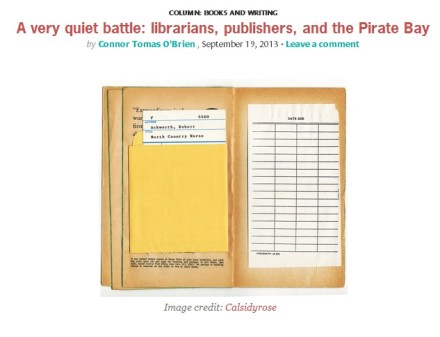
Start with this image:

This was the picture that EWF Digital Festival Director Connor Tomas O’Brien used to illustrate his position on libraries’ attempts to secure e-book lending rights with publishers.

It’s in ‘A very quiet battle’, Connor’s piece for Kill Your Darlings on publishers and libraries’ negotiations around digital lending of e-books. He claims to be neutral in this debate, but his piece includes comments like:

I’m tempted to believe that ebooks and public libraries fundamentally just don’t mix.

and:

It’s unclear how public libraries can lend out ebooks without either becoming conduits for piracy (even now, it’s not hard to loan out an ebook, strip the DRM, then send out copies of the file) or cannibalising ebook sales, nor is it clear why anybody would want to visit a physical space just to load digital files onto their ereader. After all, if you don’t need to visit a real-world space to loan the ebook, doesn’t that defeat the purpose of the public library existing physically as a cultural hub?

That last line comes dangerously close to an argument against public libraries having a physical presence of any kind in the community.

Concerned by this, I approached Connor for an interview. In his piece, Connor had tried to protect himself from seeming like an enemy of libraries by writing:

The public library, in other words, is nowhere near obsolete. In some cases, it’s more important than ever.

Therefore, I asked him: What do you think a public library should be doing in 2013?

Connor’s response offered Melbourne’s city-centre based Wheeler Centre as an example:

The issue public libraries face is largely that there often isn’t that critical mass of energy. Instead, that energy is usually spread across state writers’ centres, universities, cafes, and bookstores. Melbourne already has the Wheeler, but in other states I hope likeminded groups converge to set up similar spaces. If you have one or two central spaces for books and ideas in a city, all the energy flows through those spaces, and it has a catalysing effect.

For me, that sounded like a centralising impulse which would deprive neighbourhoods, especially in our most disadvantaged, remote, rural, and suburban areas, of their local librarian. Instead, marginalised communities would be expected to find their way under their own steam to “one or two central spaces for books and ideas in a city”.

Public librarians exist to give every community member access to all of human knowledge and culture, whether rich or poor, young or old, urban, suburban, or rural. (Caitlin Moran has written especially eloquently about this at The Huffington Post).

Therefore, I felt that Connor’s idea was A Bad Thing.

Connor’s probably a very nice man, but his words lend ammunition to the enemies of libraries and damage the future prospects for marginal communities to have the full local support of their own public librarians as information and culture professionals.

I wrote in response:

I sometimes feel uncomfortable with all those big-city cultural venues. It’s not the institutions’ fault, rather it’s that of the funding bodies, but when did the Sydney-based NSW Writers Centre, allegedly a state-wide body, last have the money to run a programme west of the Blue Mountains? And the “national” Centre for Youth Literature at State Library of Victoria is crewed by a team of awesome badasses, who do make the effort to tour Victorian schools – but it seems to be “national” only in the sense that any Australian can access their website.

In the ensuing Twitter discussion, which got somewhat tetchy as these things do in 140-character bites, I gently challenged  Melbourne’s Centre for Youth Literature on their city-centre focus.

The author Cory Doctorow, whose work explores decentred and future-facing solutions to the problems of 21st century economics, knowledge, and culture, is visiting the Centre this month – but all they’re doing with him is hosting the same old city-centre panel discussions and speeches and workshop events.

I suggested they should take him to a marginalised venue instead, and use digital technology to connect Doctorow to the usual, privileged, CBD audience. To show that I’m not just taking a cheap shot, I wrote a short proposal on how they could use Doctorow’s visit to ‘hack Australian literary culture’:

My suggestion was this:

Imagine if SLV hacked old-school literary festival practice and used Doctorow’s visit to celebrate culture at the margins for once. Imagine if he was speaking, not in the Melbourne city centre, but at a marginal, underutilized venue; perhaps a school or library in one of Melbourne’s less privileged suburbs.

SLV and its Centre for Youth Literature, who organized Doctorow’s visit, could encourage attendees to come out to the suburbs using their networks – but they could also ensure a city-centre audience by streaming Doctorow’s presentation to the[ir high-tech] Experimedia suite.

It’s an opportunity to reverse the opposition between the city centre and the margins. Anna Burkey, SLV’s Reader Development Manager, is clearly under pressure to deliver footfall through the SLV’s city-centre doors – it must be necessary for SLV to justify all that expensive real estate! – so why not run a makerspace in SLV on the day of the talk?

Invite Melbournian makers in to Experimedia, celebrate their work, remind people that libraries are about more than books on shelves (or e-books, for that matter), and really bring to life the work of the man who wrote a novel called Makers

(I’m not pretending it’s perfect, but if I can come up with that on my coffee break, I expect the talented people at the Centre could do much better as part of their actual day job – and although Doctorow was careful not to annoy his Melbournian hosts, he posted a timely blog on librarianship at Tumblr which was in favour of both local libraries in general, and libraries having e-books).

Connor responded, “Broadly I agree w/ some of your points, Matt, but I don’t think your proposals are very practical.

As far as I can see, my suggestion was no more or less practical than the existing model, I just moved physical presence to the needy periphery and digital outreach to the already privileged centre. I did a double-check and ran the Doctorow ideas past a few tech and community outreach people, who seemed to think it wouldn’t be such a struggle. I’m Skyping a talk soon from rural Australia to a conference in the city of Brisbane, for example, and Auckland Libraries has only recently run a city-centre makerspace within their walls.

I’m not a raving fan of Steve Jobs, but when I hear people like Connor being naysayers and merchants of the “can’t-do” attitude, I do think of that Jobs quote: “The people who are crazy enough to think they can change the world are the ones who do.”

That should definitely be true for arts people in bleeding-edge roles like director of a digital festival for emerging writers. Surely they should be the most audacious, innovative, and swashbuckling agents of change in a nation’s literary culture?

But the truth is, librarians may actually be more radical, more relevant, and more engaged with our most marginal and dispossessed communities than the city-centre arts crowd.

Connor has just posted a new piece on this topic at The Writers Bloc.

He frames the issue as being about individual writers’ choices to stay in the regions or migrate to cities like Melbourne. He writes,

Writing in regional areas – South Australia, Tasmania, the Northern Territory, and rural New South Wales, Queensland, Victoria, and Western Australia – is not impossible, because it is possible to write from anywhere, but subtle infrastructure gaps do make sustaining your writing practice more difficult. Internationally renowned authors routinely visit Melbourne to deliver lectures, creating an invigorating culture of ideas in that city that sends a strong signal that writing matters. When you’re writing in a regional area, that culture can be lacking, making it infinitely more likely that prospective writers will never open their word processor in the first place.
[…]
There are also questions to be raised about the goal of outreach programs: do Melbourne-based organisations travel to regional areas to preach the benefits of living and working in Melbourne (to some degree, I think so – that’s one reason I’m now living here), or do they travel to regional areas to encourage those in the region to stay put and establish their own infrastructure (I think this happens, too)?

What saddens me is that Connor, in his role as director of a digital writers’ festival, doesn’t seem to be clear whether he wants to support the regions or try to consolidate power in places like Melbourne. He acknowledges that effort has gone into giving Melbourne “an invigorating culture of ideas in that city that sends a strong signal that writing matters”, but won’t use his privilege to help other places share that culture and that signal.

It’s even more disheartening when you remember that this is a man who has questioned the value of local branch libraries and proposed a consolidated model based on places like the Wheeler Centre: his words sap power and potential from marginal, rural, suburban and disempowered communities, despite his acknowledgement that “stories from the margins […] can be the most vital”.

The truth is that digital technology, transport, and telecommunications are better and cheaper than ever. That we have ever more people writing, blogging, creating fan fiction; using literacy to express themselves in an unimaginable diversity of ways. (Maori librarian Kris Wehipeihana in New Zealand questioned Connor’s “narrow definition of who is a ‘writer'” in her impassioned response to his post.)

American author Matt de la Peña wrote this week about his work in schools outreach – about identifying tough kids, not the superstars, not the self-identified writers, who have great potential to become the storytellers of tomorrow. Their stories resonated with Matt’s own experience as an author who himself didn’t read a novel all the way through until after high school.

The sad truth is that Cory Doctorow visiting Melbourne CBD, and Connor effectively telling marginal writers, “It’s up to you if you stay or go”, will do nothing for the Australian equivalent of Caitlin Moran, or Matt de la Peña, or those tough kids of whom Matt wrote.

Even that I could forgive if Connor would just give real and wholehearted support to local libraries. If his festival won’t be there for the writers and readers of rural and marginalized Australia, local librarians will be – but they need his support, not popcorn complacency.

The Worst Song I Ever Loved, or: What Can You Do With A Writers’ Group?

Every now and then, I get asked to run a writers’ group in whatever community I’m currently working in.

This is one of the most intimidating challenges for a stranger in town, because each group is its own unique beast. Some people go to these things because they’re working on their magnum opus and are seeking feedback; others want exercises to stimulate their creativity; still others want to write in silent company; and some will be simply be there for the social contact.

On a couple of occasions, I’ve found myself leading a three-hour group with participants ranging in age from 14 to 65, and trying to solve this riddle:

What do you do with the buggers for that long?

Well, just like when running immersive storytelling events for kids and teens, I start off by stealing an idea.

It’s like Newton standing on the shoulders of giants – I dig out something like Daniel Nester’s lovely writers’ course idea ‘The Worst Song I Ever Loved.’

Read more

Popcorn? Connor Tomas O’Brien and Chris Cormack on the battle for libraries’ future

Find an update to this blog debate at Popcorn Complacency: Supporting Readers and Writers at Australia’s Margins, on this site.

Today on the blog I’m joined by writer, web developer, and Australian creative-man-about-town Connor Tomas O’Brien plus Kiwi open source advocate (and fellow developer) Chris Cormack of Koha.

Connor is the director of the EWF Digital Writers’ Festival. He came to my attention after a Twitter conversation which led to his article “A very quiet battle” for the journal Kill Your Darlings. In it, he addressed sci-fi author Ursula Le Guin’s argument that publishers are deliberately making it untenable for public libraries to loan e-books to their patrons.

Connor Tomas O'Brien at Kill Your Darlings

“That’s probably true, and actually not very surprising,” Connor replied, suggesting that “ebooks and public libraries fundamentally just don’t mix”:

After all, if we accept that one of the core roles of the public library system is to make work freely available, and to make that work as convenient as possible to access… well, it’s already extremely easy to acquire ebooks freely and easily online without paying a cent. If we ignore the copyright implications, the torrenting website The Pirate Bay is, in a sense, like a modern day Library of Alexandria […D]igital lending systems are so complex, restrictive, and counterintuitive that it’s far more convenient for somebody with a limited income to pirate an ebook than rent it from their public library. The Pirate Bay, though illicit, offers a superior system of unrestricted free digital access to written work than any public library in existence. (For reference, here’s a breakdown of a typical library’s ebook checkout restrictions).

It’s hard to see things improving. Public libraries were established to facilitate the distribution of physical objects, not digital files. The conceptual framework for lending – involving one patron visiting a physical space, removing a book from the collection for a limited period, then returning it for others to enjoy – breaks down when it comes to ebooks, which can be accessed anywhere and endlessly duplicated.

Connor acknowledged that “The public library […] is nowhere near obsolete. In some cases, it’s more important than ever”, but without giving examples of what he expected the library to do in this brave new world. And when he signed off the article like this:

For now, there’s not much to do, really, but grab the popcorn and sit back and watch as publishers and librarians battle it out (very, very quietly, of course).

Well, of course this got my dander up. I was minded of Edward Burke’s “All that is necessary for the triumph of Evil is that good men do nothing.” If people complacently munch popcorn while public libraries ail and the smallest, most disadvantaged communities lose their free point of access to human knowledge and culture, they’re actually helping a deeper slide into inequality across the nation.

So I got in touch with Connor and asked him to talk through his ideas about the future of public libraries – and to bolster my limited technical knowledge, I talked also with Chris Cormack of Koha, an open-source software developer who spoke at this year’s Auckland Libraries Youth Hui. I won’t deny I’ve got a soft spot for Chris ever since I found out he arranged for the Māori hero Maui to attend his son’s birthday party – the kind of parenting that chimes so well with the spirit of playful learning.

The following interview comes from stitching together e-mail discussions with Connor and Chris. Connor ran out of time because of his work with the Digital Writers’ Festival, but I hope interested readers will be able to pursue the issue further online – you can find Connor online as @mrconnorobrien and Chris as @ranginui.

After reading Connor’s article, I asked him: “Aren’t the systems around e-book lending only so complex because publishers are trying to enforce unenforceable, outdated business systems? It’s so easy to publish an ebook now: aren’t publishers trying to create an artificial scarcity, because the traditional business model was based on scarcity of the physical text? I’ve heard it argued that libraries should directly value and reward authors for the work that they do, rather than the distributors who might be increasingly irrelevant. Rather than the problem being libraries, isn’t the problem a publishing business model which places intrinsic value not on the work, but on its transmission?”

Read more

Finding Library Futures, 4: Delivering the Literacy Smackdown – Big Box Battle

Big Box Battle monsters pose in their cardboard city

Last time on the blog we were discussing Parkes Shire’s time travel roleplay activity for schools, Time Travel Detectives. In it, a time portal had been opened from a polluted future Earth. Insidious, bug-like creatures were trying to cross timelines and usurp the present, but Parkes kids were able to go after them and capture them in specimen jars…

In the follow-up school holiday activity, ‘Big Box Battle’, another time portal presented a rather bigger challenge. Our young heroes found themselves wrestling Godzilla-like monsters in a knee-high cardboard city. Like our live action teen zombie roleplays, which you can see news coverage of here, this was a chance for kids to physically enter the world of an adventure story.

Read more

Finding Library Futures, 2: We Built This City – Embedding Stories in a Community

In part one of this blog series, I took a look at TimeQuest, the citywide programme which I devised for Auckland Libraries’ school holiday programmes – an opportunity to embed storytelling, adventure, and literacy into the life of an entire city.

The TimeQuest team created a simple storyline which all Auckland’s library branches could use as a leaping-off point for their own activities over the holidays. We might have been imposing a half-dozen lines of text, but there’s a real difference between this imposition and the various ‘One Book, One City’ programmes which have gained ground around the world.

Read more

Finding Library Futures, 1: TimeQuest – A Scientific Romance for Libraries

Auckland Libraries - Timequest
Auckland Libraries – Timequest logo
This school holiday season has seen Auckland’s library branches join forces to deliver a programme of activities built around a single citywide storyline, “TimeQuest.” Working with the city’s Service Development advisers Anne Dickson and Danielle Carter, I wrote the short text which frames the whole season:

Auckland, 2379. It’s the end for planet Earth – a red sun burns in the sky and the ground is parched of life.

The last survivors are preparing to leave for a new home on the other side of the galaxy, when the scientist Maia completes her greatest invention – a time portal that can take you to any moment in Auckland’s history.

Her plan: to send you back in time to recover the best books, art, and objects from New Zealand’s past.

Where will you go – and when?

What will you choose to save?

TimeQuest – Raid the past to save the future.    

Read more