The Thrill of Heritage: Playful, postapocalyptic, postcolonial cultural programming

TimeQuest Postapocalyptic Auckland Skyline by Nicola Brady

Heritage is one of the most exciting challenges in community outreach. It’s an opportunity to dispel the myth that the past is staid or somehow divorced from the present. Many public and private bodies hold weird and wonderful archives, unique traces of the generations that have preceded us.  Everything we do and dream is rooted in what has gone before, whether we like it or not, and yet the past is not fixed, as we uncover new truths, new ways of looking at those who have gone before us. The strange and beautiful thing about historical narrative and memory is that even a path you’ve already trodden can still change course in retrospect.

Two years ago I visited Auckland in New Zealand for a six month contract as Service Development Adviser to the city’s libraries. My brief was “to push the boundaries in how our large public library network creates innovative programmes for children and young people […] to inspire others to experiment and learn from the experience of working in fresh, even unexpected ways.”

During my stay, Auckland celebrated its 2013 Heritage Festival, an annual “opportunity for everyone, locals and visitors to Auckland, to celebrate and remember our past and discover our heritage.”

With my Auckland Council hat on, I looked for ways to make the past thrilling, and immediate, and to create opportunities for each neighbourhood library to take responsibility for devising and delivering inspired, playful programming.

A trip to Chromacon, the city’s festival of illustration, led to a meeting with British expatriate artist Nicola Brady. Her drawing of a crumbling present-day Auckland was the perfect inspiration for a time-travelling heritage event.

Nicola’s doomy vision provoked questions: What if we made our heritage programming about both the future and the past? What if we turned it into a dynamic mission of rescue, with participants making their own choices about the value of history?

TimeQuest was born: a season of cultural programming for the school holidays, with a heritage theme and an overarching narrative:

Auckland, 2379. It’s the end for planet Earth – a red sun burns in the sky and the ground is parched of life.

The last survivors are preparing to leave for a new home on the other side of the galaxy, when the scientist Maia completes her greatest invention – a time portal that can take you to any moment in Auckland’s history.

Her plan: to send you back in time to recover the best books, art, and objects from New Zealand’s past. Time has run out for the planet Earth, but we can still rescue the best of our heritage and take it with us to our new home.

Where will you go – and when?

What will you choose to save?

Time Quest – Raid the past to save the future.

For me, it was important to create a storyline which respected New Zealand’s bicultural past and future. If we were going to imagine a postapocalyptic science fiction setting, it would be one where Māori identity was front and centre. Our defiant genius hero would be a Māori woman and a scientist, who invited TimeQuest participants to make their own decisions about the value of heritage, rather than accept some dusty authoritarian imposition.

My Auckland supervisor, Peter Thomas, is a Māori public servant with extensive experience offering guidance and representation to government bodies working in New Zealand. He helped us to choose the right name for our rebellious female science-hero, and also took me through the process needed to approve the use of a quote I’d found at Auckland Museum, which became the motto of TimeQuest:

“Haere mai, e tai, kei te wera te ao”

“Come and see, the world is going to be burned”

These were the words recalled by an eyewitness to the 1886 eruption of Mount Tarawera, a violent natural disaster which decimated communities. I had seen the quotation in a display on volcanoes and earthquakes at the Auckland Museum, and saw it as a symbol of our programme’s link between an imagined future and authentic historical accounts. Peter helped guide me through the sensitivities around using a quotation in this way.

To balance out the gravity and drama of our programme, we also created an alternate promotional image which was friendlier and more cartoony, for TimeQuest events featuring younger children.
Auckland Libraries - Timequest
Auckland Libraries – Timequest logo

Having established our storyline, we wanted to be sure that local communities would create their own events and not just copy some central voice of authority. We wanted local stories, local histories, local art, and local play – so rather than create a prescriptive centralised programme, we created a resource pack with eight model activities to serve as inspiration for local librarians to devise their own versions.

By kind permission of Greg Morgan and the team at Auckland Libraries, I’ve been allowed to share the Auckland Libraries TimeQuest 2013 Mission Pack here as a PDF download. 

Our simple missions included robotic dress-up, Nerf gun battles, creative writing, and research activities for a variety of age ranges. In many ways these events were the forefathers to later projects like Time Travel Detectives, Write Your Own Urban Myths, and Big Box Battle.

Auckland’s librarians ran with the inspiration they’d been given and came up with sessions such as these:

  • Time travellers from the year 2379 are on their way to find out information about the culture and life of the tweens and teens of today. They’ve asked us to make a teen’s room that they can teleport to the future. Help us to design and decorate a representation of what a teen’s room looks like in 2013.
  • Life in 2379 is rather bleak. With the sun burning out, life on earth is dying. The time travellers have come back to 2013 to gather enough knowledge and resources to save the future generations. But they will need enough sustenance to do this. Tweens and teens will be asked to investigate the vitamins and minerals humans need to keep healthy and strong. They will then be blending up some fruity concoctions for the travellers to take back with them to help them save the world.
  • Time travellers, to slow the sun and save the future you have been asked to bring back to the future Maui, the Māori hero of How Maui slowed the sun. Listen to the story and help Maui to catch and slow the sun again by making your own fishhooks and ropes.

It was great to watch local librarians take on the challenge and the opportunity of a heritage programme that left space for their own creativity. TimeQuest was just one of many experiments in Auckland over my six month stint there: everything from zombie battles to librarians in comic book stores and a national youth libraries conference.

Over the last couple of years, I’ve watched with pleasure as participatory, local, and lively approaches to culture and creativity have spread. For me, the most promising model for a decentered, participatory approach to the arts in local communities has been Fun Palaces, the British event co-directed by the Kiwi-raised Stella Duffy from an original 1960s idea by Joan Littlewood and Cedric Price. If it’s true that the neighbourhood public library is the gateway to all human knowledge and culture, then Fun Palaces are a beautiful fit for libraries’ swashbuckling cultural mission.

You can download the Auckland Libraries TimeQuest 2013 Mission Pack here as a PDF file – and read more about the project in my blog “A Scientific Romance for Libraries.”

#Citylis talk with library students at City University

I had a great visit to City University in London today, talking with students on the Master’s course #citylis, convened by Ernesto Priego.

Our conversation covered everything from the art history of Aby Warburg to civil unrest in Ferguson, Missouri, tabletop gaming, and, of course, the inevitable zombie battles.

Here’s a PDF download of the notes from my talk on comics, libraries, and community, “Words and Pictures, Space and Play.”

Also speaking to the students was James Baker, curator of Digital Research at the British Library. His presentation on “Future Libraries: Considering Publishing” can be viewed here.

I often say that a neighbourhood library is like the TARDIS on your streetcorner – an ordinary box which can take you anywhere in human knowledge or imagination. If that’s true, watching James speak about the British Library’s digital innovations was like watching Doctor Who dance around the TARDIS control panel, flicking switches and levers with gleeful abandon.

You can find more of James’ work via his Twitter account @j_w_baker and his website, Cradled in Caricature.

To see more of what City University’s library students get up to, check out #citylis and #inm380 on Twitter.

Josie Long on BBC Artsnight: The importance of art for suburban communities

Writer and comedian Josie Long has made a short film for the BBC which neatly captures the reasons why arts venues and programmes are so important to suburban communities, those which are seen as “not pretty enough to be in Kent, and not exciting enough to be in London.”

The argument resonates with my work last year on Fun Palaces and the ongoing debate around arts access in Australia.

Josie Long on Artsnight

Check out Josie Long’s report from last Friday’s edition of Artsnight.

Lecture at City University London, Guest Editorial at Public Library News

The TARDIS from Doctor Who lands on a suburban housing estate

My guest editorial for Public Library News, The TARDIS on your streetcorner,” is out this week. Editor Ian Anstice offered me the chance to share my some of my experiences working with community libraries in Australia and New Zealand, and of course I worked a Doctor Who reference in there too.

Next month, I’ll be giving a guest lecture to students at City University, London. I’ll be talking about “Words and Pictures, Space and Play” alongside digital curator James Baker from the British Library and information science lecturer Ernesto Priego, who is also presiding genius at The Comics Grid.

Read more

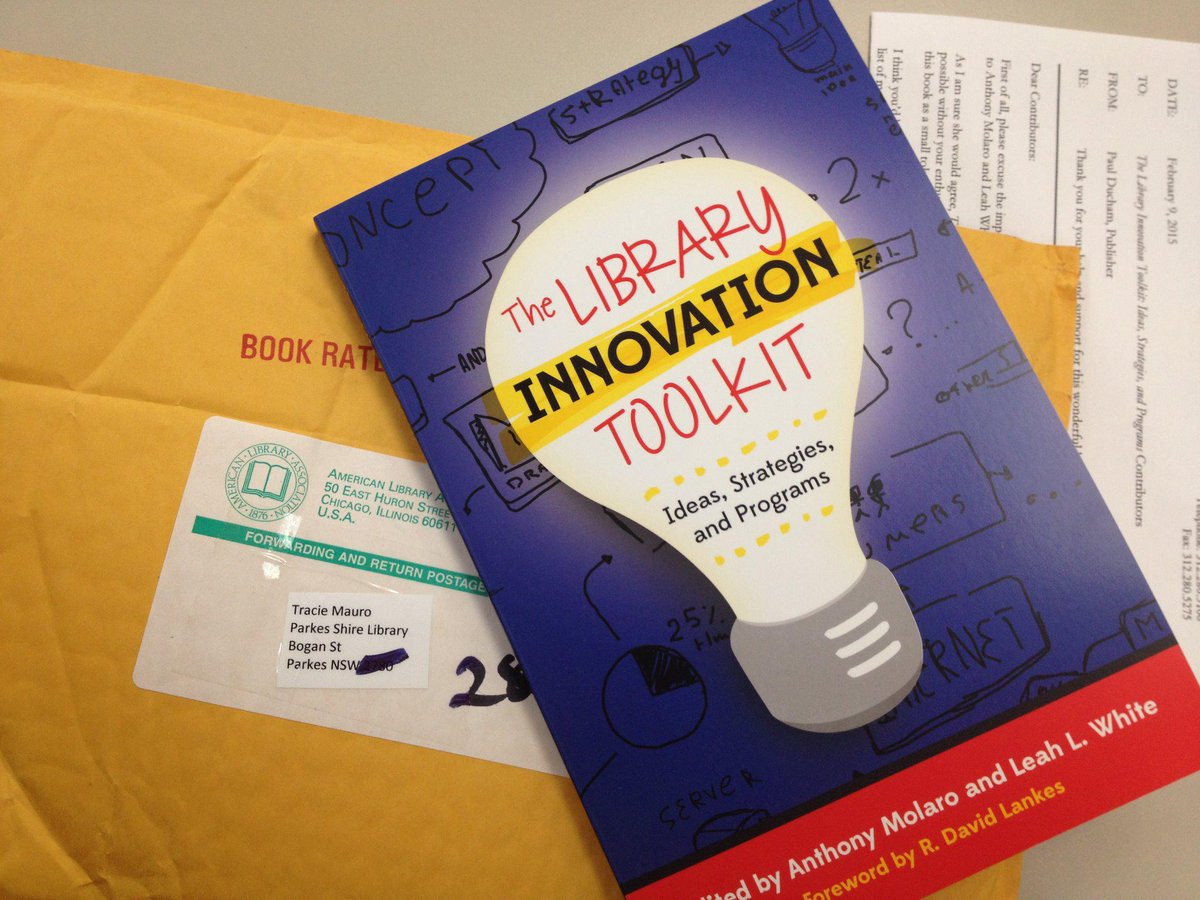
The Library Innovation Toolkit, Out Now

The Library Innovation Toolkit

The Library Innovation Toolkit is out today from ALA Editions!

The book “encourages readers to take big risks, ask deeper questions, strive for better service, and dream bigger ideas”, with practical examples and suggestions for 21st century library services.

I wrote “Monsters, Rockets, and Baby Racers”, the chapter on working with children and young people, together with Tracie Mauro of Australia’s Parkes Library.

Readers will get inspiration and case studies from the team which picked up a 2014 national award for innovation in youth services.

If you fancy unleashing the power of play and immersive storytelling in your museum, gallery, school, or library, the book’s worth checking out. You can buy it from ALA Editions at their website.

Guest Post: Santhoshi Chander, “A Love Letter to Parkes”

This slideshow requires JavaScript.

I was trying to find the words to look back on an eventful season with Parkes Shire Libraries, culminating in this year’s Australian national award for innovation in library youth services. I could have talked about how the country stereotypes have yielded to reveal a town of tough and funny and mad and passionate people. I could have recounted how all the amazing things we’ve done were really about a community that was ready for change, and a bunch of smart librarians who recognised that fact, and who drafted in an outsider to provoke and support and sustain that change.

Instead, I wanted the last word to come from someone else. One of our local writers, but one who – like me – came to Parkes a stranger and a foreigner. 

Santhoshi Chander of the town writers’ group Author-rised kindly allowed me to share her thoughts about the experience of finding a new home out in the Aussie regions. “Ex-city-slicker” San divides her time between Sydney and Parkes.

A Country Fling, or
A Love Letter to Parkes

It seemed from the beginning the stakes were against us. I’m not claiming our story has Romeo and Juliet status. But in our own way, we started as star crossed lovers.

Read more

Reader-in-Residence article in SCAN Magazine

Parkes High School’s teacher librarian Tracy Dawson has an article in the latest SCAN magazine about the Reader-in-Residence role which I held in Parkes across late 2013 and early 2014.

The role was designed to link the school and wider community in a celebration of storytelling, literacy, and culture in all its forms. Events included teen publishing workshops, our biggest ever zombie roleplay, urban myth writing, and the inaugural Central West Comics Fest, which will be returning in 2015. I also mentored high school students, led sessions for the Parkes writers’ group, and worked with the school’s special needs unit.

Tracy gives a teacher’s perspective on how trying new things, pushing boundaries, and reaching out to a wider community also yielded great benefits to students at the high school. You can also read her guest posts on this site about Auckland’s XXUnmasked project and the work of a teacher librarian.

SCAN magazine is a refereed journal published by the New South Wales Department of Education, focussed “on the interaction between information in a digital age and effective student learning.” You have to subscribe for recent issues, but the archive is publicly available – I’ll let readers know when the current issue moves into the free archive.

“You ate my battleship???” – Pub librarianship and tabletop games

Last night, the team at Parkes Library headed to the Railway Hotel for an evening of drinks, dining, and tabletop games.

After chatting with ABC Central West about the project, we invited residents from across the region to drop in and try their hand at some of the games we’ve been developing this year. People could take on the challenge of the Tabletop Superheroes adventure we devised for Fun Palaces 2014:

Library users Jake and Kellie brought in their own home-made game for people to try – it was beautifully made and fiendishly difficult.

There was also a new game, Battle Pizzas, which set pub patrons against one another in a game of wits. The prize? Dinner itself.

You can read more about Battle Pizzas, and download instructions, at the Parkes Dog-Eared website. You can also download the Tabletop Superheroes adventure, which can be remixed under a Creative Commons licence. We played the games in the pub but they’re designed for all ages; we think they’d work just as well in schools, libraries, or the comfort of your own home. Give them a go. Have fun!

Debbie Gould at Parkes Fun Palace: Making Games with the Currajong Disability Group

Debbie Gould is one of the librarians I work with in Parkes, New South Wales. She creates and delivers library programmes for the Currajong Disability Group. Currajong clients are people who require some degree of care. They are diverse in ability, with some who are nonverbal, some needing 24/7 care, and others who have learning disabilities. Debbie created a game for Parkes’ Fun Palace last month and was then able to share it with her clients in the group on one of their weekly visits.

Here’s Debbie talking about her work with the Currajong group, and how she brings Parkes’ philosophy of fun and open-ended learning to library users with disabilities.

This image is licensed by Parkes Shire Library under a CC 4.0 BY-NC-ND licence http://creativecommons.org/licenses/by-nc-nd/4.0/

At Parkes Library, we believe that libraries are about so much more than books and shelves. Our job is helping our whole community to learn, explore, and have fun on their own terms.

I started working with the Currajong Disability group at the start of 2012. I’ve been doing it for almost three years now, but the clients change and so I’m always adapting my programme to suit them.

In the early days, it was trial and error. I wasn’t concerned about not being able to relate to the clients, but I was concerned that I wouldn’t be able to provide a programme that worked for everyone, all the time. I wanted all the clients to enjoy their library time. As the weeks passed, I could see that the group did enjoy themselves. Their needs were met even though I was experimenting as I went along, finding out what was going to work best. That was part of the experience!

Building a relationship with the clients took time. It was important to watch and listen as well as present to the group. Clients have different ability levels, and my sessions had to take that into consideration.

In the group, we explore books and stories as well as practical and playful activities. I have found that the world of my clients is very factual. The world of fiction relies on imagination and a sense of “let’s pretend” which can be difficult for my clients. Concepts such as animal characters in books taking on human characteristics aren’t always understood. Quite often clients don’t get the punch line at the end of a story because it isn’t a “real” experience.

Clients work better with non-fiction and real life activities, where as many of the senses can be engaged as possible. Simple science experiments and activities are often popular. Each session I try to incorporate sight, hearing, touch, smell. Taste is explored sometimes but I have to be mindful that not all clients are able to take food by mouth and some have special dietary needs.

This slideshow requires JavaScript.

When I designed a game for Parkes’ Fun Palace weekend, I chose to make a maze based on old sideshow games. Players had to drop a ping-pong ball into a slot and try to land on a high score. Age and ability was not a hindrance to playing the game I created. I saw the joy people had playing it at the Fun Palace, and knew that my clients would have a good time with it.

Watching the Currajong group play my game was interesting. They all interacted with it in different ways, but they were all excited to see the end result. They loved the mystery of just where the ball would land. Each of them played their own version of the game – even if it wasn’t quite what I’d intended, they still achieved the goal of landing a score with the ping pong ball.

Relationships are key to making this group work. Without a solid relationship between clients, carers, and the library, our sessions would not be successful. There is no way a programme could run and meet the goals set if the presenter was not mindful of the clients and their needs.

All relationships take time to develop; they need genuine interest, concern, and respect. A little bit of yourself has to be given in each session you present. If it isn’t, then you aren’t presenting effectively. Working with disabled adults is a privilege and it has been exciting to see each client share a bit of their personality in the sessions. The joy and reward from the sessions is priceless and being able to expand the world the clients live in is amazing.

This is a condensed version of a blog post which originally appeared at Parkes’ site, Dog Eared.

Parkes Library Roundup

My friends and clients at Parkes Library are having a big week on the Internet. I’ve collected some of the various links in this blog post.

Our “Tabletop Superheroes” game devised for October’s Fun Palaces weekend is now available for free download. A remix of Cory Doctorow’s article ‘DMing for your toddler’, it was featured by Cory on BoingBoing. There’s also a blog post about the game at the State Library of New South Wales website.

Over at Library as Incubator, you can read Tracie Mauro and Shellie Buckle’s account of running Australia’s first ever Fun Palace.

Meanwhile at Zoe Toft’s Playing By The Book site, Tracie is interviewed by Zoe about the “Wonder-based library programmes” she creates for children and families. Tracie explains how you can create similar activities at home, school, or your own local library.

The Parkes Library team
This image is licensed by Parkes Shire Library under a CC 4.0 BY-NC-ND licence http://creativecommons.org/licenses/by-nc-nd/4.0/

The Parkes team are among the most daring and resourceful librarians I’ve ever worked with – no project daunts them, from live action zombies to wading through chocolate pudding swamps. Stay tuned, because there’s much more to come from these amazing Australians.