Popcorn? Connor Tomas O’Brien and Chris Cormack on the battle for libraries’ future

Find an update to this blog debate at Popcorn Complacency: Supporting Readers and Writers at Australia’s Margins, on this site.

Today on the blog I’m joined by writer, web developer, and Australian creative-man-about-town Connor Tomas O’Brien plus Kiwi open source advocate (and fellow developer) Chris Cormack of Koha.

Connor is the director of the EWF Digital Writers’ Festival. He came to my attention after a Twitter conversation which led to his article “A very quiet battle” for the journal Kill Your Darlings. In it, he addressed sci-fi author Ursula Le Guin’s argument that publishers are deliberately making it untenable for public libraries to loan e-books to their patrons.
Connor Tomas O'Brien at Kill Your Darlings

“That’s probably true, and actually not very surprising,” Connor replied, suggesting that “ebooks and public libraries fundamentally just don’t mix”:

After all, if we accept that one of the core roles of the public library system is to make work freely available, and to make that work as convenient as possible to access… well, it’s already extremely easy to acquire ebooks freely and easily online without paying a cent. If we ignore the copyright implications, the torrenting website The Pirate Bay is, in a sense, like a modern day Library of Alexandria […D]igital lending systems are so complex, restrictive, and counterintuitive that it’s far more convenient for somebody with a limited income to pirate an ebook than rent it from their public library. The Pirate Bay, though illicit, offers a superior system of unrestricted free digital access to written work than any public library in existence. (For reference, here’s a breakdown of a typical library’s ebook checkout restrictions).

It’s hard to see things improving. Public libraries were established to facilitate the distribution of physical objects, not digital files. The conceptual framework for lending – involving one patron visiting a physical space, removing a book from the collection for a limited period, then returning it for others to enjoy – breaks down when it comes to ebooks, which can be accessed anywhere and endlessly duplicated.

Connor acknowledged that “The public library […] is nowhere near obsolete. In some cases, it’s more important than ever”, but without giving examples of what he expected the library to do in this brave new world. And when he signed off the article like this:

For now, there’s not much to do, really, but grab the popcorn and sit back and watch as publishers and librarians battle it out (very, very quietly, of course).

Well, of course this got my dander up. I was minded of Edward Burke’s “All that is necessary for the triumph of Evil is that good men do nothing.” If people complacently munch popcorn while public libraries ail and the smallest, most disadvantaged communities lose their free point of access to human knowledge and culture, they’re actually helping a deeper slide into inequality across the nation.

So I got in touch with Connor and asked him to talk through his ideas about the future of public libraries – and to bolster my limited technical knowledge, I talked also with Chris Cormack of Koha, an open-source software developer who spoke at this year’s Auckland Libraries Youth Hui. I won’t deny I’ve got a soft spot for Chris ever since I found out he arranged for the Māori hero Maui to attend his son’s birthday party – the kind of parenting that chimes so well with the spirit of playful learning.

The following interview comes from stitching together e-mail discussions with Connor and Chris. Connor ran out of time because of his work with the Digital Writers’ Festival, but I hope interested readers will be able to pursue the issue further online – you can find Connor online as @mrconnorobrien and Chris as @ranginui.

After reading Connor’s article, I asked him: “Aren’t the systems around e-book lending only so complex because publishers are trying to enforce unenforceable, outdated business systems? It’s so easy to publish an ebook now: aren’t publishers trying to create an artificial scarcity, because the traditional business model was based on scarcity of the physical text? I’ve heard it argued that libraries should directly value and reward authors for the work that they do, rather than the distributors who might be increasingly irrelevant. Rather than the problem being libraries, isn’t the problem a publishing business model which places intrinsic value not on the work, but on its transmission?”

Read more

A brief round-up on All Hallows’ Eve

I’m just back from Manila after flitting around Australia and the Philippines for a couple of weeks, running various events for libraries and art galleries. 7 flights in 8 days…that’s more than enough!

Zombies are people too - a survivor tries to escape the zombie hordes in Tullamore with a disguise
Zombies are people too – a survivor tries to escape the zombie hordes in Tullamore with a disguise and some pro-zombie sentiments

On the 10th and 11th of October, Parkes Shire Library ran our biggest and best zombie roleplay event to date, working in collaboration with three local schools, police, firefighters, and student volunteers from Charles Sturt University. We had two days of around 70 people taking part in a 4 1/2 hour unbroken zombie-fighting roleplay with real emergency services. You can see video from the news coverage at the ABC website. 

That event was the culmination of about a month’s work creating immersive theatre and learning activities in country libraries; you can find out more under the Finding Library Futures tag at this site. As the zombie dust settled, I spent a week training librarians around the region before flying to Sydney during the bushfires, which give the city a rather unnervingly apocalyptic skyline:

Sydney skyline - image via @peteresho's Twitter account
Sydney skyline – image via @peteresho’s Twitter account

The next day, I was off to Manila’s Museum of Contemporary Art and Design to give a talk and run another day of events. This included activities like making storytelling dice with comic-book panels on each face:

Teens make comic book storytelling dice at Manila's MCAD art museum
Teens make comic book storytelling dice at Manila’s MCAD art museum

The kids were very cool but it was pretty intense work – in fact, just walking down the street was pretty intense! Tho’ I’ve been to bustling cities in Peru and Indonesia, this was another level of wild traffic, wealth disparity, and sheer volume of humanity. Five minute taxi rides generated impressions that will take a long time to process. I felt privileged to be invited to work with the talented staff at MCAD and the youth museum Museo Pambata.

On my last night in the city, I went to a gallery launch but ended up sneaking off with another artist, Leeroy New (designer of a Lady Gaga dress, not the infamous meat one), to see his exhibition Gates of Hell, which I found utterly wonderful:

Leeroy New as Buddha encased in expanding foam

Leeroy’s transgressive, playful, pop-cultural take on the sacred had an impact as soon as you entered the room, yet when you ventured beneath the carapace of oozy foam which encased many of his holy subjects, there was a serious engagement with the numinous and transcendent. Gates of Hell reminded me of one of my favourite novels, Toby Litt’s troubling, surrealist fairytale-for-adults Hospital. With its psychopomps and defiantly rebellious bodies, its unyielding but indefinable laws of magic, It’s one of those flawed yet lingering novels – see this Telegraph review for a decent skewering of the flaws – which, despite it all, I can’t recommend enough.

This slideshow requires JavaScript.

I loved Leeroy’s work for recalling the grotesquerie of Bosch as much as the claymation splurge of the British 1980s cartoon Trap Door. Gates of Hell marked a perfect balance between pop culture and traditional spirituality, those two rival paths towards a world beyond the everyday. No wonder Lady Gaga had Leeroy make wearable art for her.

After escaping the Gates of Hell, I chaired an evening panel on monsters in children’s literature for the New South Wales Writers’ Centre (you can see a great write-up here from panellist Nyssa Harkness) before finally flying home (my 7th flight in 8 days)…

To recover from all that adventure, I spent a long weekend in a darkened room with too many comics and now I’m back in the game. Stay tuned for tomorrow’s big interview/discussion piece on e-books, publishing, and the future of libraries…

Update: just to round off the festivities on this ghoulish night, you can find a six-minute recording of my piece There’s No Terror In The Carelessness of Flesh online at Soundcloud. Strictly NSFW – an adult exploration of blood, bodies, desire, and dismay. Happy Hallowe’en!

Finding Library Futures, 5: “I Was Elected To Lead, Not To Read” – Thoughts On Library Leadership

Part 5 in my series on Finding Library Futures.

In my travels, I’ve met some incredible and inspiring library leaders. Managers and specialists delivering incredible stuff: people like Hamish Curry, the Melbournian library superhero who gets kids making Ned Kelly armour in his library, or Adrienne Hannan in the New Zealand capital Wellington, a children’s and youth specialist whose role outside traditional management structures gives her freedom and flexibility to innovate. But sometimes libraries’ own bureaucracy impedes them: sometimes, even when the media, local communities, and local politicians, too, are supporting libraries’ attempts to be audacious, internal process can be an obstacle. So – here’s three thoughts on a style of leadership which will let libraries be the sword-hand of literacy and the major cultural player they so clearly ought to be in the new Information Age.

1. Library leaders need to be librarians.
Don’t get me wrong; I’m not talking my role out of existence – outsiders to library service have a value in stirring the pot, bringing in new ideas, cross-pollinating between librarianship, education, theatre, creative writing, marketing, etc – but I truly believe that the people at the head of a library organisation need to have walked the floor, stacked the shelves, held their own on a desk shift, and put contact plastic on a few books in their time. Read more

Finding Library Futures, 4: Delivering the Literacy Smackdown – Big Box Battle

Big Box Battle monsters pose in their cardboard city

Last time on the blog we were discussing Parkes Shire’s time travel roleplay activity for schools, Time Travel Detectives. In it, a time portal had been opened from a polluted future Earth. Insidious, bug-like creatures were trying to cross timelines and usurp the present, but Parkes kids were able to go after them and capture them in specimen jars…

In the follow-up school holiday activity, ‘Big Box Battle’, another time portal presented a rather bigger challenge. Our young heroes found themselves wrestling Godzilla-like monsters in a knee-high cardboard city. Like our live action teen zombie roleplays, which you can see news coverage of here, this was a chance for kids to physically enter the world of an adventure story.

Read more

Finding Library Futures, 3: Time Travel at the Speed of Pop Culture

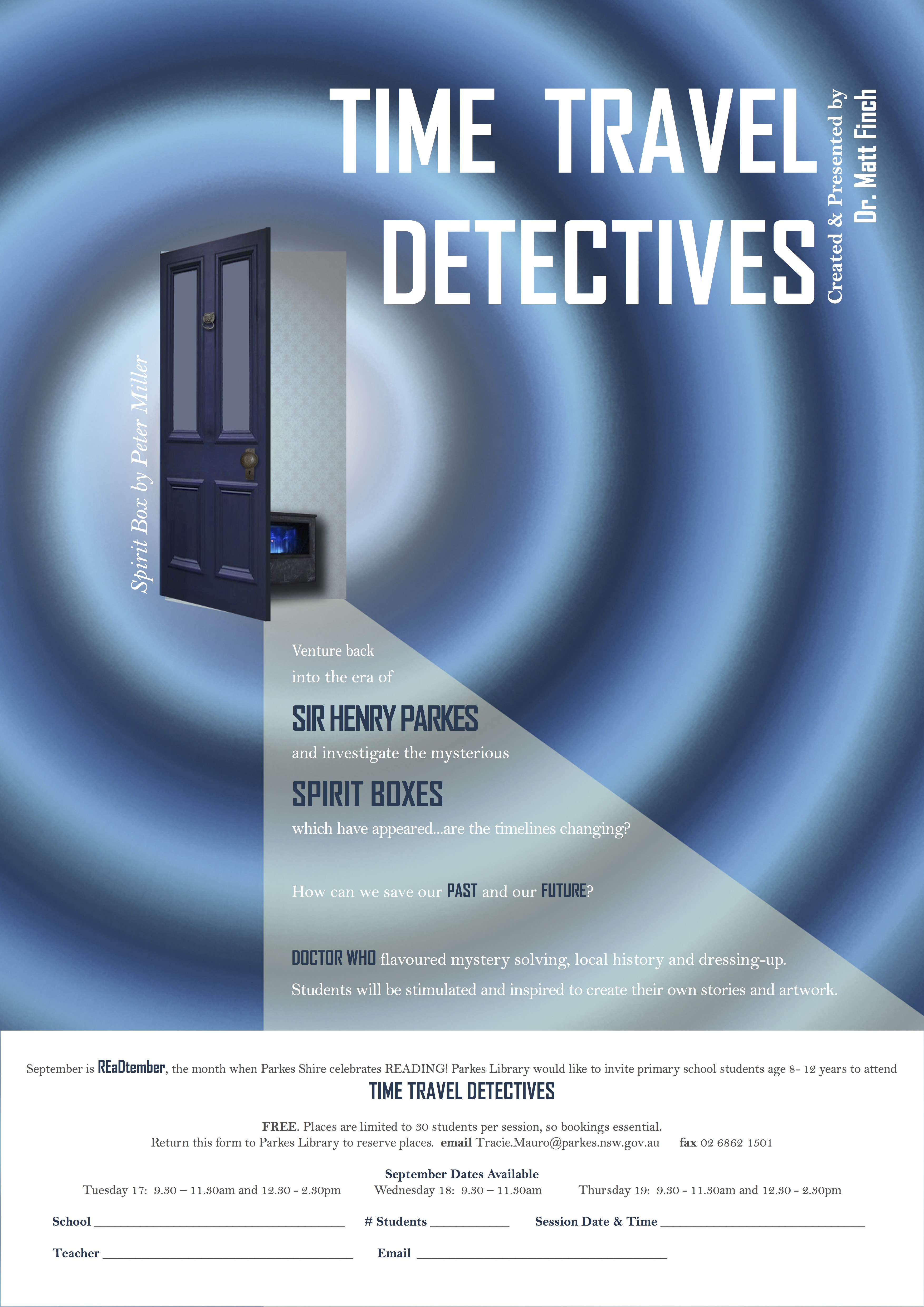
This article looks at Time Travel Detectives, my recent youth activity for Parkes Library in New South Wales. For more on the concept of storylining a public library system’s youth offerings, see TimeQuest – A Scientific Romance for Libraries.

Poster from Parkes Library's Time Travel Detectives event with Matt Finch

Let’s start with science. Australia’s new government might have decided there’s no need for a dedicated science minister, but scientific research is not going to simply stop in Australia. We need to encourage children and young people to develop that sense of wonder which impels scientific research around the world.

I’m currently based in Parkes, New South Wales. It’s a quiet rural town, but one which played a vital part in putting a man on the moon. Its radio telescope, celebrated in the movie The Dish, helped Neil Armstrong to make that giant leap back in 1969.

Invited to make school holiday activities for the September vacations in Parkes, I wanted to find something which respected the town’s history and scientific traditions, but also offered an adventure that looked forward as well as back.

My work is based on storytelling and immersive play. In creating a science-themed activity, I don’t seek to duplicate the work of science educators, but rather inspire and intrigue audiences with an adventure that would get them thinking about the scientific method and the practice of disciplined observation.

Spirit Box
Spirit Box

Read more

From monsters to Manila: a few upcoming events

Awestruck Time Travel Detectives!
Awestruck Time Travel Detectives at Parkes Shire Library, New South Wales

Once again, it’s busy times over at Finch Towers. I owe this blog a report on Time Travel Detectives and Big Box Battle, two immersive roleplay activities that I’ve just run at Parkes Library. That’s coming, but in the meantime you can see a few photographs from the two events below. There’s no qualitative assessment quite as cool as the awestruck expression on a child’s face…or the air-punching victory of a seven-year-old girl who just took down a chainsaw wielding Elvis robot.

This slideshow requires JavaScript.

Next week sees schools from around Central West New South Wales converge on Tullamore for the sequel to 2012’s zombie showdown, and after that I’ll be speaking in Manila and Sydney.

Zombie at the window
ALWAYS with the zombies…

In Manila, I’ll be running a youth activity for the Museum of Contemporary Art and Design, (MCAD) as well as speaking to Filipino librarians on strategy and innovation. MCAD made a rather beautiful poster for the event:

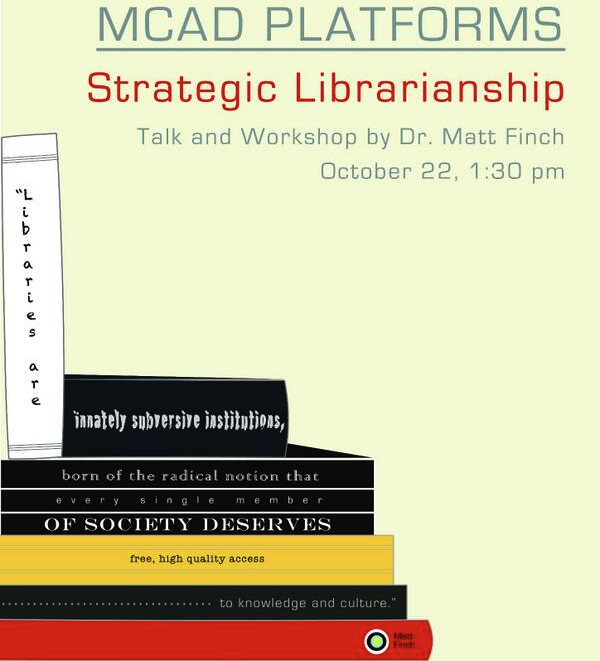
Poster for Matt's talk on librarianship to Manila museum of contemporary art and design

After that, I’ll be speaking at a New South Wales Writers’ Centre event on Thursday 24th October, Monsters Under The Bed, alongside novelist Kate Forsyth and researcher Nyssa Harkness. We’ll be looking at the place of monsters in children’s and Young Adult fiction – and with Nyssa’s gaming background, I’m hoping we get to explore whether our relationship to monsters changes in an age when interactive storytelling and gaming often allow us to struggle with them directly… You can order tickets for the event at the Writers’ Centre Eventbrite page.

And when all that is done, I have a few words for you on immersive roleplay, performance and literacy, and embedding stories in a community. Stay tuned…

Busy week, lucky country

It’s been another busy week out here in Central West New South Wales.

On Monday, I interviewed the Australian comics creator Pat Grant for the New South Wales Writers’ Centre. You can read Pat’s comics Blue and Toormina Video online. Pat and I will both be teaching courses at the Centre later this year – Pat’s on Graphic Storytelling and mine on Storytelling for a 21st Century Audience.

Time Travel Detectives poster

Talking to Pat was timely, because I’d just arranged for Sydney’s superlative comic store Kings Comics to send our local library a vast selection of comics on sale-or-return, which we then allowed the public to choose from in a series of all-ages workshops which I ran to determine our new collection. (Kings mistook me for Doctor Who, too, which only endeared them to me more).

Tuesday saw the kick-off of Time Travel Detectives, an immersive role-play programme for 5-12 year olds which invited local children to enter the Parkes Library Time Travel Lab and venture back to 1873 to prevent a time-lost Justin Bieber and his strange minion creatures from changing history and taking over the town.

The event included two new artworks by the Melbournian artist Peter Miller, Spirit Box and the Life Projector, which became Victorian scientists’ devices for detecting the time-travelling intruders – with Peter and his wife Wendy taking on the roles of rival 19th-century inventors battling to outdo one another. Read more

Interview with comic creator Pat Grant for New South Wales Writers’ Centre

Pat Grant cartoon“In an age of touchscreens, desktops, and video-on-demand, the ability to handle visual communication is an advantage for every writer. It’s not always about artistic technique, but a willingness to embrace the use of images to get your message across.”

Read my interview with Australian comic book author and scholar Pat Grant at the New South Wales Writers’ Centre website.

Can Aussie libraries learn from their Kiwi cousins?

It’s a cheeky question, really. A few days back I was trying to tease the Centre for Youth Literature team at the State Library of Victoria on Twitter, as they ran an event which saw authors debating the relative merits of zombies and unicorns:

http://storify.com/booksadventures/zombies-vs-unicorns-nz-versus-australia

All I was really doing was stoking the old trans-Tasman banter between Australia and Aotearoa/New Zealand, suggesting that Melbourne were all about the author talks, while the Kiwis rolled up their sleeves and waded into the front lines of storytelling and outreach.

The State Library of Victoria is one of my favourite libraries in the world: a beautiful building to rival the New York Public Library, home to non-shelfy treasures like Ned Kelly’s armour, staffed by people like the superheroic Hamish Curry running gaming and cinema events, the Centre for Youth Literature’s Adele Walsh creating activities like “comic book speed dating”, and the zombies versus unicorns ringmaster herself, Jordi Kerr, who wrote for this very site on roller derby and librarianship last year.

So why tease such lovely people?

Well, it was this talk of zombies vs unicorns – a debate for the schools element of the Melbourne Writers Festival featuring authors Justine Larbalestier and Margo Lanagan – a spin-off from Justine’s anthology of the same name.

When I saw that the Melbourne Writers Festival was charging schools $7 per student to visit the city centre and hear writers debate “zombies versus unicorns” on stage, I got to thinking about the work we’d been doing in New Zealand over the last six months, which focussed on taking storytelling off its pedestal and out of the city centre; getting out in the community and inviting kids into the world of stories through roleplay and immersive storytelling.

Read more

Matt and His Week of Wonders

I alluded to my busy Auckland week in Friday’s post announcing my New Zealand Book Domino Challenge – for which the prize is cake, so if you are a Kiwi librarian and feeling adventurous, please join in.

Portal Cake
The Cake Is Not A Lie

Last Saturday saw Auckland Libraries take their services into the city’s comic stores for Free Comic Book Day, as part of my project to expand librarianship beyond the walls of individual institutions into the wider community.

I was then interviewed by the erudite and wonderfully geeky Emmet O’Cuana for his podcast The Momus Report, with the discussion ranging widely from the educational value of pop culture to the Kierkegaardian implications of the 1978 movie Star Crash.

This week also included a visit to Auckland Libraries from Tracie Mauro of Parkes, NSW – a daring and innovative librarian whose work appeared on Monday’s Library as Incubator Project. Tracie and I travelled the Far North District in New Zealand, exploring library services and programmes in rural areas far from my usual Auckland beat.

Yesterday I was quoted in the New Zealand Herald, in a satisfyingly positive article which recognises that the 21st century library is about so much more than just shelves…and I also took some time out for a trip to the Christchurch vs. Auckland roller derby match, which reminded me of this neat guest post on roller derby and librarianship from Melbourne’s Jordi Kerr.

If you’ll excuse me all, it’s Sunday evening, so I will now go for a lie down…

sleepy