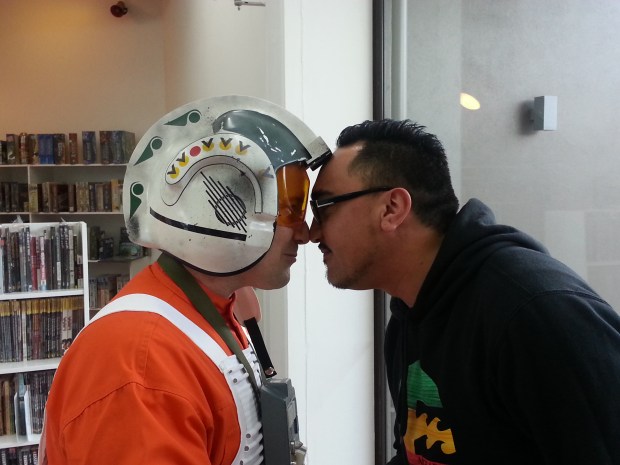
Librarians in Auckland ventured into comic book stores to celebrate Star Wars Day and Free Comic Book Day by issuing memberships and loaning items from their collections. More soon, but in the meantime here’s Twitter coverage via Storify.
Although Kiwi librarians are attempting to push back with the Twitter hashtag #morethanbooks, responses have tended to focus on the fact that libraries use e-books too, and include other items like music in their collections as well.
The simple truth is, libraries aren’t about books on shelves, or compact discs, or even e-readers. Those are tools, mere means to an end.
A library isn’t just a storage space for books on shelves – it’s also a place where musicians perform; where computer software is written; where teens get to wrestle a zombie-bitten police officer to the ground while debating the ethics of surviving a disaster scenario.
Yet one local politician has said “Why not replace libraries with e-readers?” and Kiwi librarians are on the defensive, letting their enemies set the terms of the debate. Read more →
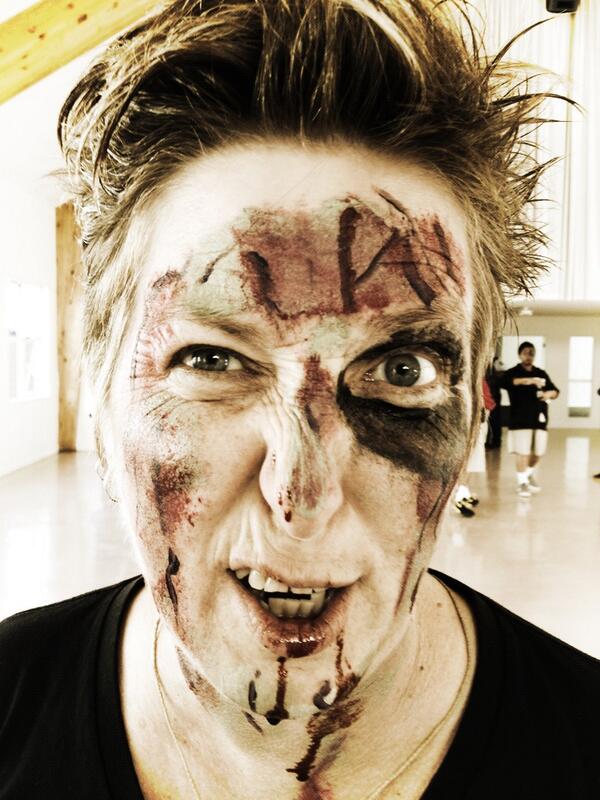
Auckland Libraries’ Anne Dickson led teen zombie hordes against a group of survivors in Tupu Youth Library
Last Friday in Tupu Youth Library, South Auckland, I ran an interactive live-action zombie event for teens on their school holidays.
The ‘survivors’, aged from 12 to 18, found themselves besieged in a meeting room while zombies feasted on hapless victims outside. Teens made barricades from furniture, used library resources to plan their escape from South Auckland, and faced special challenges including detecting potential zombie victims and even wrestling with a zombified police officer!
One of the first things I did on arrival in Auckland is arrange for the library to purchase a number of Nerf guns – toys which shoot foam darts – with the aim of encouraging librarians to create activities which combined literacy with more boisterous forms of action and adventure.
The message I’ve been trying to get across is that roleplay and activities which immerse you in a story are just as valid for libraries as anything involving books on shelves.
UNESCO’s Missions of the Public Library don’t even use the word ‘book’ once – but they do mention providing access to cultural expressions of all performing arts, stimulating the imagination and creativity of children and young people, and providing opportunities for personal creative development – alongside reading!
Corin has been, to his credit, an early adopter of the Nerf gun in Auckland – that’s him in the final frame of this YouTube video, which shows staff getting to grips with the toys:
Should we be allowing kids to identify with explicitly villainous figures? (Somewhere in my mum’s house there is a photo of me dressed as Darth Vader – but I alternated that costume with Spider-man pyjamas and my favourite hero outfit, Batman).
If kids use play to make sense of the world, do we have the right – or the power – to stop them thinking through violence and its consequences using play?
In the light of recent events, I’ll be following up on these questions after a pause for contemplation and acknowledgement of the tragedy in Massachusetts.
I have been fascinated by how and why people use space, and how subtle design can influence behaviour, for as long as I can remember.
As a teen, I merged this interest in social geography with psychology and came up with a degree in Urban Planning and Design. I was going to change the world. Improve open spaces. Create spaces people felt happy in. The reality I found was far from my planned dream. Rows of brickwork, overshadowing, trellis screens, and complaints all dominated my day. Not even I liked the spaces I was approving. Approving, not designing.
Fast-forward fifteen years. I am still an urban planner, but only in my mind. I have been trained to look at spaces, movement of people, land use, all in a certain way. I can no longer look at a space like an ordinary person. Taking my kids to the shops, the park, the library, I analyse the flow of movement through space. When I see conflicting uses, I see a design-based solution. When I see desire lines – the unplanned paths naturally taken by people in any setting – I read them.
So, a big announcement has been in the works for some time: from 25th February I begin a six-month contract as adviser to Auckland Libraries, the largest public library network in the southern hemisphere. The mission is to extend and enhance Auckland’s already superlative library offerings for children and young people with creative, challenging, and sustainable activities for the future.
Before Auckland beckons, I’ve been looking at the latest developments in the UK and US. The Future Foyles workshop held on Monday of this week brought together publishing, retail, and literacy professionals seeking a vision for London’s next great flagship bookstore – you’ll see me quoted in The Bookseller’s report of the event – and finding much food for thought from a wider community outreach perspective.
Polyester Books – the self-proclaimed ‘World’s Freakiest Bookstore’ – spells trouble. It did from the moment I discovered it.
I was visiting Melbourne for the first time and a friend recommended an alternative bookshop at the far end of Brunswick Street in Fitzroy.
I had no idea where this was, so on a visit to the State Library of Victoria, I asked one of the youth librarians to help me find it. She googled ‘Polyester Books’ on a State Library computer terminal and we were both immediately confronted with the store’s incredibly NSFW logo.
As Polyester proprietor Jo Emslie puts it, “If that sign upsets you, don’t look around our shop, ‘cos your head’s gonna explode!”
Polyester Books, Melbourne
Yet Polyester’s commitment to supplying all kinds of books, DVDs, zines, art, and periodicals is deeply relevant to the mission of 21st century librarians. I dropped in to the shop for a browse and was impressed to find the likes of obscure Austrian novelist Hermann Broch on the shelves alongside the more eyebrow-raising fare.
So what can librarians learn from the World’s Freakiest Bookstore?
In the ‘Dirty Library Trilogy’, I’m going to try and push the boundaries and see what libraries can learn at the far reaches of pop culture…from the battling broads of the rollerderby rink to the barrooms of the world.
So…could we drink our way to better librarianship?



 matt finch / mechanical dolphin