The Thrill of Heritage: Playful, postapocalyptic, postcolonial cultural programming

TimeQuest Postapocalyptic Auckland Skyline by Nicola Brady

Heritage is one of the most exciting challenges in community outreach. It’s an opportunity to dispel the myth that the past is staid or somehow divorced from the present. Many public and private bodies hold weird and wonderful archives, unique traces of the generations that have preceded us.  Everything we do and dream is rooted in what has gone before, whether we like it or not, and yet the past is not fixed, as we uncover new truths, new ways of looking at those who have gone before us. The strange and beautiful thing about historical narrative and memory is that even a path you’ve already trodden can still change course in retrospect.

Two years ago I visited Auckland in New Zealand for a six month contract as Service Development Adviser to the city’s libraries. My brief was “to push the boundaries in how our large public library network creates innovative programmes for children and young people […] to inspire others to experiment and learn from the experience of working in fresh, even unexpected ways.”

During my stay, Auckland celebrated its 2013 Heritage Festival, an annual “opportunity for everyone, locals and visitors to Auckland, to celebrate and remember our past and discover our heritage.”

With my Auckland Council hat on, I looked for ways to make the past thrilling, and immediate, and to create opportunities for each neighbourhood library to take responsibility for devising and delivering inspired, playful programming.

A trip to Chromacon, the city’s festival of illustration, led to a meeting with British expatriate artist Nicola Brady. Her drawing of a crumbling present-day Auckland was the perfect inspiration for a time-travelling heritage event.

Nicola’s doomy vision provoked questions: What if we made our heritage programming about both the future and the past? What if we turned it into a dynamic mission of rescue, with participants making their own choices about the value of history?

TimeQuest was born: a season of cultural programming for the school holidays, with a heritage theme and an overarching narrative:

Auckland, 2379. It’s the end for planet Earth – a red sun burns in the sky and the ground is parched of life.

The last survivors are preparing to leave for a new home on the other side of the galaxy, when the scientist Maia completes her greatest invention – a time portal that can take you to any moment in Auckland’s history.

Her plan: to send you back in time to recover the best books, art, and objects from New Zealand’s past. Time has run out for the planet Earth, but we can still rescue the best of our heritage and take it with us to our new home.

Where will you go – and when?

What will you choose to save?

Time Quest – Raid the past to save the future.

For me, it was important to create a storyline which respected New Zealand’s bicultural past and future. If we were going to imagine a postapocalyptic science fiction setting, it would be one where Māori identity was front and centre. Our defiant genius hero would be a Māori woman and a scientist, who invited TimeQuest participants to make their own decisions about the value of heritage, rather than accept some dusty authoritarian imposition.

My Auckland supervisor, Peter Thomas, is a Māori public servant with extensive experience offering guidance and representation to government bodies working in New Zealand. He helped us to choose the right name for our rebellious female science-hero, and also took me through the process needed to approve the use of a quote I’d found at Auckland Museum, which became the motto of TimeQuest:

“Haere mai, e tai, kei te wera te ao”

“Come and see, the world is going to be burned”

These were the words recalled by an eyewitness to the 1886 eruption of Mount Tarawera, a violent natural disaster which decimated communities. I had seen the quotation in a display on volcanoes and earthquakes at the Auckland Museum, and saw it as a symbol of our programme’s link between an imagined future and authentic historical accounts. Peter helped guide me through the sensitivities around using a quotation in this way.

To balance out the gravity and drama of our programme, we also created an alternate promotional image which was friendlier and more cartoony, for TimeQuest events featuring younger children.
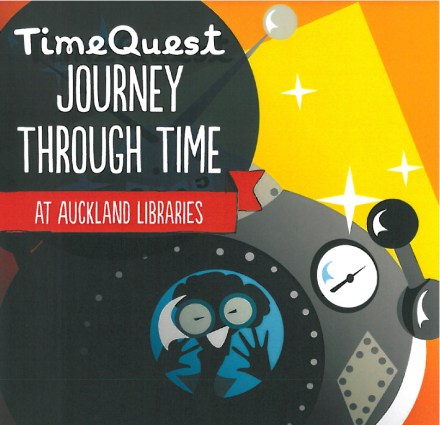
Auckland Libraries - Timequest
Auckland Libraries – Timequest logo

Having established our storyline, we wanted to be sure that local communities would create their own events and not just copy some central voice of authority. We wanted local stories, local histories, local art, and local play – so rather than create a prescriptive centralised programme, we created a resource pack with eight model activities to serve as inspiration for local librarians to devise their own versions.

By kind permission of Greg Morgan and the team at Auckland Libraries, I’ve been allowed to share the Auckland Libraries TimeQuest 2013 Mission Pack here as a PDF download. 

Our simple missions included robotic dress-up, Nerf gun battles, creative writing, and research activities for a variety of age ranges. In many ways these events were the forefathers to later projects like Time Travel Detectives, Write Your Own Urban Myths, and Big Box Battle.

Auckland’s librarians ran with the inspiration they’d been given and came up with sessions such as these:

  • Time travellers from the year 2379 are on their way to find out information about the culture and life of the tweens and teens of today. They’ve asked us to make a teen’s room that they can teleport to the future. Help us to design and decorate a representation of what a teen’s room looks like in 2013.
  • Life in 2379 is rather bleak. With the sun burning out, life on earth is dying. The time travellers have come back to 2013 to gather enough knowledge and resources to save the future generations. But they will need enough sustenance to do this. Tweens and teens will be asked to investigate the vitamins and minerals humans need to keep healthy and strong. They will then be blending up some fruity concoctions for the travellers to take back with them to help them save the world.
  • Time travellers, to slow the sun and save the future you have been asked to bring back to the future Maui, the Māori hero of How Maui slowed the sun. Listen to the story and help Maui to catch and slow the sun again by making your own fishhooks and ropes.

It was great to watch local librarians take on the challenge and the opportunity of a heritage programme that left space for their own creativity. TimeQuest was just one of many experiments in Auckland over my six month stint there: everything from zombie battles to librarians in comic book stores and a national youth libraries conference.

Over the last couple of years, I’ve watched with pleasure as participatory, local, and lively approaches to culture and creativity have spread. For me, the most promising model for a decentered, participatory approach to the arts in local communities has been Fun Palaces, the British event co-directed by the Kiwi-raised Stella Duffy from an original 1960s idea by Joan Littlewood and Cedric Price. If it’s true that the neighbourhood public library is the gateway to all human knowledge and culture, then Fun Palaces are a beautiful fit for libraries’ swashbuckling cultural mission.

You can download the Auckland Libraries TimeQuest 2013 Mission Pack here as a PDF file – and read more about the project in my blog “A Scientific Romance for Libraries.”

Guest Post: Santhoshi Chander, “A Love Letter to Parkes”

This slideshow requires JavaScript.

I was trying to find the words to look back on an eventful season with Parkes Shire Libraries, culminating in this year’s Australian national award for innovation in library youth services. I could have talked about how the country stereotypes have yielded to reveal a town of tough and funny and mad and passionate people. I could have recounted how all the amazing things we’ve done were really about a community that was ready for change, and a bunch of smart librarians who recognised that fact, and who drafted in an outsider to provoke and support and sustain that change.

Instead, I wanted the last word to come from someone else. One of our local writers, but one who – like me – came to Parkes a stranger and a foreigner. 

Santhoshi Chander of the town writers’ group Author-rised kindly allowed me to share her thoughts about the experience of finding a new home out in the Aussie regions. “Ex-city-slicker” San divides her time between Sydney and Parkes.

A Country Fling, or
A Love Letter to Parkes

It seemed from the beginning the stakes were against us. I’m not claiming our story has Romeo and Juliet status. But in our own way, we started as star crossed lovers.

Read more

Reader-in-Residence article in SCAN Magazine

Parkes High School’s teacher librarian Tracy Dawson has an article in the latest SCAN magazine about the Reader-in-Residence role which I held in Parkes across late 2013 and early 2014.

The role was designed to link the school and wider community in a celebration of storytelling, literacy, and culture in all its forms. Events included teen publishing workshops, our biggest ever zombie roleplay, urban myth writing, and the inaugural Central West Comics Fest, which will be returning in 2015. I also mentored high school students, led sessions for the Parkes writers’ group, and worked with the school’s special needs unit.

Tracy gives a teacher’s perspective on how trying new things, pushing boundaries, and reaching out to a wider community also yielded great benefits to students at the high school. You can also read her guest posts on this site about Auckland’s XXUnmasked project and the work of a teacher librarian.

SCAN magazine is a refereed journal published by the New South Wales Department of Education, focussed “on the interaction between information in a digital age and effective student learning.” You have to subscribe for recent issues, but the archive is publicly available – I’ll let readers know when the current issue moves into the free archive.

How To Be A Big Evil Head: Fun Palaces from the Supervillain’s Perspective

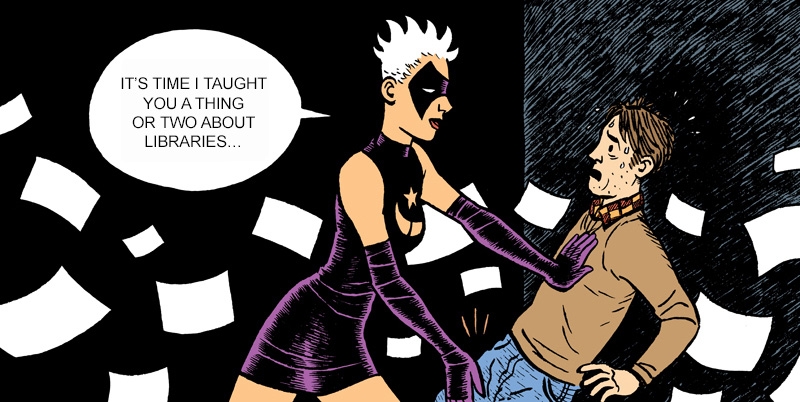
Louie Stowell's secretly heroic supervillain-in-training, Mandrake DeVille
Louie Stowell’s secretly heroic supervillain-in-training, Mandrake DeVille

Louie Stowell, who contributed author videos to the Parkes Library Fun Palace earlier this month, has written about the experience of being a Big Evil Head, projected across continents and timezones in the name of fun and supervillainy.

Check out Louie’s report over at the Fiction Express blog.


Arts and Edges: Australian creativity at the centre and periphery

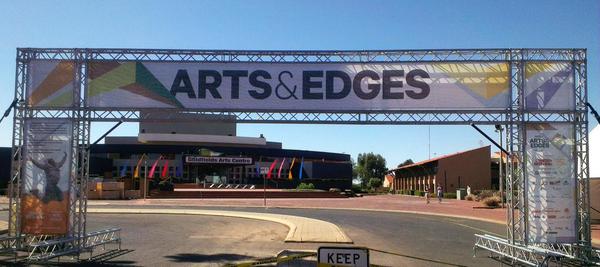
Arts and Edges banner - from the Regional Arts Summit @raasummit on Twitter
Arts and Edges – from the Regional Arts Summit @raasummit on Twitter

I was sad not to be able to attend the Regional Arts Summit in Kalgoorlie, Western Australia this year – despite best efforts, we couldn’t square it with all the projects currently on the go at Parkes Library.

Earlier this year, I was privileged to keynote at VALA, the biennial culture, libraries, and tech conference which took place in Melbourne. I spoke about opportunity and equity in Australian libraries, trading my Hugo Boss for a miner’s uniform on stage to make a point about arts access outside Australia’s big cities.

Working in Parkes has opened my eyes to the challenges that rural, regional, and marginal communities in Australia still face in gaining access to arts and culture – both as audiences, and as creators in their own right.

In Parkes, we’ve designed events like the Central West Comics Fest to reach out beyond an arts-event circuit that focusses on state capitals, and give regional creators, fans, and audiences their due.

Some of the Twitter coverage from Kalgoorlie was relevant to this work in Australian regional libraries, especially contributions from Curtin University librarian Teresa Bennett – @kalgrl on Twitter.

You can find out more by checking out the #RAASummit hashtag on Twitter, listening to summit coverage on ABC Radio National, and visiting the Regional Arts Summit site.

You can read text based on my VALA keynote here and watch a video of the presentation by entering your email at the VALA website.

The Regional Arts Summit in 2016 will take place in Dubbo, just down the road from my friends at Parkes Library. It’s going to be a great time for Central West New South Wales. I look forward to seeing an Australia where the culture scene goes further in embracing the sharp edges and strange delights of life at the margins.

What’s She Building In There? – Parkes Library Fun Palace Next Week!

Next week, the national award winning team at Parkes Library host their first ever Fun Palace event. As you can see from the photos, we’re currently hard at work preparing…

This slideshow requires JavaScript.

Fun Palaces take place on the weekend of 4th and 5th October 2014. You’ll find them in theatres, libraries, museums, and public spaces around the world. They give people the chance to take part in the exciting business of art and science, wherever they live. Thanks to the wonder of time zones, Parkes will be the first Fun Palace in the world to open its doors.

Theatre director Joan Littlewood and architect Cedric Price came up with the idea of Fun Palaces in the UK, back in the 1960s. They imagined “a laboratory of fun” that would serve as a pop-up community venue for both art and science.

The Parkes team will give the concept an Aussie spin, drawing on their tradition of immersive and interactive play. In previous years, Parkes’ librarians have organised thrilling zombie sieges and Godzilla battles. I designed these interactive games for Parkes with the idea that young players would generate unpredictable outcomes.

This year we’re putting even more power into the hands of children and young people. Over three days next week, Parkes Library staff will help local kids create their own challenges for the weekend Fun Palace.

Our events are inspired by British author Louie Stowell‘s book The School for Supervillains. Each day has a different supervillainous theme.

Local teens will join library staff in mentoring younger participants, too. We’ve always been keen on the idea of mixed-age play, pitting teens against kids in 2013’s Big Box Battle. It’s really exciting that “graduates” from our previous games are now volunteering their time as Fun Palace mentors.

On the weekend itself, Parkes kids will share their creations with the whole community. There’ll be a special roleplaying event drawing on the inspiration of games like Dungeons and Dragons. There’ll also be a chance for families to try out some of Parkes Library’s greatest hits, including a dinosaur dig and “Paint Like Michelangelo“, plus a few more surprises besides. Many of our activities can be copied at home without fuss or expense, so that the spirit of fun continues beyond the weekend!

As you can tell from the photos, we’re still putting the finishing touches to next week’s event – plus, we aren’t going to over-plan. We want to be surprised and amazed by all the unexpected things our participants devise!

Stay tuned to this blog for more details next week – with a special pre-Fun Palace blog post on Friday 3rd October.

In the meantime, you can find out more about Fun Palaces at the international homepage and visit the Parkes Fun Palace page online.

Award-winners Parkes Shire Library share the secrets of their library programming

Last night, Parkes Shire Library won the Australian library association ALIA’s Bess Thomas award for innovative work with children and young people. I’ve been working with the Parkes community for some years now, and I’m proud to have played a part in their journey to national recognition.

This slideshow requires JavaScript.

It’s great for Parkes’ librarians, serving a community of just 15000 out in Central West New South Wales, to have their daring work celebrated by peers at a national level.

If you want to steal some of the Parkes magic, you can find “how-to” articles and resources for some of our most exciting programmes online:

Keep your eyes peeled for more surprises as Parkes kicks off the 2014 season of activities this month…

First light in Parkes

Parkes Library Coffee Cups

I always get up and make a cup of coffee while it is still dark—it must be dark—and then I drink the coffee and watch the light come. […] And I realized that for me this ritual comprises my preparation to enter a space that I can only call nonsecular . . . Writers all devise ways to approach that place where they expect to make the contact, where they become the conduit, or where they engage in this mysterious process. For me, light is the signal in the transition. It’s not being in the light, it’s being there before it arrives. It enables me, in some sense.

– Toni Morrison, interviewed in the Paris Review

I’m writing this at 5.30 on Monday morning in Parkes, New South Wales. The sky’s just going from bruise to blush, and five hours from now we’ll be holding our first team meeting after months of preparation for “Readtember”, a family festival of literature, literacy, and play.

It’s been a huge honour for me to join forces with the team at Parkes. They’re brave and creative souls who give the lie to tired assumptions that nothing exciting happens beyond the city limits of Sydney or Melbourne. Our track record in devising and delivering mad, wonderful, compelling play and learning events for all ages is getting so long that it makes me laugh.

Yesterday I had my first takeout coffee in one of the library coffee cups which are used by every café in town. I suggested the idea based on a project that had run in Melbourne a while ago, but it only became real to me when I finally drank from one. I hadn’t even thought about the fact I’d be getting one when I placed my order; I just asked for a latte and suddenly I was holding a piece of local literature in my hand.

The texts chosen for the project remind readers that Parkes is a town of stargazers and poets, as well as farmers and miners. With both feet planted in red rural dirt, they still keep one eye on the cosmos. The coffee cup stories conjure early morning routines, the special camaraderie of the outback, and a world where we “listen to the gossip of the galaxies / trying to catch the whispers of how it all began.”

This year we’re challenging ourselves to go further than ever before. Parkes is the first Australian community to host an outpost of the global Fun Palaces movement; our famous interactive storytelling events are going to explore the dastardly world of supervillainy via a collaboration with British author Louie Stowell; and after challenging the biggest Australian arts organisations to push their own boundaries in February, we’ll be reaching out to new communities and new audiences on our own patch.

We’re proud when colleagues and allies, at home and overseas, share the fabulous ideas that we’ve tested out here in rural Aussie; most recently, New Zealand’s capital delivered a swathe of play-based sessions developed from programming devised in Parkes.

But as the sun rises on a new day, here in Parkes we’re sipping our coffee and looking forward to uncharted territory.

For me, light is the signal in the transition. It’s not being in the light, it’s being there before it arrives.

When You Look You May Not See: Archives and Public Space

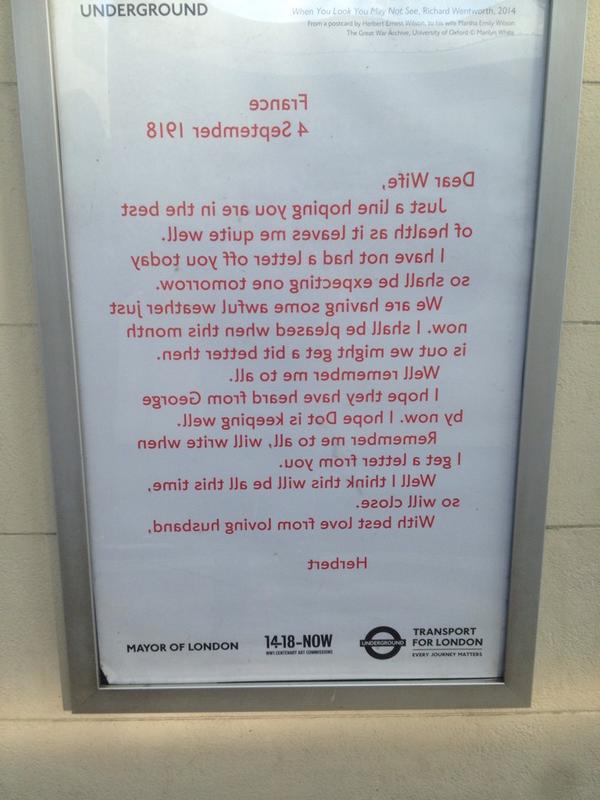
Just a quick post from London, where I saw this poster at Turnham Green tube station:

Richard Wentworth - When You Look You May Not See

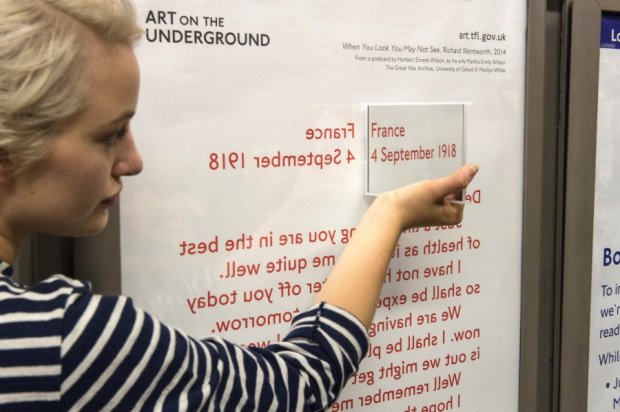
Richard Wentworth’s When You Look You May Not See takes a postcard written by First World War soldier Herbert Wilson and simply reverses the original lettering.

The postcard comes from the University of Oxford Poetry Archive and is presented as part of Art on the Underground’s contribution to London’s commemoration of the 1914-18 war.

Richard Wentworth - When You Look You May Not See
When You Look You May Not See being read with a mirror. Photo from Art on the Underground

To me it’s a perfect piece of public art. It uses genuine everyday communication from the archives; presents it in a simple, yet challenging, way; and it’s not bound within the walls of a museum or a prestigious city-centre location – it’s flung out to the platforms of public transport in the commuter suburbs.

It’s really important to think about where we physically place arts and culture programming – you can read more on that, in an Australasian context, in my VALA keynote from earlier this year. And in their own small way, my friends in the Australian town of Parkes have also been exploring the pleasures of ‘locative literature’ in 2014.

Huge congratulations to all involved in the London project and you can read more about When You Look You May Not See at the Art on the Underground website.