
“Libraries need to understand literacy in the broadest sense – exploring all of the senses in the way kids and teens relate to the diverse services they have to offer.”
“Libraries need to understand literacy in the broadest sense – exploring all of the senses in the way kids and teens relate to the diverse services they have to offer.”
Forgive the shameless self-promotion, but I’ve just been featured in the latest edition of Australian Books & Publishing, speaking about community outreach, daring to be different, and why rural Australia proved one of the most exciting places to create children’s and youth events for libraries.
It’s a subscriber-only link, but there is the option to sign up for a free trial.
You can read my profile piece in Australian Books & Publishing Online.
A guest post by urban planner turned librarian Jessica Begley. What can libraries do to help users make the most of their spaces?
Like the Pixies, I believe in Space.
I have been fascinated by how and why people use space, and how subtle design can influence behaviour, for as long as I can remember.
As a teen, I merged this interest in social geography with psychology and came up with a degree in Urban Planning and Design. I was going to change the world. Improve open spaces. Create spaces people felt happy in. The reality I found was far from my planned dream. Rows of brickwork, overshadowing, trellis screens, and complaints all dominated my day. Not even I liked the spaces I was approving. Approving, not designing.
Fast-forward fifteen years. I am still an urban planner, but only in my mind. I have been trained to look at spaces, movement of people, land use, all in a certain way. I can no longer look at a space like an ordinary person. Taking my kids to the shops, the park, the library, I analyse the flow of movement through space. When I see conflicting uses, I see a design-based solution. When I see desire lines – the unplanned paths naturally taken by people in any setting – I read them.
In the last of three features pushing the boundaries of what librarians can learn from pop culture, Melburnian writer and roller derby official Jordi Kerr tells us what libraries can learn from the glamorous, full-throttle sport of roller derby.

In the second of three features pushing the boundaries of what librarians can learn from pop culture, we take a visit to Melbourne bookstore Polyester Books and talk readers’ advisory with one of the most provocative booksellers I’ve ever met.
Polyester Books – the self-proclaimed ‘World’s Freakiest Bookstore’ – spells trouble. It did from the moment I discovered it.
I was visiting Melbourne for the first time and a friend recommended an alternative bookshop at the far end of Brunswick Street in Fitzroy.
I had no idea where this was, so on a visit to the State Library of Victoria, I asked one of the youth librarians to help me find it. She googled ‘Polyester Books’ on a State Library computer terminal and we were both immediately confronted with the store’s incredibly NSFW logo.
As Polyester proprietor Jo Emslie puts it, “If that sign upsets you, don’t look around our shop, ‘cos your head’s gonna explode!”

Yet Polyester’s commitment to supplying all kinds of books, DVDs, zines, art, and periodicals is deeply relevant to the mission of 21st century librarians. I dropped in to the shop for a browse and was impressed to find the likes of obscure Austrian novelist Hermann Broch on the shelves alongside the more eyebrow-raising fare.
So what can librarians learn from the World’s Freakiest Bookstore?
As my regular readers will know, Friday 9th November saw a very special event in Tullamore, New South Wales. Australasian libraries have run a lot of innovative youth activities in recent years – but I think this was the first time that they had gone so far as to summon the living dead in the name of literacy…

A selection of photographs from some of my recent workshops for children and young people in New South Wales.
These school holiday sessions in libraries offered high quality speaking and listening opportunities alongside exciting and unusual hands-on experience, with attendees also producing a range of narrative and non-fiction writing amid the fruit smashing and tower building!
On 13th September, I spoke in Australia’s Parliament House at the inaugural meeting of the Parliamentary Friendship Group for Early Literacy, followed by a keynote address to the third annual Paint the Town REaD Early Literacy Conference.
Paint the Town REaD (PTTR) is the Australian initiative which encourages families, carers and the wider community to ‘read, talk, sing and rhyme with your child from birth.’

I tend to give speeches the same way I used to prepare my classroom as an infant school teacher: research the topic, put loads and loads of resources into place, then allow free play across the interests and needs of the audience. Today’s blog post captures a few highlights from the conference’s keynote discussion, assembled under the hashtag #occupyliteracy.
Adele Walsh, aka Snarky Wench, runs the Centre for Youth Literature at the State Library of Victoria in Melbourne.
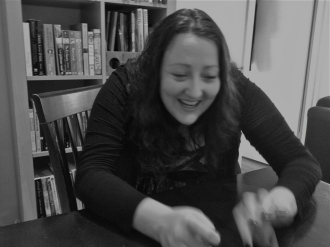
Adele’s one of my writing heroes because she used her blogging skills to shift from a career as a schoolteacher to a dream role as champion of youth literature in one of the coolest and most hipsterious* cities on the planet.
After I blogged on the unexpected joys of copywriting, I started to think of other writing careers that don’t focus on the ‘hunched over a desk cranking out a Great Novel’ model, and Adele came to mind.
There’s a lot of waffle written on the Internet about following your heart and living the dream – but Adele really did find a way to turn her passion into her career, using her writing skills as a springboard.
*Yes, hipsterious.
Here’s Adele on ‘how to get your dream job in 10 (easy?) steps’:
This is one in a series of posts supporting my article in the June 18th curriculum supplement to the New Zealand Education Gazette. Find more resources, interviews and features on comics in education via my site’s comicsedu tag.
Today, I’m joined by Raymond Huber and Hugh Todd, lifelong devotees of the iconic boy reporter, Tintin.

Raymond is a New Zealand children’s author whose novel Wings was a finalist in the 2012 Julius Vogel awards.
Hugh, a fellow Kiwi now based in Australia’s Blue Mountains, is a cartoonist, graphic designer and author of the Scholastic picture book Bring Back the Ball, Daisy Dog.
Raymond and Hugh agreed to discuss the enduring appeal of Europe’s most famous comic book character and his creator, Georges Remi, over an informal “dinner with Hergé”.
 matt finch / mechanical dolphin