This week I’m joined by an exceptional arts educator, Marta Cabral of Teachers College at New York’s Columbia University. Marta supports young children in creating art which is then exhibited in a gallery space, allowing her students to experience the roles of artist, curator, and exhibition guide. Her passion for student-directed learning and supporting the artistic expression of even the very youngest children is exceptional.
Here’s Marta on “Being in Wonder (Wonderings and Wanderings of an Early Childhood Studio Teacher)”:
Training as an infant school teacher brought me back to public libraries for the first time in ages. I’d stopped using them since the Internet had supplanted the local library as my source for obscure music, and I guess before that my last memory of a library was being brutally mocked by some badass teenage girls drinking round the back of one, the first time me and my best friend tried to get served in a pub underage!
As a teacher, school trips to the library were pretty anodyne – the best bit was the forced march three blocks or so from the infant school, the kids’ faces full of wonder as they held hands in pairs and went on a five year old’s adventure into the Big World of grocer’s stores and banks and traffic lights…then, the library.
It was an old building in sore need of refurbishment, overlit within by fluorescent striplights, walls painted the blank cream colour of a hospital corridor, and fitted with that curious, bristly tiled carpet forever associated with Britain’s more dismal civic spaces – probably not even the same colour throughout, with a patch of grey lingering in one corner where the fitters had run out of brown.
One of the first things I did on arrival in Auckland is arrange for the library to purchase a number of Nerf guns – toys which shoot foam darts – with the aim of encouraging librarians to create activities which combined literacy with more boisterous forms of action and adventure.
The message I’ve been trying to get across is that roleplay and activities which immerse you in a story are just as valid for libraries as anything involving books on shelves.
UNESCO’s Missions of the Public Library don’t even use the word ‘book’ once – but they do mention providing access to cultural expressions of all performing arts, stimulating the imagination and creativity of children and young people, and providing opportunities for personal creative development – alongside reading!
Corin has been, to his credit, an early adopter of the Nerf gun in Auckland – that’s him in the final frame of this YouTube video, which shows staff getting to grips with the toys:
Should we be allowing kids to identify with explicitly villainous figures? (Somewhere in my mum’s house there is a photo of me dressed as Darth Vader – but I alternated that costume with Spider-man pyjamas and my favourite hero outfit, Batman).
If kids use play to make sense of the world, do we have the right – or the power – to stop them thinking through violence and its consequences using play?
In the light of recent events, I’ll be following up on these questions after a pause for contemplation and acknowledgement of the tragedy in Massachusetts.
Today we’re joined by Paul Alborough – a witty British rapper who “hosts, performs and teaches hip-hop in more ways than you can imagine” in the guise of steampunk cleverclogs Professor Elemental.
Paul’s been interviewed many times about his music, but as I’ve recently started working in South Auckland, with its strong hip-hop culture, I was especially excited by his former career as a special needs educator, and his ongoing commitment to youth development through hip-hop workshops.
I began our interview by asking about Paul’s time as a teacher.
The truth is that I stumbled into it, having realised that I hated or had been fired from every other day job that I could possibly think of. That, and a natural affinity with children, who always seemed a lot more fun to hang out with than adults, led me to the world of education.
In the second part of his guest post for Books and Adventures, Steve Saville of Alfriston College in Auckland, New Zealand, discusses the lessons to be learned from his pioneering comics in the classroom workshops.
Most educators currently involved in secondary schools in New Zealand would agree that creativity is a good thing and that it needs to be encouraged; that we need to nurture and encourage the creative young people who will solve the problems posed by our ever changing world.
We can all look to our own school environments and proudly detail how creativity is nurtured, encouraged, and celebrated in our schools. We provide ample opportunities for writing, artistic expression, the creative use of digital technologies, dance, and drama. Our schools have bands, singers, sculptors. We offer classes in creative writing and philosophy. It can be argued that we have countless opportunities for young people to express and develop their creative skills.
We can also think of numerous teachers that we would classify as creative in their approaches, talented educators who find new and exciting ways to get their learners thinking. Teachers who challenge thinking by making learners ask questions and by asking learners to seek the relevance and authenticity of material studied.
All of this is totally correct – but is it enough?
It may be creative to enable a learner to write a story, to perform in a play or to design a web page but who chose the play and who decided the topic and who wrote the brief?
There is a difference between asking a learner to produce a creative response to something on a particular day, as part of a particular programme of work, and allowing an individual to be creative.
More profoundly, how can creativity flourish in schools, which are essentially non-creative environments?
Today, we’re joined by Steve Saville, deputy principal at Alfriston College in South Auckland. For four years, Steve has championed the use of comics in the classroom through a series of innovative workshops which have allowed students to develop and publish their own high quality comic books. In the first of a two-part guest post, Steve tells the story of Alfriston’s unique comic book education project.
Like most teachers, I can think of numerous times that I have attempted to encourage or develop creativity with students, both in and out of the classroom. Like most teachers, my in-class efforts have fallen firmly in the realm of teacher-directed, and therefore dictated, creativity.
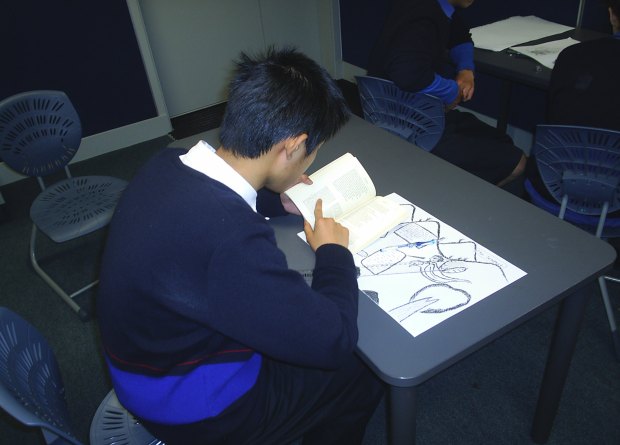
Comic book learning in action at Auckland’s Alfriston College
More recently, I’ve spent a few years encouraging learners to genuinely take control of the creative process, exploring creativity through the medium of comics. The aim has been to produce original comics that are of a publishable and professional standard. I have done this within a single school environment, Alfriston College. A potted history of our programme follows.
Paint the Town REaD (PTTR) is the Australian initiative which encourages families, carers and the wider community to ‘read, talk, sing and rhyme with your child from birth.’
I tend to give speeches the same way I used to prepare my classroom as an infant school teacher: research the topic, put loads and loads of resources into place, then allow free play across the interests and needs of the audience. Today’s blog post captures a few highlights from the conference’s keynote discussion, assembled under the hashtag #occupyliteracy.
Adele’s one of my writing heroes because she used her blogging skills to shift from a career as a schoolteacher to a dream role as champion of youth literature in one of the coolest and most hipsterious* cities on the planet.
After I blogged on the unexpected joys of copywriting, I started to think of other writing careers that don’t focus on the ‘hunched over a desk cranking out a Great Novel’ model, and Adele came to mind.
There’s a lot of waffle written on the Internet about following your heart and living the dream – but Adele really did find a way to turn her passion into her career, using her writing skills as a springboard.
*Yes, hipsterious.
Here’s Adele on ‘how to get your dream job in 10 (easy?) steps’:
I recently took a contract putting stilted government language into plain speech. I’m rewriting hundreds of web pages covering all kinds of public service – from pest control to parking and schools to recycling.
Public sector copywriting might not sound glamorous, but it’s fun to attack a mountain of jargon and break it down into something clear, friendly, and informative for a wider readership.
I meet a lot of students who want to make a living as a writer. Although there’s a few working on screenplays, many teens imagine themselves growing up to be novelists – solitary, self-reliant figures hunched over a desk, creating a masterpiece which will earn them Rowling megabucks.
Yet the joys of many writing jobs are not solitary but social. Journalism and copywriting both involve getting out, talking with people, communicating and learning.
I was only knee-deep in icy seawater, but that was enough. Beside me, a half-dozen anxious Moms formed a loose human chain. We were trying to cordon off a horde of 6-year-olds, cheerfully running amok at the water’s edge. My eyes flicked around the shoreline, trying to keep track of each and every child. I’d been teaching for less than a year and the safety of these happy, heedless kids was my responsibility.
You think you know fear? Try taking a class of 1st graders to the beach.




 matt finch / mechanical dolphin