In advance of the conference, we got together for an informal chat covering five years of work pushing the boundaries of occupational therapy education, exploring what futures & foresight work can do for occupational therapists, and how learning from the futures which challenge our assumptions can complement the practical experience which comes from student placements.
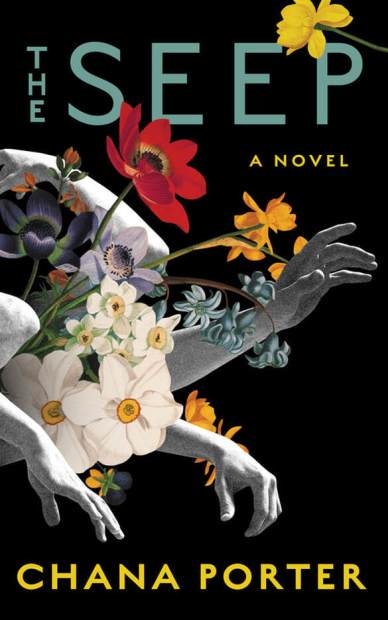
Playwright, novelist, and education activist Chana Porter joined me to talk about her new novel The Seep.
In the book, Porter imagines an alien invasion of an unusual kind. The Seep find their way into the Earth’s ecosystem and cause every living being on the planet to become connected. “Capitalism falls, hierarchies and barriers are broken down; if something can be imagined, it is possible.”
M: The book is so steeped in grief, and it’s a theme we see elsewhere in your writing; the play Phantasmagoria has this question, for example, “Do the dead truly leave us?”
How did grief come to the forefront in this particular novel?
C: Don’t you think that ageing is a kind of grief? We betray our younger selves, our ideas of who we were or what we wanted, as we move on in time. I’ve lost some dear people who are close to me, people who died suddenly and young, so I have a little more of that shock of grief than some — but I think that in any kind of long-term relationship, what people don’t tell you about marriage is that there is a slow betrayal of whoever you were on your wedding day. I think that if there’s not, you’re doing it wrong!
You need to become another person when you make this commitment, and you’re very lucky if you can change alongside your partner in a way that you get to rediscover one another. I don’t really know how we manage to promise anyone else anything, except to be clear, and true, and kind.
Playwright, novelist, and education activist Chana Porter joined me to talk about her new novel The Seep.
In the book, Porter imagines an alien invasion of an unusual kind. The Seep find their way into the Earth’s ecosystem and cause every living being on the planet to become connected. “Capitalism falls, hierarchies and barriers are broken down; if something can be imagined, it is possible.”
M: I was reading about your play Leap and the Net Will Appear. You talk about the play coming to you after a silent retreat. I wondered about what the balance between writing-as-inspiration and writing-as-carpentry was for you?
Playwright, novelist, and education activist Chana Porter joined me to talk about her new novel The Seep.
In the book, Porter imagines an alien invasion of an unusual kind. The Seep find their way into the Earth’s ecosystem and cause every living being on the planet to become connected. “Capitalism falls, hierarchies and barriers are broken down; if something can be imagined, it is possible.”
Trina Goldberg-Oneka, a middle-aged trans woman, is the book’s protagonist. An artist who retrains as a doctor after the invasion, she cherishes “the casual overthrow of everything that had felt codified but broken for so long“ — until her partner Deeba decides to use the Seep’s power to be reborn as a baby, moving on to a new life. The book follows Trina along her spiral of grief as she begins a strange quest in a transformed world.
Our conversation touched not just on the novel, but also Porter’s plays and her work as an education activist. She is a founder of the Octavia Project which brings together young women and trans, gender non-conforming, or non-binary teens to create speculative fictions offering “new futures and greater possibilities for our world”, blending creative writing, art, science, and technology.
I began by asking Chana about her first glimpse of the idea that became The Seep.
C: There’s a secret book that probably no-one will ever see, written from the point of view of a teenager in my hometown.
I was really intrigued by this concept of an Invasion of the Body Snatchers style alien takeover, without it being a cut-and-dried thing of “This is good, this is bad.” This is also the feeling I have when I watch the 1978 Body Snatchers movie; it feels so brutal because we don’t really understand what these beings are feeling or what they care about, but the more that we understand as a scientific community about how trees communicate with each other, and protist communications, the more we question: what is alive? What is a life? What is social? What is a community?
When you use the lens of a horror film to reflect on these issues, when you consider the destruction we have wrought on the planet, it prompts you to ask: what if it’s not bad?
I wouldn’t say I have the best handwriting. It’s a bit of an unpretty scrawl, though people can mostly decipher it. I use my left hand to hold a pencil or pen, though I do everything else with my right; I can’t use left-handed scissors or can openers, and whenever it was I last played cricket or tennis, my right hand was dominant. I’m probably a natural righty who picked up the left-hand habit from copying a left-handed parent, back in those days when they first get you to clutch a crayon and make your mark.
M.C. Escher, Drawing Hands
This week, I was helping a group of people learn to use scenario planning. There are a lot of ways to define what a scenario is, but in the Oxford Scenario Planning Approach, scenarios are assessments of the future context, developed for a particular user and purpose, to contrast with the way that the future context is currently being framed. People engaged in scenario planning devise plausible futures in order to test assumptions, challenge existing framings, and enrich decision-making in the present.
Stretching your sense of the futures you may have to inhabit can feel like “thinking with your non-dominant hand”. We’re so used to trying to solve the problem in front of us, “get on with the job”, fix things, make them better, chart a course, steer the ship. The act of strategic reframing – creating plausible futures to stretch our understanding of a given context – can feel seriously counterintuitive.
Even clasping your hands or crossing your legs the opposite way round to usual can feel odd; using your non-dominant hand when playing sports, using scissors, or writing could feel even more so. So it’s not a surprise that scenario planning might feel strange when you first try it.
Yet releasing yourself from a dominant or habitual approach can bring all kinds of benefits. You may be forced to rethink processes from first principles, returning you to “beginner’s mind” and unpicking tightly woven assumptions. You may find that your engrained habits of thinking are patterns of comfort and convention, rather than the best way to address an issue. You may see things from a different angle when approaching from the left instead of the right, or vice versa.
In successful scenario planning engagements, people often feel a sudden moment of realisation – what the pioneering scenario planner Pierre Wack called an “a-ha” moment. “It does not simply leap at you,” Wack wrote in a 1985 issue of the Harvard Business Review. “It happens when your message reaches the microcosms of decision makers, obliges them to question their assumptions…and leads them to change and reorganise their inner models of reality.”
Once people have experienced this benefit of thinking from the “outside in” – starting with future contexts, then working back to an assessment of options and strategic possibilities, often in an iterative process which is enriched by multiple repetitions – they see the merits in going against the grain of habit.
The more they employ this approach, the better their “muscle memory” for scenario work. (A right-hander who tries playing the guitar left-handed just once might not get very far, but continued practice could yield competence and even virtuosity). Gradually it becomes possible to integrate “left-handed” and “right-handed” thinking into processes of assessment and decision-making, so that our perceptions, our judgment, and our capacity to act are enriched.
And in times of turbulence and uncertainty, when tomorrow will not be like yesterday or today, that could make all the difference.
The “Instructions…” emerge from theIMAJINE project exploring the future of European regional inequality. The text experiments with a second-person perspective, inviting the reader to dream themselves into the bodies of four very different figures drawn from early drafts of IMAJINE’s four scenarios for the future of Europe in 2048.
For the latest edition of Information Professional magazine, I interviewed singer-songwriter Jonatha Brooke about her experiences creating an album of new songs from Woody Guthrie’s archives.
Matt: Guthrie’s archive is a blend of images and words, sketches and paintings – it’s not just a collection of texts, let alone ready-made lyrics waiting to be put to music. What surprised you when you started to explore what he’d left behind?
To consume media today means using the same tools and skills as it takes to produce; the device in your pocket is capable of both and its platforms are built with this in mind. This is a profound shift, even from the assumptions that underlie the web, and it’s a landscape in which, superficially, the book does not seem to have an obvious place.
In the latest edition of his newsletter, marginalia, Australia’s Simon Groth describes the closure of if:book Australia, the Brisbane-based “institute for the future of the book” which explored new forms of literature and the changing relationship between writers and readers in the digital age.
Simon’s elegaic piece recounts his journey with if:book as “one of being swept up by larger shifts in current that made it possible—if only for a brief moment in time—to create interesting experiences and opportunities for a small number of writers and readers to engage with each other”.
The anxieties and excitement around digital literature in the 2010s, back when some thought that “the ebook spelled the end of civilisation as we know it”, created an opportunity for the if:book community to surf for a while on some of the more challenging and remote parts of Australia’s literary coastline. No matter how many people were standing on the shore to bear witness, those surfers know what they achieved. The tricks and techniques they discovered will continue to teach all of us who are interested in the future of the written word, both digital and physical.
Today, Simon notes, if:book Australia has no web presence:
Its various project sites have all vanished, their domains no longer point to active sites. Its social media accounts are deleted. If not for the Internet Archive, there would be almost no online evidence that any of it had happened. Maybe this was how it was meant to be. Memory Makes Us had already anticipated disappearance as the logical end for digital literary projects. Such is the nature of the web and digital media more broadly: the threat of data rot is much more aggressive and immediate than the slow degradation of the page.
[…] Ten years on from its initial flurry of activity, its bold charge to explore and investigate how technology was set to expand our conception of the book, all that’s left of if:book Australia is a collection of printed, bound pages.
Last month, I invited three photographers to discuss how their medium is used for art, research, and storytelling in families, communities, and institutions.
Joining me for the conversation were Australian artist Wendy Catling, Research Librarian Dr. Natasha Barrett of the Alexander Turnbull Library (National Library of New Zealand Te Puna Mātauranga o Aotearoa), and British filmmaker Jonathan Bart.
Do photographs offer a collection of scattered moments or an unbroken connection to the past? From first pictures taken through “memories of memories”, stories of migration and famiy secrets, questions of colonialism, agency, and power, my three guests talk candidly about their personal, professional, and artistic relationships to this unique and powerful medium.
Information architects design, organize, and label digital artefacts and services like websites, intranets, and software to help people find and use the information they want and need. Recently, Peter Morville, one of the “founding fathers” of IA, proposed a new definition: “the design of language and classification systems to change the world”. (You can read my interview with Peter here). In uncertain times, information architects need tools to think about the futures which their work may have to inhabit. That’s where scenario planning comes in.
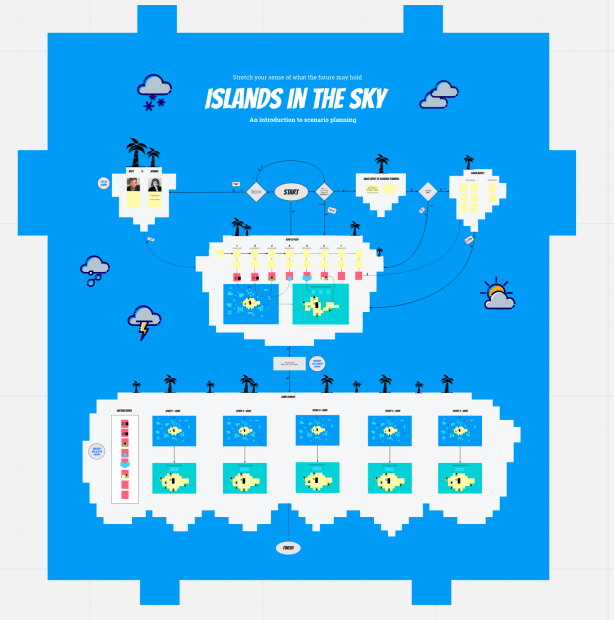
Our interactive conference session invites attendees to try their hand at the basics of scenario planning, in a playful and thought-provoking online setting. It’s a successor of sorts to the in-person Library Island game which was so well-received in pre-COVID times.
We’ll report back from our experiments at the IA Conference and keep you updated as the Islands evolve.