The Spanish Ministry of Culture and Sport’s “Laboratorios Ciudadanos” (Citizen Labs) course returns this year, offering a series of online modules for Spanish speakers who would like to develop community-led innovation projects in their local area.
Si hablas castellano y te interesan las cuestiones de innovación liderada por la ciudadania, inscríbete antes del 29 de abril de 2021 para un viaje de aprendizaje y aventura. Sign up before 29th April 2021 to join us on a journey of learning & new adventures in citizen-led innovation.
The new strategic plan for Open Education Global (OEG), “Open for Public Good“, has just been released.
OEG is a member-based, global non-profit supporting the development and use of open education around the world. Over a six month period, I supported their leadership team in devising and delivering a planning process designed to engage stakeholders, elicit insights, and develop key areas of focus as part of a long-term strategy for the organisation.
Matt Finch played a tremendously helpful role in the development of Open Education Global’s 2021-2030 strategic plan – Open for Public Good.
Matt provided input and recommendations on what the overall process for developing a strategic plan should entail. He provided guidance on how to design hands-on interactive activities participants could do virtually during a pandemic to provide their input and recommendations. He introduced me to new concepts of value co-creation that ended up being one of our three areas of strategic focus. And he served as a member of a working group charged with synthesizing all the inputs into a draft strategic plan.
Throughout this entire process Matt was caring, helpful, and provocative, making sure we considered unexpected and novel perspectives. The resulting plan has been shared widely and is being received with excitement and support. I’m a Matt Finch fan and plan to do more work with him going forward.
Paul Stacey, Executive Director, Open Education Global
Last month, I spoke with Travis Egedy, who makes electronic dance music as Pictureplane. His most famous track is “Goth Star”, a 2009 cut built from a Fleetwood Mac song, “Seven Wonders”, which he broke down and stripped for parts.
“Goth Star” is all but unique in the Pictureplane repertoire: Egedy doesn’t play any instrument or sing, but chops and layers the 1980s track until it’s all but unrecognisable. (The video depicts a séance whose participants are visited by the ghost of Stevie Nicks, her vocals transformed into yelps and word-fragments that taunt us with the possibility of deciphering them). Every single element of the song comes from Fleetwood Mac’s original.
“Goth Star” has its own origins in Egedy’s Santa Fe high school years, when, as an aspiring hip-hop musician, he’d raid the CD collections of his friends’ parents for anything that might yield a good beat.
I turned my ankle walking in the park the other day, which is good going for someone who used to hike at every opportunity and now, in lockdown, barely gets more than a block from his house.
It hurt a little, but the more notable thing is that it revived some memories.
Ten years ago, I broke my leg quite badly. It required surgery, and they screwed the bone back together with bits of metal.
It never really gives me problems these days, but any injury to the same leg gets me wondering and even worrying: Have I done something to the screws? Am I going to have to go through all of that again?
I dealt with my park injury as I usually would, but the real problem was the sensation of “having done something to my leg”. Every bit of sensory information coming from that part of my body now goes through the lens of history, memory, and emotion. Does it feel weird? Does it feel different? Is there a problem there? I have to try and separate out my historic feelings from the present experience – not rejecting them, but recognising them for what they are.
Pain is a great source of information, if only you know how to process it.
The great choreographer Twyla Tharp wrote that:
“The dancer learns early to take pain for granted and that there is great freedom in choosing how to respond to its appearance. The thing NOT to do is deny pain. It must be acknowledged. Sometimes the right way of moving forward will be to push through pain. Your choices determine who you will be, who the world will see[.]”
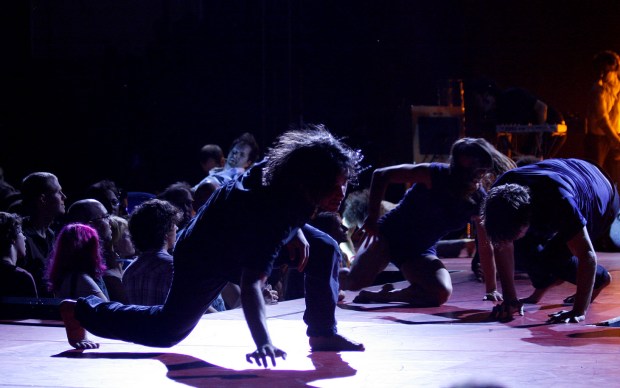
Ultima Vez / Wim Vandekeybus + Mauro Pawlowski: “What’s the Prediction?” (ImPulsTanz Vienna 2010)
Walter Benjamin wrote a few famous lines about Paul Klee’s artwork Angelus Novus. You may know them:
A Klee painting named ‘Angelus Novus’ shows an angel looking as though he is about to move away from something he is fixedly contemplating. His eyes are staring, his mouth is open, his wings are spread. This is how one pictures the angel of history. His face is turned toward the past. Where we perceive a chain of events, he sees one single catastrophe which keeps piling wreckage and hurls it in front of his feet. The angel would like to stay, awaken the dead, and make whole what has been smashed. But a storm is blowing in from Paradise; it has got caught in his wings with such a violence that the angel can no longer close them. The storm irresistibly propels him into the future to which his back is turned, while the pile of debris before him grows skyward. This storm is what we call progress.
-Walter Benjamin, “On The Concept of History”
Imagine the plight of Benjamin’s angel today. The winds are more turbulent than ever. The ground on which the angel walks has become, perhaps, more unstable. Each step, however small, is taken in extreme uncertainty.
Perhaps the angel has come to realise that they are no longer alone. Other angels, with other perspectives and other understandings of what has gone before or where they are headed, also stagger against the storm. However much they wish to stay with the past that has gone before them, they are constantly driven onwards.
Earlier this year, I interviewed the academic and researcher Mark Stewart about the changing nature of television in the digital age. Our discussion, presented in two parts, explores the geography of televisual culture: who gets access to what TV and when? Whose content is privileged and whose is excluded? What happens when you can’t get the shows you’re looking for, because you find yourself in the “wrong” part of the world or wanting the “wrong” content?
Mark also talked about his personal journey to becoming a television studies researcher and how he found himself reading his way into a culture of shows and movies which had not featured in his New Zealand childhood. You can read the first part of our interview here.
*
I want to return to this question of networks, and awareness of what is out there, from online Buffy fandom, to the streaming services’ cornucopia, to the grey market trading in unlicensed material. How do you map the television landscape?
Mainstream content providers are locked into a framework which is colonial. It consists of a set of privileged spaces which generate and export content for the rest of the world – both as a capitalist endeavour but also to establish certain values and norms.
In the age of subscription streaming, you enrol into the system, you accept that you’re its subject; you play by capitalist rules as you subscribe, you accept that they’ll tell you: “This is what comedy looks like, this is what drama looks like, this is what sexy looks like…”?
Part of the intent is to share a set of cultural values and assumptions that make the environment more hospitable to the content provider. One of those assumptions is that there is a homogenous nation of television watchers. Yet in every corner of the world, we’re way beyond that kind of homogeneity; we understand that the nation is an imposition. Its boundaries are permeable, it’s filled with diverse and ill-fitting and resistant elements.
Earlier this year, I interviewed the academic and researcher Mark Stewart about the changing nature of television in the digital age. Our discussion, presented in two parts, explores the geography of televisual culture: who gets access to what TV and when? Whose content is privileged and whose is excluded? What happens when you can’t get the shows you’re looking for, because you find yourself in the “wrong” part of the world or wanting the “wrong” content?
Mark also talked about his personal journey to becoming a television studies researcher and how he found himself reading his way into a culture of shows and movies which had not featured in his New Zealand childhood.
*
A few years back, you wrote about “the myth of televisual ubiquity”, this notion that despite the sense that television is abundant and easily available worldwide now, there are still barriers, restrictions, and friction when it comes to global access to television. The “tyranny of distance” still applies thanks to national borders, licensing deals, and the assumptions made by content providers about what kinds of show people want to watch.
We caught up to talk about her work using games as a tool to stimulate and develop the thinking of policymakers, including the innovation board game Innovate!, which was released in 2018.
Playing the Innovation Policy board game prototype – image courtesy of Nesta
M: You’re fond of quoting Bernard Suits in The Grasshopper: games are “the voluntary attempt to overcome unnecessary obstacles”, what he calls “the lusory attitude.” Have you always enjoyed overcoming unnecessary obstacles?
F: It’s a really cool quote, isn’t it? I’ve always been into all kinds of games; growing up with two brothers who are close in age, and parents who weren’t great fans of television or pop culture, I spent a lot of time “off screen”. As I grew older, I graduated from games like Uno to those which my parents might have labelled as “brain games” – more intense and elaborate stuff like Pandemic or Risk, where you might end up banging your head against the board!
M: Games serve so many purposes: entering an imagined world, competition, intellectual challenge, social connection — for you, was there one particular aspect which appealed above all?
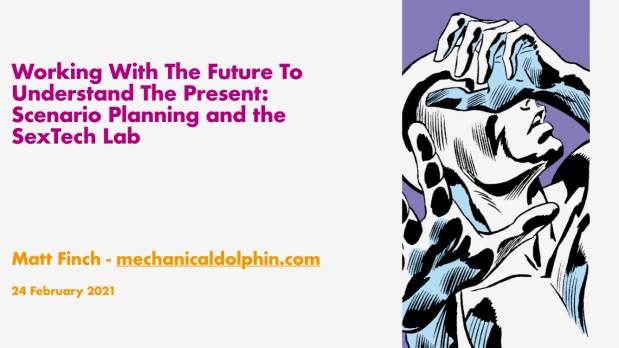
I was privileged to be Dr. Pani Farvid‘s guest at The New School’s SexTech Lab this week, talking about how researchers of gender, sexuality, and identity can work with the imagined future to understand the present and challenge its assumptions.



_10.jpg)