We The Humanities: Interview with Natasha Barrett, University of Leicester

This week you can find me over at @wethehumanities, a rotating Twitter account where people working in the humanities get to share ideas, experiences, and stories. I’m using my week to talk about the grey areas between fact and fiction, dream and experience, stories and everyday life – as well as people who cross back and forth over the walls of universities and academic institutions.

Today I’m joined by Natasha Barrett, a British researcher and cultural heritage expert currently studying for a doctorate at the University of Leicester.

Natasha tells me: 

I’m researching commercial colonial-era photographs (1860s-1914) of Māori (the indigenous Polynesian people of New Zealand) and their taonga/cultural treasures. Essentially I’m looking at the meaning of these photographs to Māori, and how they have been used over time both within and outside of museums. I’m also considering how Māori perspectives can inform the way these photographs are understood in museums. My approach treats photographs as three-dimensional objects. I pay close attention to their material qualities, such as the albums they are placed in, any writing on their surfaces. As well as, the sensorial or different ways people engage with photographs, inlcuding looking at, talking about and touching them.

You’ve returned to academia after a long time working in the cultural heritage sector; what’s it like returning to research and how have your experiences off-campus shaped what you do now? Read more

We The Humanities: Interview with Daisy Johnson, University of York

This week you can find me over at @wethehumanities, a rotating Twitter account where people working in the humanities get to share ideas, experiences, and stories. I’m using my week to talk about the grey areas between fact and fiction, dream and experience, stories and everyday life – as well as people who cross back and forth over the walls of universities and academic institutions.

Writer, researcher, and librarian Daisy Johnson blogs on children’s literature and literary tourism – which also happen to be her research topics as a doctoral candidate at the University of York. She began by telling me about her thesis.

I research children’s literature and literary tourism in the United Kingdom. I’m interested in what happens after the book; that moment when you visit somewhere in the real world that you’ve previously read about in a book.

I think I’ve always been interested in literary tourism without quite knowing what it is. I visited the Achensee in Austria when I was younger, solely because of my interest in the Chalet School series by Elinor M. Brent-Dyer, and ever since that point, I’ve been interested in the edges of the literary experience and what happens when you experience the fictional in the real world and vice-versa.

Read more

We The Humanities: Interview with Matti Bunzl, Vienna Museum

This week you can find me over at @wethehumanities, a rotating Twitter account where people working in the humanities get to share ideas, experiences, and stories. I’m using my week to talk about the grey areas between fact and fiction, dream and experience, stories and everyday life – as well as people who cross back and forth over the walls of universities and academic institutions.

One such person is Matti Bunzl, a personal hero of mine. Back when I was a postgraduate studying Austrian identity and refugees from the Nazis, Bunzl was an brave and innovative Chicago-based anthropologist whose careful, critical works captured the ways in which Austria had manipulated the representation of its past.

Today, Bunzl is director of the Wien Museum in Vienna: a triumphant step in his ongoing adventures in history and anthropology. He agreed to answer a few questions for my @wethehumanities session. Read more

Curious, Mysterious, Marvellous, Electrical: (Un)comfortable Defiance

1968 Mexico Olympics, Men's 200m winners' podium

This week’s Marvellous, Electrical looks at Brisbane street art and how we remember a quiet gesture of defiance from 1968: 200m runner Peter Norman chose to wear a human rights badge in solidarity with black US athletes in the year of Martin Luther King’s death.

Ostracised by the Australian athletic community after this act, Norman descended into depression, painkiller addiction, and heavy drinking. The Australian government only apologised for his treatment six years after he died.

How can we remember Norman today, acknowledging his heroic act without hiding the grim reality of the years which followed?

You can subscribe to the Curious, Mysterious, Marvellous, Electrical newsletter here.

Curious, Mysterious, Marvellous, Electrical: All We Leave Are The Memories

You can subscribe to the Curious, Mysterious, Marvellous, Electrical newsletter here.

Brisbane’s weird, in the best way. They’ve got portals into the past – actual physical gateways. Years ago, they had state-sponsored magicians who could make buildings disappear overnight. Their job was to erase the city’s history. These things happened right in the middle of town.

It’s all documented. The magic’s fading now, and when I first heard the stories, I assumed it was just people exaggerating. But I work in an archive, the place where records are kept, and it turns out Brisbane’s magic is real.

Check it out over at Curious, Mysterious, Marvellous, Electrical.

Curious, Mysterious, Marvellous, Electrical: Dinner at the Circus

You can subscribe to the Curious, Mysterious, Marvellous, Electrical newsletter here.

This week’s newsletter features an interview with Dale Woodbridge-Brown, acrobat and ringmaster at Circus Oz.

While Dale gave me an unusual Australian cookery lesson, we talked about sport, storytelling, country childhoods, and indigenous identity.

Check it out over at Curious, Mysterious, Marvellous, Electrical.

Dulwich Picture Gallery – 3D biographical comics

You can now see video from last month’s event “Your Mind Is The Scene Of The Crime” at Dulwich Picture Gallery in London.

Inspired by the work of M.C. Escher, the event saw teens exploring comics and biography through thirty boxes containing text and images from the life of a mysterious woman.

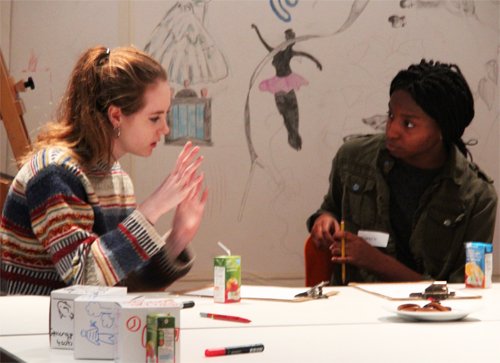
Teens discuss biographical comics at Dulwich Picture Gallery

Over the course of a two-hour session, participants transformed the thirty boxes into individual artworks which together formed a biographical installation: a three-dimensional comic book which used perspective and storytelling to respond to the facts and feelings of a stranger’s life.

Read more about Escher, Dulwich, and Your Mind Is The Scene Of The Crime here.

Curious, Mysterious, Marvellous, Electrical: The Butcher of Mungindi

You can read this week’s Curious, Mysterious, Marvellous, Electrical newsletter here.

Last week I set off on a 1000 kilometre road trip across rural Australia on a kind of impulse Bowie pilgrimage.

I didn’t get to my destination, but found myself at the border between Queensland and New South Wales: a land of cotton farms, ice, drought, and drama.

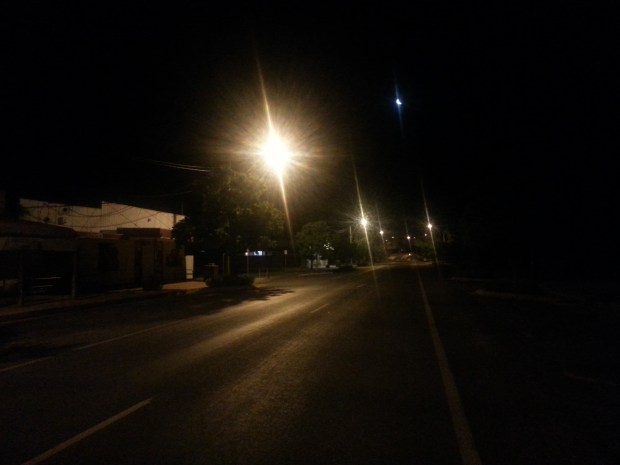
The night time streets of Mungindi, on the border of Queensland and New South Wales

I learned about beer and butchery, drugs and irrigation, the ballad of Kelly and Red, plus timezones, crime, and the One Ton Peg in the thick of the bush.

You can learn about those things too, over at Curious, Mysterious, Marvellous, Electrical.

Curious, Mysterious, Marvellous, Electrical: Bowie at the Aussie Borderlands

You can read this week’s full newsletter here.

David Bowie performing in the 1980s

I was seriously late to discover David Bowie. When I was a kid, I didn’t like him very much; I was born in 1980, so the Bowie I grew up with was a pretty mainstream pop star, like Elton John or Cher. I remember the Bowie of Live Aid and “Dancing In The Streets”, not Ziggy Stardust or the Berlin years, and I hadn’t been around for the extraterrestrial visitations of the 70s, when he’d blown away a generation of kids desperate to know it was okay to be different.

A post by the writer Javier Grillo-Marxuach reminded me this week that the whole point of mid-Eighties Bowie was to be mainstream that way. He explained that his favourite Bowie track was the middle-of-the-road “Modern Love”:

my favorite bowie song is “modern love”: it proves that bowie’s art sprang from complete mastery of form. it was bowie declaring that just in case anyone thought he hadn’t written a perfect, chart-busting, commercial radio-friendly, movie-soundtrack baiting song that would make elton john blush with envy, it was purely by choice.

Dave Thompson’s Hallo Spaceboy quotes Bowie himself on the same era:  “‘Let’s Dance’ put me in an extremely different orbit… artistically and aesthetically. It seemed obvious that the way to make money was to give people what they want, so I gave them what they wanted, and it dried me up.”

I guess I just hadn’t realised, as a little kid, that in seeing mainstream Bowie, I was missing the other chapters of his story.*

When I got into young adulthood, I started to ask new questions: who was it okay to kiss, to love; who was allowed to paint their nails, their lips, colour their hair. Now Bowie’s value as a star to navigate by – discussed beautifully by Stella Duffy here – became clear to me.

I was surprised how much I felt his death this week. Not so much because he was currently at a creative peak, but because he was a truly heroic figure for any of us who ever wondered about the ways you could choose to be different.

I heard the news of his death while I was en route from Europe to Australia. After landing, I spent my first couple of days in Australia on a kind of Bowie pilgrimage through the long, arid stretches of rural Queensland and New South Wales. The video for “Let’s Dance”, Bowie’s most successful and mainstream song, was shot in country Australia in 1983.

You can read about what happened on my trip at this week’s Curious, Mysterious, Marvellous, Electrical. You can also subscribe to the newsletter here for ongoing weekly updates.

*As a child, I probably preferred Midge Ure and Ultravox to Bowie, which doubtless says terrible things about me – except you can read Leigh Alexander writing brilliantly about 80s nostalgia, video games, and Midge Ure’s cover of The Man Who Sold The World here