I joined Jaqueline Crawshaw of Energy Consumers Australia on their Watts Next podcast to discuss how we can deal with uncertainty in matters of policy, governance, and leadership.

I joined Jaqueline Crawshaw of Energy Consumers Australia on their Watts Next podcast to discuss how we can deal with uncertainty in matters of policy, governance, and leadership.
On Wednesday May 10th, I’ll be speaking at the New School’s SexTechLab on “Foresight, Justice, and the Territorial Body in Time”.
How can we explore what lies at the future intersections of gender, race, sexuality, culture, technology, AI, ethics, social justice, and intimacy?
Given that we can’t gather data or evidence from events which haven’t happened yet, how can exploring times to come usefully inform issues we face in the here and now?
What lies beyond hope, fear, expectation, and prediction when we look to what tomorrow holds?
This past weekend saw the celebration of Earth Day on 22nd April. Since 1970, the date has provided a moment of focus and celebration for communities and organizations focussed on protecting our environment.
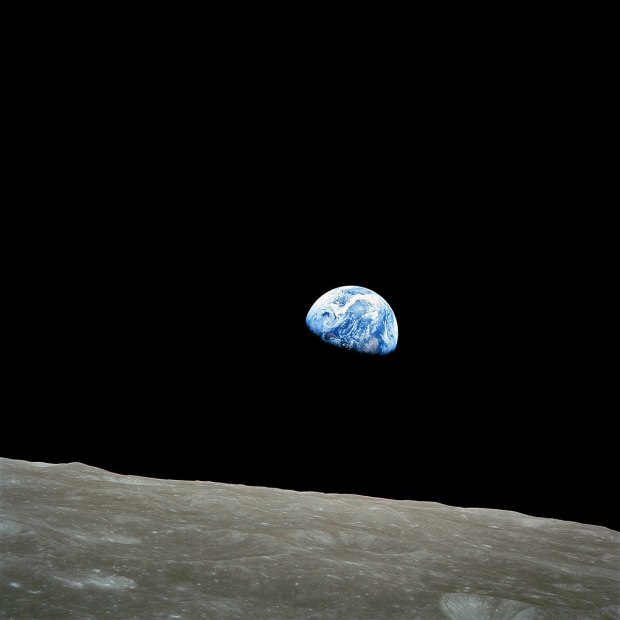
The first Earth Day was shaped by many factors. These included the 1969 Santa Barbara oil spill in Southern California, which caused public outrage and helped motivate Republican President Richard Nixon to found the US Environmental Protection Agency, and the Earthrise photograph taken by Apollo astronaut Bill Anders in 1968, which has been described as “the most influential environmental photograph ever taken”.
Earth Day serves to draw our attention, energising debate and action around what must be done to protect and sustain our planet’s environment. The events from over fifty years ago, which helped to inspire its creation, remind us of the ongoing need to cultivate fresh perspectives, in order to act effectively in these complex and turbulent times.
Read moreWell, it’s like cranes in the sky
Sometimes I don’t wanna feel those metal clouds
Some time ago, I found myself reflecting on Solange’s song ‘Cranes in the Sky’ at the end of a strategy project. Sometimes the best way into something is at an angle; not through the Excel sheets and the PDFs and the ‘lessons learned’, but through a feeling, a stray thought, an analogy, a song or an image which reminds you somehow of the matter at hand.
In a 2017 interview with her sister Beyoncé, Solange explains where the song came from:
“Cranes in the Sky” is actually a song that I wrote eight years ago. It’s the only song on the album that I wrote independently of the record, and it was a really rough time. I know you remember that time. I was just coming out of my relationship with Julez’s father. We were junior high school sweethearts, and so much of your identity in junior high is built on who you’re with. You see the world through the lens of how you identify and have been identified at that time. So I really had to take a look at myself, outside of being a mother and a wife, and internalize all of these emotions that I had been feeling through that transition. I was working through a lot of challenges at every angle of my life, and a lot of self-doubt, a lot of pity-partying. And I think every woman in her twenties has been there—where it feels like no matter what you are doing to fight through the thing that is holding you back, nothing can fill that void.
I used to write and record a lot in Miami during that time, when there was a real estate boom in America, and developers were developing all of this new property. There was a new condo going up every ten feet. You recorded a lot there as well, and I think we experienced Miami as a place of refuge and peace. We weren’t out there wilin’ out and partying. I remember looking up and seeing all of these cranes in the sky. They were so heavy and such an eyesore, and not what I identified with peace and refuge. I remember thinking of it as an analogy for my transition—this idea of building up, up, up that was going on in our country at the time, all of this excessive building, and not really dealing with what was in front of us. And we all know how that ended. That crashed and burned. It was a catastrophe. And that line came to me because it felt so indicative of what was going on in my life as well. And, eight years later, it’s really interesting that now, here we are again, not seeing what’s happening in our country, not wanting to put into perspective all of these ugly things that are staring us in the face.
Sometimes it’s so hard to face the real issue, what the strategist Richard Rumelt might call the crux or the kernel of a situation. Our anxiety about facing up to the truth causes our attention to slip away from harsh reality; we seek comfort in makework that seems to gird us.
Read moreI’m very pleased to be joining the Romancing the Gothic lecture series for a session on “Climate, Justice, and the Strategic Sublime: Scenarios as Gothic Genre”.

The lecture, which will take place at 10am BST on Sunday 21st May, with a repeat at 7pm BST the same day, forms part of the “EcoHorror, Nature and the Gothic” lecture season.
Register for the 10am BST session on Eventbrite here.
Register for the 7pm BST session on Eventbrite here.

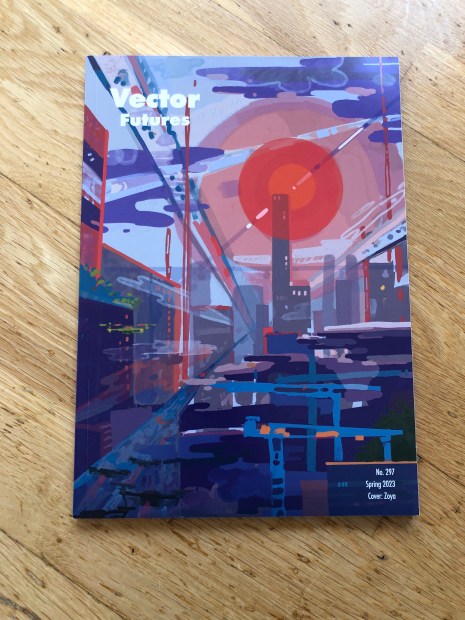
“Facing The Strategic Sublime: Scenario Planning as Gothic Narrative”, my piece with Marie Mahon, is in the latest issue of the British Science Fiction Association’s Vector magazine.
You can read the article below as a PDF download, or at the Vector website.
The team at Energy Consumers Australia have shared videos and resources from last month’s 2023 Foresighting Forum online.
You can watch a video recording of my interactive keynote for attendees on YouTube.
On 21st April, I’ll be joining a webinar hosted by the Singapore chapter of the International Society for Knowledge Organization to discuss scenario planning, strategic foresight, and knowledge management.
Hosted by Patrick Lambe, the session will include panellists Gary Klein of Macrocognition LLC and Susann Roth of the Asian Development Bank as well as myself.
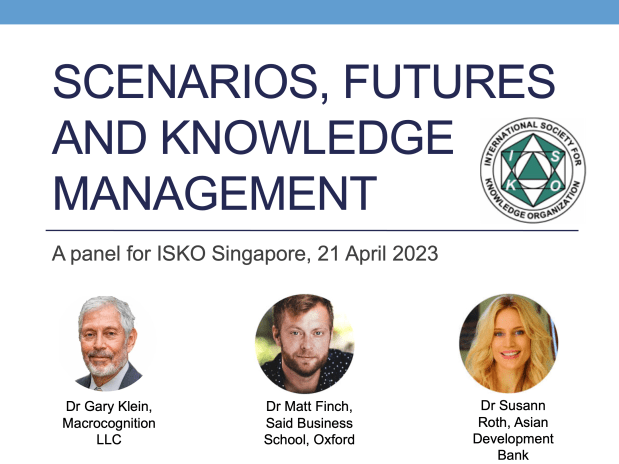
The online event takes place on Friday 21 April 2023, 7.00-8.30pm SGT (7.00am EDT, 12 midday UK, 7.00pm Manila) – find out more and register here.
There’s been a feeling lately of things coming full circle for me.
There’s been a period in which the links between the scenario work I do today and the art of moviemaking, which obsessed me as a kid, became very evident – you can see some of this in my recent writing on Decision to Leave, Burden of Dreams, and The Limey.
And I found myself training as a group facilitator at the Tavistock and Portman NHS Trust, a specialist mental health organization in the UK.
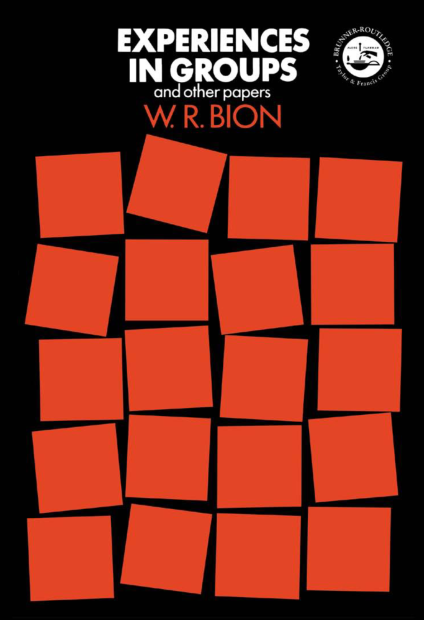
This is a journey I probably should have seen coming ever since a colleague, Steffen Krüger, sat down with me after a scenario planning workshop which had left Post-It notes strewn across a number of whiteboards, and showed me the strangely resonant cover of the psychoanalyst Wilfred Bion’s book Experiences in Groups.
The team at Energy Consumers Australia have released a short Q&A video covering aspects of my recent keynote on dealing with uncertainty in sociotechnical systems.
You can find more from the recent Energy Consumers Australia 2023 Foresighting Forum here.


 matt finch / mechanical dolphin
