Mega Robo Bros: The End / Interview with Neill Cameron

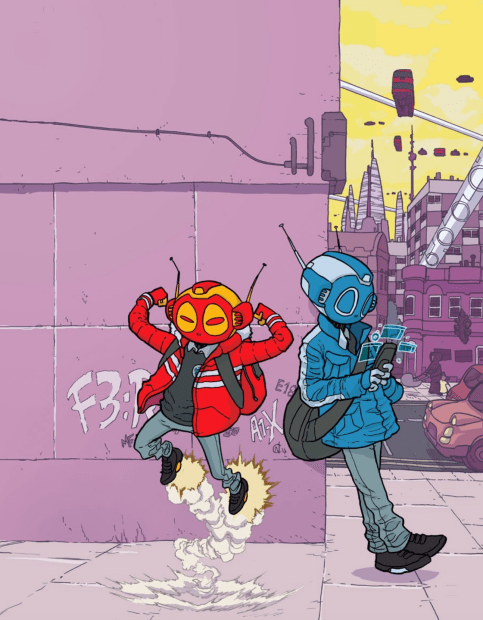
Earlier this year, I spoke with the great Neill Cameron about ending the ten-year journey of his comic Mega Robo Bros.

Our conversation covers everything from the first glimpse of the Bros in his mind’s eye to the final pen stroke on the final frame, and many wonderful adventures in between; it’s a proper deep dive from one of the most thoughtful comics creators around. You can read the transcript of our complete conversation as a PDF download here.

Time, Space, and Unbelonging: An Online Conversation with Kay Sohini, 27th October

“They say that time heals. But in my experience, grief slows down time. It interrupts the directional, linear way we perceive time.”

What special relationship does the comics medium have to time? How do comics-making and comics-reading affect our own experience of time? And what might the future hold for comics?

On 27th October, I’ll be joining researcher and comics creator Kay Sohini for “Time, Space, and Unbelonging”, a one-hour conversation which forms part of the 2024 Thinking Through Drawing event.

This year, the theme of Thinking Through Drawing is “Marking Time”: find out more about my session with Kay, and the wider event, which includes online and in-person gatherings, here: https://www.thinkingthroughdrawing.org/ttd-24-marking-time.html

“Portraits of queer futurity” at National Portrait Gallery, Canberra

Where do we find the limits of identity and desire? What secret possibilities of thinking the world anew exist in quiet suburbs, remote farmsteads, Olympic pools, and the farthest reaches of time and space?

Join me next month for a special online virtual tour of Australia’s National Portrait Gallery, exploring portraits that offer different gateways to worlds beyond, blending past, present and future.

‘The future is queerness’s domain. Queerness … allows us to see and feel beyond the quagmire of the present.’ – José Esteban Muñoz

Scripturient: To Dream Like A Human

The world could always be otherwise than it is. Sometimes fate is only a failure of imagination. The trajectory of automation is not only uncertain, it is unwritten. The fundamental question is less about technical capacity than ethics, authority, and accountability: Who will create the future – and with what ends in mind?

In the latest instalment of ‘Scripturient’, my quarterly column for Information Professional magazine, I draw together comments from a few different thinkers on automation and art.

You can read ‘To Dream Like A Human’ here.

BMJ Medical Humanities Podcast: Scenario Planning, Healthcare, and the Humanities with Professor Matthew Molineux

Years ago, casting around for a way to explore “applied medical humanities”, I read Matthew Molineux’s essay “A Labour in Vain”, a kind of intellectual history of occupational therapy which spoke directly to the fraught, pragmatic question of what good we really do, when we strive to help others. It’s one of my all-time favourite pieces of scholarly writing and you can find it as a free PDF download from publishers Wiley here.

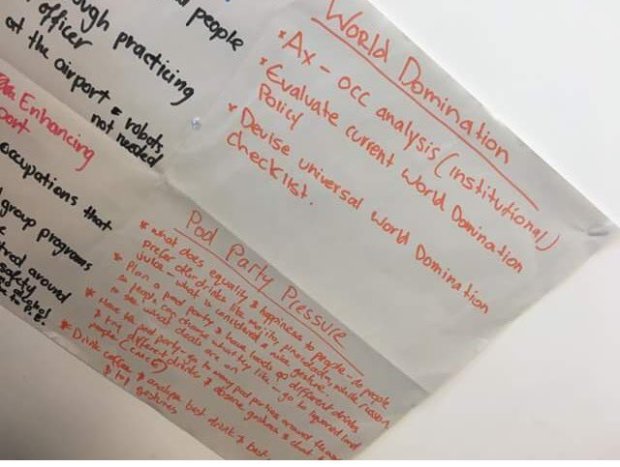
Working with Matthew in a collaboration between Griffith University and State Library of Queensland, I got to know him not just as a great writer, but a colleague and a friend. Combining a creative hands-on approach to occuaptional therapy education with foresight and psychodynamic work, we took Griffith students to distant futures — all in the service of exploring occupational therapists’ role in a changing world.

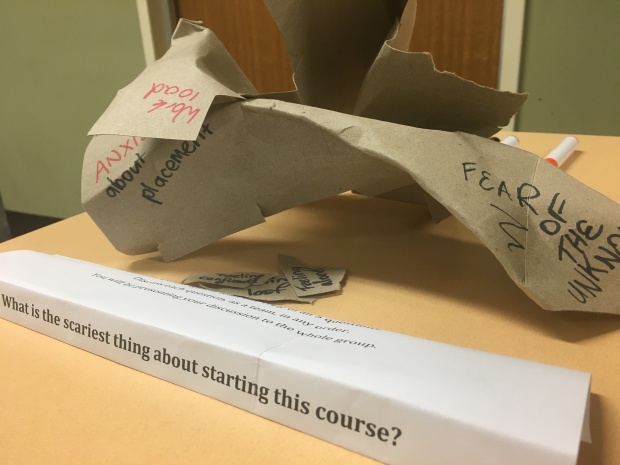
Toys, cake, and cardboard were just some of the materials which were brought into the work, which included a challenge to produce an edible presentation. The students were resourceful, empathetic, creative, good-humoured – exemplfying the best characteristics of their profession.

Now for The BMJ’s Medical Humanities podcast, Matthew and I join hosts Cristina Hanganu-Bresch and Brandy Schillace to explore scenario planning, healthcare, art, foresight, and the humanities.

“How I use the dream”: 5 reflections on strategy + reperception

What do I do? I help people think through big decisions, individually or collectively, when situations are uncertain.

It’s strategy, not therapy, but there’s kinship between the two.

Learning about “what goes on within and between us”, the psychology of individuals and groups, nourishes the work – and you can find that nourishment in unexpected places.

Sometimes it’s pretty conventional: a journal article, a course at the Tavistock, formal professional gatherings such as a group relations conference.

Sometimes learning seems to find its way to you: a challenging event in your personal life yields a nugget of wisdom, a conversation with a musician provides an unexpected metaphor, or maybe you get an unexpectedly helpful book recommendation from a chatty shop assistant. (That’s how I first encountered the work of Irvin Yalom).

Sometimes you can learn a lot just from getting stuck in a transit strike.

As Ellen Ramvi puts it, “learning is getting involved in what one doesn’t know” — and there’s plenty of ways to get there.

Read more

The power of an unresolved chord

In New York, I attended a concert, “Concerto per violini: 18th-century Italian virtuosi“, performed by members of Early Music New York (EM/NY).

At the end of the event, EM/NY announced the retirement from public performance of Frederick Renz, the storied conductor and early music expert who directs the organisation. They also announced that plans for future performances by EM/NY were as yet unclear.

The program notes for the event reminded us that, while most people think of concertos as works for solo instruments accompanied by an orchestra, the original definition of the term in the Baroque era, was “a work for musicians playing together.”

Such were the works performed at the EM/NY event, including pieces by Vivaldi, Arcangello Corelli, Pietro Locatelli, and Francesco Geminiani.

There’s a tension within the very name “concerto”: not just the way in which the term has evolved musically, but between the literal Italian meaning “gathering” or “accord” and the Latin derivation “concertare”, which denotes confrontation or battle. There are so many ways we can come together, in collaboration, competition, or opposition – sometimes “either/or”, sometimes “both/and”.

I was reminded of a workshop series which I ran for an organisation facing a challenging strategic situation, thick with uncertainty. Together, we built scenarios to explore how these uncertainties might play out in ways beyond their expectations, assumptions, hopes, or fears.

Those scenarios were then presented to the organisation’s board during an away day. Board members were introduced to the scenario planning approach, worked with the scenario material created by the organisation’s staff and other stakeholders, and then engaged in strategic conversation: what did these scenarios mean for the organisation? How could they inform the decisions which needed to be made?

Read more

Scenarios: Their Ends, Art, and Agency

Occasionally, I write a post in the spirit of “showing your working”: playing with one or more concepts, seeing how they fit together, what use can be made of them.

In today’s long read, I’m looking at the work of Alfred Gell, an anthropologist whose book Art and Agency explored the social efficacy of art: the way that artworks and the process of making them influences the thoughts and deeds of others.

If we take scenarios and other strategic artefacts as art-objects, what can Gell tell us about their making, their use, and impact?

Read more

Hopper/Vermeer: Things that never quite were

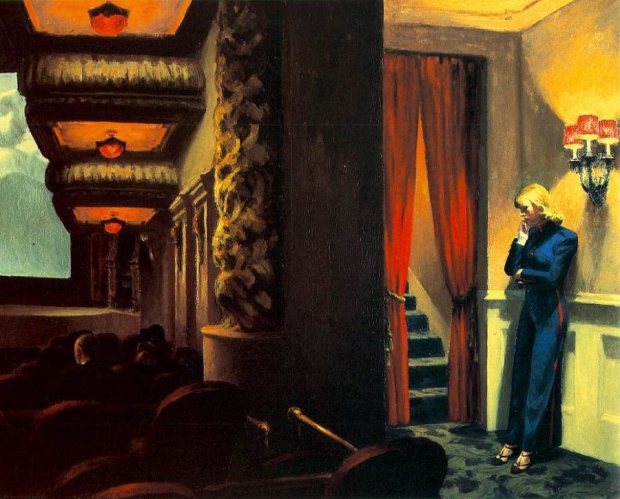
New York’s Whitney Museum is currently hosting an exhibition on Edward Hopper’s New York, which I visited on a recent trip.

As the exhibition blurb puts it, for Hopper “New York was a city that existed in the mind as well as on the map, a place that took shape through lived experience, memory, and the collective imagination.”

The show is especially satisfying for its use of newly acquired archives, showing how Hopper and his wife Josephine Nivison Hopper collaborated in a lifetime of artistic production.

Works like New York Movie are exhibited alongside preparatory studies and sketches as well as photographs from some of the real-life locations the artists visited as part of their creative process.

We see just how fictive Hopper’s New York was: scenes created from amalgamation of multiple locations, with imaginary additions or even omissions, creating a city-that-never-was which is nonetheless powerfully evocative of New York specifically and a certain quality of mid-twentieth-century American life more generally.

I’m always seduced by sketches; I love it when people show their working. You can see the traces of their choices, the possibilities they pursued and then abandoned, especially when the artist is “thinking through drawing”.

Read more