Scenarios: Their Ends, Art, and Agency

Occasionally, I write a post in the spirit of “showing your working”: playing with one or more concepts, seeing how they fit together, what use can be made of them.

In today’s long read, I’m looking at the work of Alfred Gell, an anthropologist whose book Art and Agency explored the social efficacy of art: the way that artworks and the process of making them influences the thoughts and deeds of others.

If we take scenarios and other strategic artefacts as art-objects, what can Gell tell us about their making, their use, and impact?

Read more

Hopper/Vermeer: Things that never quite were

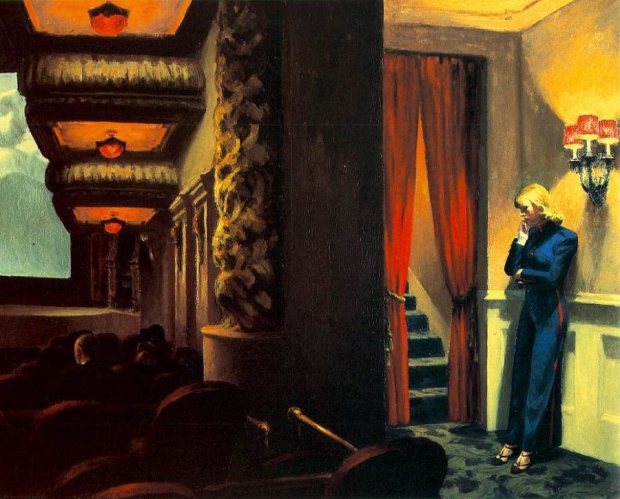
New York’s Whitney Museum is currently hosting an exhibition on Edward Hopper’s New York, which I visited on a recent trip.

As the exhibition blurb puts it, for Hopper “New York was a city that existed in the mind as well as on the map, a place that took shape through lived experience, memory, and the collective imagination.”

The show is especially satisfying for its use of newly acquired archives, showing how Hopper and his wife Josephine Nivison Hopper collaborated in a lifetime of artistic production.

Works like New York Movie are exhibited alongside preparatory studies and sketches as well as photographs from some of the real-life locations the artists visited as part of their creative process.

We see just how fictive Hopper’s New York was: scenes created from amalgamation of multiple locations, with imaginary additions or even omissions, creating a city-that-never-was which is nonetheless powerfully evocative of New York specifically and a certain quality of mid-twentieth-century American life more generally.

I’m always seduced by sketches; I love it when people show their working. You can see the traces of their choices, the possibilities they pursued and then abandoned, especially when the artist is “thinking through drawing”.

Read more

Life after trends

In the memorable phrase of Ged Davis, a trend is a trend until it bends…or breaks.

For many of us, the pandemic era has been a reminder of this, as the course of events has not always followed the trajectory we were expecting.

Today, we sometimes hear talk of “megatrends”, too; Stefan Hajkowicz of Australia’s Data61 told me you could compare these to the powerful rip currents which pull swimmers out to sea.

Sometimes such currents are hard to spot, and researchers put dye in the seawater to make them visible. Savvy surfers can use rips to swiftly travel out from the shore to the point where they can catch a wave.

Perhaps thinking in terms of trends can work this way, too: using foresight to make a previously unseen tendency visible, using strategy to take advantage of it.

But what happens when the perceived tendency, mega or otherwise, bends or breaks? Our expectations are thwarted and we are reminded that a trend is a projection from the past into times yet to come. The ghost of yesterday’s future haunts our thinking in the here and now.

It’s not that tendencies don’t ever endure – sometimes they do. But it doesn’t always tell us much about what is coming next. After all, we can’t gather one shred of evidence or data from events which haven’t happened yet.

Read more

IMAJINE: Visions of the Rural in a Globalised World

In the latest response to the IMAJINE scenarios for the future of European inequality, Professor Esther Peeren of the University of Amsterdam explores the representation of the rural in each scenario, relating these visions back to concerns and challenges in the present day.

Drawing on Donna Haraway’s work, she reminds us that, “Rather than seeking to predict the future or escape from the present, these are ways of ‘staying with the trouble’ in the present, for the future.”

Esther highlights “the dangers inherent to the fantasy of the rural idyll as an isolated paradise shaped by a homogenous community, as well as underlining that such isolated worlds are not exclusive to the rural but may also exist in urban areas and online”; and she reminds us that even when the urban-rural divide seems to be overcome, its inequalities can be displaced “to the global and even interplanetary scale”.

Find Esther Peeren’s response to the IMAJINE scenarios here.

The full IMAJINE scenario set can be found here.

The RURALIMAGINATIONS project “Imagining the Rural in a Globalised World”, which Esther heads, can be found here.

Preservation for All: Whose Future?

“We need to meet this inflection point with a more expansive imagination of what conservation work could be…The tools of the conservator can remind us of the fundamental human need for creativity, most especially under difficult or dehumanising conditions.”

In this short video for America’s National Gallery of Art, Sanchita Balachandran of The Johns Hopkins University speaks about “preservation for all” and strategising under TUNA conditions of turbulence, uncertainty, novelty, and ambiguity.

Chessboard Interrobang / Burden of Dreams

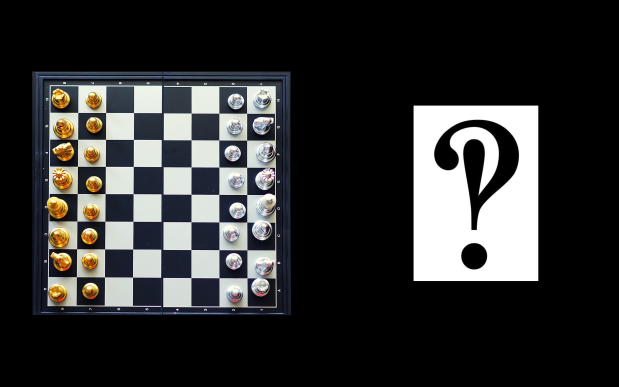
At a recent event, I was allowed just one slide to present an approach to strategic foresight.

Here it is:

On the left is a chessboard, the setting for a game where all the moves are knowable in advance, and the winning and losing conditions clearly defined. It’s just a matter of which piece goes where and when within the constraints of the rules. (Not that it makes chess easy!).

On the right is an interrobang, an unusual punctuation mark which is intended for use at the end of an exclamatory rhetorical question: Are you out of your mind!? Is this for real!?

To me, the point of manufacturing plausible futures when doing strategy work is more about the right hand side of the image than the left.

It’s not about identifying all the contingencies, or modelling all the ways you think the action could play out according to today’s rules.

It’s about showing you something which usefully pushes the bounds of what you believe is plausible; which uncovers issues previously unseen from your standpoint in the present, and makes you question yourself.

Read more

Scenarios for the future of civil protection in Germany

I served as an expert respondent on the pro bono scenarios for the future of civil protection in Germany created by the team at CapGemini Invent.

German speakers (or those of you possessed of a decent machine translation option) can read more about the Katastrophenschutz 2035 scenarios here.

IMAJINE: Behavioural insights and interventions with Stefan Kaufman

A.I. that is better at exploiting behavioural science than humans are; transformations in land management that enhance the value and sustainability of natural resources; defence of “cognitive sovereignty” in a world of dark patterns and malevolent nudges; the weaponisation of behavioural insights in the service of “socio-technical Darwinism”…

A new response to the IMAJINE scenarios for European spatial justice from BehaviourWorks Australia’s Stefan Kaufman offers a foresight perspective on behavioural science, insights, and interventions in the Europe of 2048.

PUSH SUMMIT Podcast with Rowan Drury, Malin Leth, Anders Mildner

Altitude Meetings’ PUSH Summit on climate and democracy is currently taking place in the Swedish city of Malmö and online.

I joined sustainability consultant Rowan Drury, Malin Leth from Håll Sverige Rent – the Keep Sweden Tidy organisation, and Altitude’s own Anders Mildner to discuss issues of system change, futures thinking, strategy, and sustainability.

You can listen to the half-hour podcast here and watch my short online presentation to PUSH SUMMIT here.