Scripturient: Handover

After five years, I’m passing ‘Scripturient’, my column at Information Professional magazine, over to the National Library of Australia’s brilliant Barbara Lemon.

Barbara joined me for a special handover edition of the column, looking back one last time – and taking a glance at what’s to come.

Read the latest ‘Scripturient’ as a PDF download here.

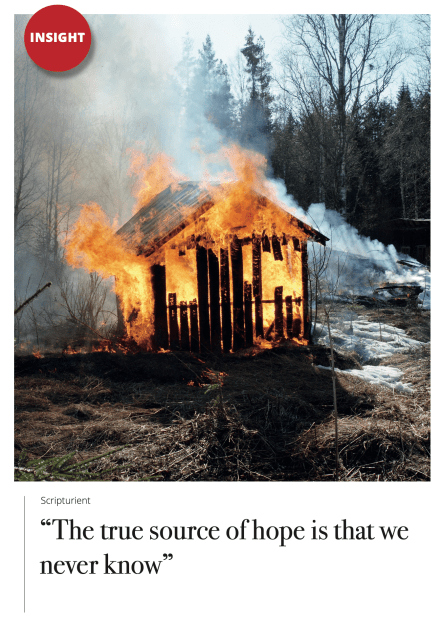
“The True Source of Hope Is That We Never Know”: Scripturient x Design by Fire, with Brett Milligan

The latest edition of Scripturient, my quarterly column for Information Professional magazine, is out now and can be downloaded here.

In it, I interview UC Davis’s Brett Milligan, who together with Emily Schlickman is the author of Design by Fire, a new book exploring our relationship to wildfires.

A transcript from the interview underpinning my column can be read below.

Matt: What was your first ever encounter with fire in nature?

Brett: It would have been the hearth at home, or campfires; my dad took me, sometimes the whole family, camping a lot as a kid and would be very clear about taking care to extinguish it properly. I wasn’t exposed to wildfires until my time in California, decades later, and my first close-up experience with a large wildfire, the smoke, the immediacy of it, came with the LNU (Sonoma-Lake-Napa Unit) complex fires a few years back.

By Dripwoods – Taken of the LNU Hennessey Fire, CC BY-SA 4.0, https://commons.wikimedia.org/w/index.php?curid=93869076
Read more

Scripturient: To Dream Like A Human

The world could always be otherwise than it is. Sometimes fate is only a failure of imagination. The trajectory of automation is not only uncertain, it is unwritten. The fundamental question is less about technical capacity than ethics, authority, and accountability: Who will create the future – and with what ends in mind?

In the latest instalment of ‘Scripturient’, my quarterly column for Information Professional magazine, I draw together comments from a few different thinkers on automation and art.

You can read ‘To Dream Like A Human’ here.

Scripturient Interview: Karen Levy, Road Scholar

In the latest issue of Information Professional, my column ‘Scripturient’ features an interview with Cornell University’s Karen Levy. An assistant professor in the Department of Information Science, and associate member of the faculty of Cornell Law School, Karen researches how law and technology interact to regulate social life, with particular focus on social and organizational aspects of surveillance. We spoke as her new book Data Driven: Truckers, Technology, and the New Workplace Surveillance was being released in the UK. You can download a PDF of my Scripturient column featuring Karen here, and a transcript of our conversation is below.

Read more

Scripturient: Computing Taste – Interview with Nick Seaver

For the latest issue of Information Professional magazine, my Scripturient column features an interview with Nick Seaver, Assistant Professor of Anthropology at Tufts University.

Nick’s new book Computing Taste uses ethnographic fieldwork to explore how the makers of music recommendation algorithms understand and go about their work – from product managers thinking about their relationship with users to scientists theorising the act of listening itself as a kind of data processing and engineers for whom the world of music is a geography to be cared for and controlled.

You can read the latest Scripturient column featuring Nick as a PDF download here, and there’s a full transcript of our conversation, digging even deeper into these issues and other elements of Nick’s research, below.

Read more

Scripturient: Information and Exformation

For years you think talking means finding, discovering, understanding, understanding at last, being illuminated by the truth. But no: when it takes place, all you know is that it is taking place; it’s there, you’re talking, you’re writing: talking is only talking, simply talking, writing is only writing, making the shapes of letters on a blank piece of paper.

– Georges Perec

How do you talk about a thing without talking about it? What is concealed by our efforts to make ourselves understood?

The latest Scripturient column for Information Professional is an experiment with “exformation” – the negative space of information.