The Comic Maker lets you drag and drop characters inspired by Emily Medley’s original Fun Palaces illustration into a comic-book story of your own devising.
We’ve been working on this behind the scenes for a long time, ever since I pitched the idea of an online version of Comic Book Dice for Fun Palaces 2015.
Talia Yat and Phil Gullberg of the State Library of Queensland have run with this idea and developed it into an amazing online game, as part of the Queenslanders’ contribution to Fun Palaces 2015.
It’s been a huge team effort and thanks must go to: Fun Palaces’ Stella Duffy, Sarah-Jane Rawlings, Hannah Lambert, and Kirsty Lothian; Zoey Dixon of Lambeth Libraries; Daniel Flood of State Library of Queensland; our web host Simon Appleby of Bookswarm, plus Sandy Mahal who put us in touch with him; and last but not least our digital Brains Trust of Ed Bishop, Martin Feher, Barney Lockwood, and Steven Moschidis (“I’m tempted to say I will host it just to stop the funky emails!”).
We spent four hours on the streets of South London, playing Comic Book Dice, getting people to dress up as figures from historic paintings, and sharing strange facts about art from the Dulwich collection – like The Takeaway Rembrandt, the second most stolen painting in the world…
The NCS teen volunteers will be running their own, completely self-directed art event, PROJECT SCREAM, in Ruskin Park on Saturday 26th September.
I’ll be back at Dulwich in December for my event Your Mind Is The Scene of the Crime, an activity which invites you to explore what lies in others’ hearts, delve into the dark side of the gallery, take secrets and lies and make them into art.
Your Mind Is The Scene of the Crime is part of Dulwich Picture Gallery’s Escher season. More news soon!
TimeQuest Postapocalyptic Auckland Skyline by Nicola Brady
Heritage is one of the most exciting challenges in community outreach. It’s an opportunity to dispel the myth that the past is staid or somehow divorced from the present. Many public and private bodies hold weird and wonderful archives, unique traces of the generations that have preceded us. Everything we do and dream is rooted in what has gone before, whether we like it or not, and yet the past is not fixed, as we uncover new truths, new ways of looking at those who have gone before us. The strange and beautiful thing about historical narrative and memory is that even a path you’ve already trodden can still change course in retrospect.
Two years ago I visited Auckland in New Zealand for a six month contract as Service Development Adviser to the city’s libraries. My brief was “to push the boundaries in how our large public library network creates innovative programmes for children and young people […] to inspire others to experiment and learn from the experience of working in fresh, even unexpected ways.”
During my stay, Auckland celebrated its 2013 Heritage Festival, an annual “opportunity for everyone, locals and visitors to Auckland, to celebrate and remember our past and discover our heritage.”
With my Auckland Council hat on, I looked for ways to make the past thrilling, and immediate, and to create opportunities for each neighbourhood library to take responsibility for devising and delivering inspired, playful programming.
A trip to Chromacon, the city’s festival of illustration, led to a meeting with British expatriate artist Nicola Brady. Her drawing of a crumbling present-day Auckland was the perfect inspiration for a time-travelling heritage event.
Nicola’s doomy vision provoked questions: What if we made our heritage programming about both the future and the past? What if we turned it into a dynamic mission of rescue, with participants making their own choices about the value of history?
TimeQuest was born: a season of cultural programming for the school holidays, with a heritage theme and an overarching narrative:
Auckland, 2379. It’s the end for planet Earth – a red sun burns in the sky and the ground is parched of life.
The last survivors are preparing to leave for a new home on the other side of the galaxy, when the scientist Maia completes her greatest invention – a time portal that can take you to any moment in Auckland’s history.
Her plan: to send you back in time to recover the best books, art, and objects from New Zealand’s past. Time has run out for the planet Earth, but we can still rescue the best of our heritage and take it with us to our new home.
Where will you go – and when?
What will you choose to save?
Time Quest – Raid the past to save the future.
For me, it was important to create a storyline which respected New Zealand’s bicultural past and future. If we were going to imagine a postapocalyptic science fiction setting, it would be one where Māori identity was front and centre. Our defiant genius hero would be a Māori woman and a scientist, who invited TimeQuest participants to make their own decisions about the value of heritage, rather than accept some dusty authoritarian imposition.
My Auckland supervisor, Peter Thomas, is a Māori public servant with extensive experience offering guidance and representation to government bodies working in New Zealand. He helped us to choose the right name for our rebellious female science-hero, and also took me through the process needed to approve the use of a quote I’d found at Auckland Museum, which became the motto of TimeQuest:
“Haere mai, e tai, kei te wera te ao”
“Come and see, the world is going to be burned”
These were the words recalled by an eyewitness to the 1886 eruption of Mount Tarawera, a violent natural disaster which decimated communities. I had seen the quotation in a display on volcanoes and earthquakes at the Auckland Museum, and saw it as a symbol of our programme’s link between an imagined future and authentic historical accounts. Peter helped guide me through the sensitivities around using a quotation in this way.
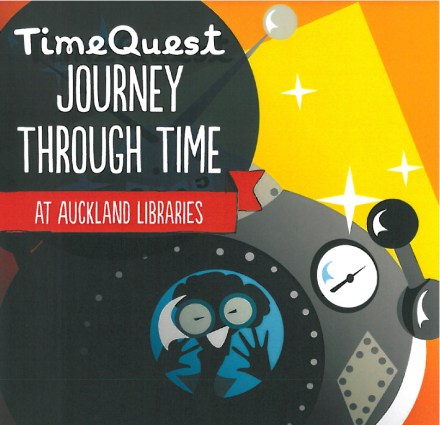
To balance out the gravity and drama of our programme, we also created an alternate promotional image which was friendlier and more cartoony, for TimeQuest events featuring younger children.
Auckland Libraries – Timequest logo
Having established our storyline, we wanted to be sure that local communities would create their own events and not just copy some central voice of authority. We wanted local stories, local histories, local art, and local play – so rather than create a prescriptive centralised programme, we created a resource pack with eight model activities to serve as inspiration for local librarians to devise their own versions.
Our simple missions included robotic dress-up, Nerf gun battles, creative writing, and research activities for a variety of age ranges. In many ways these events were the forefathers to later projects like Time Travel Detectives, Write Your Own Urban Myths, and Big Box Battle.
Auckland’s librarians ran with the inspiration they’d been given and came up with sessions such as these:
Time travellers from the year 2379 are on their way to find out information about the culture and life of the tweens and teens of today. They’ve asked us to make a teen’s room that they can teleport to the future. Help us to design and decorate a representation of what a teen’s room looks like in 2013.
Life in 2379 is rather bleak. With the sun burning out, life on earth is dying. The time travellers have come back to 2013 to gather enough knowledge and resources to save the future generations. But they will need enough sustenance to do this. Tweens and teens will be asked to investigate the vitamins and minerals humans need to keep healthy and strong. They will then be blending up some fruity concoctions for the travellers to take back with them to help them save the world.
Time travellers, to slow the sun and save the future you have been asked to bring back to the future Maui, the Māori hero of How Maui slowed the sun. Listen to the story and help Maui to catch and slow the sun again by making your own fishhooks and ropes.
It was great to watch local librarians take on the challenge and the opportunity of a heritage programme that left space for their own creativity. TimeQuest was just one of many experiments in Auckland over my six month stint there: everything from zombie battles to librarians in comic book stores and a national youth libraries conference.
Over the last couple of years, I’ve watched with pleasure as participatory, local, and lively approaches to culture and creativity have spread. For me, the most promising model for a decentered, participatory approach to the arts in local communities has been Fun Palaces, the British event co-directed by the Kiwi-raised Stella Duffy from an original 1960s idea by Joan Littlewood and Cedric Price. If it’s true that the neighbourhood public library is the gateway to all human knowledge and culture, then Fun Palaces are a beautiful fit for libraries’ swashbuckling cultural mission.
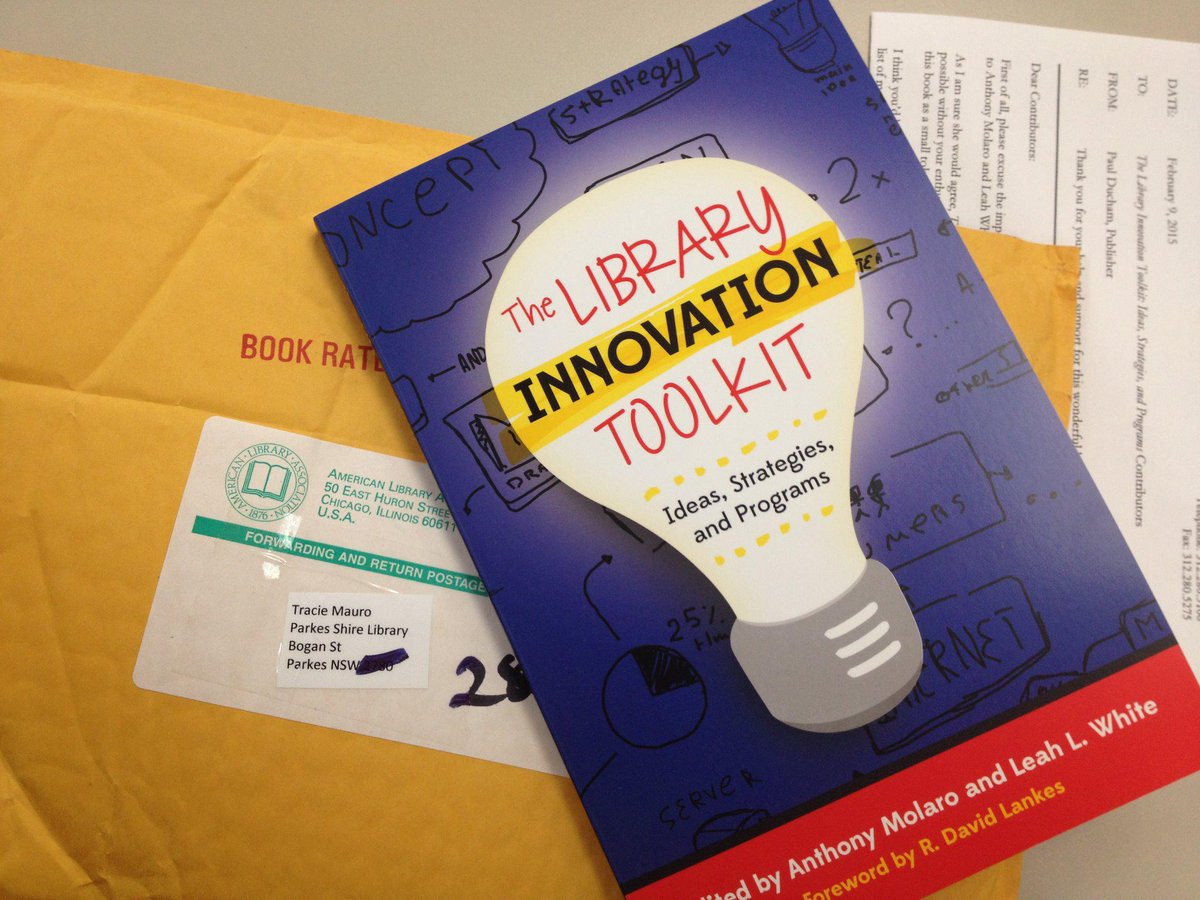
The book “encourages readers to take big risks, ask deeper questions, strive for better service, and dream bigger ideas”, with practical examples and suggestions for 21st century library services.
I wrote “Monsters, Rockets, and Baby Racers”, the chapter on working with children and young people, together with Tracie Mauro of Australia’s Parkes Library.
I love the author bios on books. Reading a good one is like reading old-time liner notes on records. The texts have an eccentric politeness, their formality spiked with unexpected jabs.
I first noticed this when my mum introduced me to The Day of the Triffids. John Wyndham’s bio on old Penguin paperbacks stated that he “decided to try a modified form of what is unhappily known as science fiction.” That adjective, that adverb, inflected everything that you read and thought about the man and his words.
'…and decided to try a modified form of what is unhappily known as "science fiction."' pic.twitter.com/B7nIbvgK6Z
I got a similar feeling from the author bio of Alice Munro, one of my favourite writers. When I discovered her in my first year at university, the bio included this comment:
I guess that maybe as a writer I’m a kind of anachronism…because I write about places where your roots are, and most people don’t live that kind of life any more. Most writers, probably, the writers who are most in tune with our time, write about places that have no texture because that is where most of us live.
I love that quotation. It is wry and quietly, Canadianly, contrary. At once it marginalises the speaker and humbly suggests that there might be a value in being out of tune with one’s time.
(And is there any better way of positing Alice Munro, of all people, as a science-fiction writer, than to suggest she is out of tune with our time, a fantastic voyager to the lost chronotopes of ordinary life, what she describes as “deep caves painted with kitchen linoleum”?).
Aimee Bender’s The Particular Sadness of Lemon Cake, which I’ve just finished reading, deals with one of these archetypal “places that have no texture”, white suburban Los Angeles. But the central conceit of Bender’s novel is not the absence of texture which Munro describes. What troubles young Rose Edelstein is texture in excess.
Turning nine years old, Rose develops the power to taste the emotions of the people who make the food she eats. It begins when she detects hidden despair in her mother’s lemon-chocolate cake, but Rose is equally overwhelmed by food in the school cafeteria, her friends’ lunchboxes, or the restaurants she visits. Gradually she becomes able to taste the origins of each individual ingredient. She can read the story behind the apparently “effortless” business of putting food on her plate.
This is timely magic for an age when food production and consumption has come, for many in the developed world, to seem effortless. Supermarket ready meals seem not to have a history, but Rose can detect where the ingredients were grown, and in which factories they were produced, as well as the moods of the people involved in their making.
Bender doesn’t let this become a straightforward search for authenticity. Rose’s mother, the cook whose food triggers the trouble, is on a jittery quest for just such a thing, some deeper and more authentic sense of how to live. She treats Rose’s standoffish brother as a kind of guru, but comically misreads his signals. When he closes his eyes at dinner to avoid eye contact with the family, she thinks it is an unspoken directive to focus on the sense of taste above all others, yet she never detects any of the sensations that bother Rose’s palate. After flitting from one pastime to the next, Rose’s mother devotes herself to woodwork, yet her own daughter’s existence gently mocks the pursuit of traditional craft: Rose finds herself dependent on junk food and industrially produced snacks to survive. (Rose gives a paean to the Dorito: “What is good about a Dorito […] is that I’m not supposed to pay attention to it. As soon as I do, it tastes like every other ordinary chip. But if I stop paying attention, it becomes the most delicious thing in the world.”).
Rose is living in the world Alice Munro imagines, the world without texture, not because the world has been drained of meaning, but because she has become overly sensitised to the inescapable meaning of everything she consumes. Rose’s brother, who begins to disappear intermittently from the family home, faces a similar struggle. He fades away from a world that is too much, not too little.
It’s significant that Lemon Cake is set in Los Angeles, a city whose texture is dictated by the superficial blandness of suburbs and freeways. (A recent LA Review of Books piece on the historic home of sci-fi writer Ray Bradbury captures the complications of LA’s real estate battle between the past, present, and future).
It’s also important that Lemon Cake is set during Rose and her brother’s coming-of-age. As Bender puts it in her entry to Book Club Cookbook, Rose’s talent means that “what is normally one of the most lovely and innocent parts of childhood comes packed with complication.” In my previous discussion about the literature of adolescence, I focussed on a line which appeared first in Buffy the Vampire Slayer and then in Doctor Who, articulating the idea that a character, in coming to know who they are, is “still cooking.”
BUFFY: I’m cookie dough. I’m not done baking. I’m not finished becoming whoever the hell it is I’m going to turn out to be.
The magic at the heart of Bender’s novel complicates this metaphor. Cooking is what undermines Rose’s straightforward growth to adulthood. She is an outsider, compared to the “Downhill Girls” she sees coasting their way through their teens, precisely because of what she tastes. Cooking reveals her mother’s secret sadness, and beyond that a wider, more complex world, with which Rose must learn to live. Rose’s struggle to understand her power leads to companionship, solace, and the truth about a family history of uncanny talents. It also leads to irrevocable loss, and the disappointment that Rose’s father has been unwilling to explore his own inherited abilities, for fear they would make his life a misery.
By the end of the novel, Rose comes to an accommodation with her ability which moderates its worst excesses. She even finds a way to use it for the good of others. Nonetheless, her compromise with the world remains imperfectly satisfying, and therefore “adult”. Rose remains, in a sense, as “out of tune with her time” as Munro. Perhaps we’re not yet done cooking, as we progress from adolescence to adulthood; but sooner or later, Bender seems to say, we will have to sit down to the meal we have prepared.
He looked slick, fought bad guys, and lived in luxurious style in a train caboose with his pal Artemus Gordon—every week a new location and a new adventure.
But more than that, the look: that snugly fitted suit, short jacket, broad shoulders and black boots. Sure, he did spend a lot of time shirtless and tied up, too. Somehow at the advent of the androgynous glam rock look of the 70s and the nascent punk scene, anything at all seemed possible—at least until my body betrayed me with the double-whammy of adolescent hormones and a thyroid that tipped over into overdrive, hitting my rangy frame with unexpected curves and a bewildered loss of identity.
That surge of hormones denying the androgynous dream brings us back to adolescence. I’ve never quite had that feeling of being forced into a category that didn’t fit me. As I sit fairly unproblematically within the straight white male box, coming to understand my identity has been more about what Eula Biss describes as “the need to acknowledge myself as dangerous.” It’s a slow and inconsistent process of learning how harmful, and how boring, we might be when our identity oppresses others. I read Biss’ words in a Harper’s interview about her book on vaccination; I’m now keen to pick up Biss’ Notes on No Man’s Land and give her thought further attention.
Still, I remember the feeling Laity describes at the tail end of my teens, before my body made the definitive shift away from androgyny.
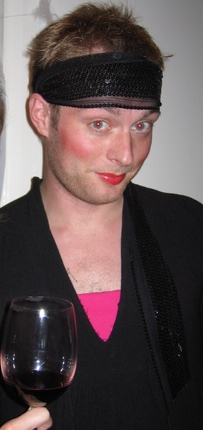
As a kid, dressing up had been everything to me. Spaceman, spy, Indiana Jones, whatever could be cobbled together from party masks and old clothes in the attic. My earliest memory is jumping off the (very low) roof of our back garden’s buried World War II bomb shelter dressed as Batman. I remember going to school for Hallowe’en dressed as a witch; my mum had a moment of inspiration, cut through the point of the plastic hat to make a flip-top lid, and filled the insides with exposed “brains” made from red paper and bubble wrap. It was my all-time favourite dress-up and I’ve loved Hallowe’en ever since.
Mum stayed cool with this proto-drag as the years went on. There’s a photograph somewhere of my little brother and I in her old clothes, lip-syncing and pretending to be the girls from ABBA.
In my teens this sense of dressing up and trying on new identities became more my own, not just play shared with a parent. The stakes grew higher as adulthood bore down on us.
I remember being in the pub, brown suede jacket, satchel, a metal Miss Selfridge heart from a girl’s sandal pinned in the lapel; a kind of lingering Indiana Jones get-up. I remember a guy from school telling me that with my hair worn long, I looked just like Heather Graham. I savoured the conflicted feeling that showed in his eyes.
Some of us at the all-boys’ school cultivated an air of camp, deciding which girl you’d have been in The Craft and having earnest discussions about whether Madonna’s voice coaching for Evita, which seemed to have affected her vocals on Ray of Light, had spoiled the Material Girl’s vulgar edges. The gym I went to had stacks of magazines for people to read while on the cross-trainer. Men had FHM and Loaded, women had stuff like Vogue. I would make a big show of reading copies of Marie Claire; the women were hotter and the articles better.
Some of my campness was protective camouflage; a lonely teenager’s fear of socialising, a way to hide from the supposed obligations of being an eighteen year old boy. Some of it was the late 90s trend for androgynous indie musicians. Some was using a performance to keep from saying what you really felt. But it was also a feeling of potential, exultant display, the feeling that Laity reminds us of when she quotes RuPaul: “We’re born naked, and the rest is drag.”
Such a useful, powerful line that. Drag is every choice of clothes. It is signification, is language, is the art of conveying meaning. Think of Roland Barthes: “Language is a skin: I rub my language against the other. It is as if I had words instead of fingers, or fingers at the tip of my words. My language trembles with desire.” (LH Johnson writes beautifully about her love for that quotation). Drag is everything that we use to communicate with the world.
The years go by, the body thickens and changes, the clothes I choose now speak a more conventional language. At thirty-four, the space marked masculinity is, in some ways, an increasingly comfortable – or at least taken-for-granted – fit.
Hell, one of the lads in the “Being A Girl” video grew up to be Danny Dyer.
Just whacked me tree up…..it's looking slightly camp this year…..can't work out how 2 give it a pair a bollocks. pic.twitter.com/6OHRpGm0GK
As I grew up, I had the luxury of nestling within a category which society more or less gives licence to behave as it wishes, straight, white, and privileged. If I stepped outside to play dress-up, I could always step back if things got scary. Hence why exploring identity can mean recognising oneself as vulnerable as well as dangerous.
I still savour the fact that all dressing is drag. That there is potential for expression, subversion, art, and play in every choice we make. But I also hope that getting older means listening better, and noticing when people are being hurt by the categories life imposes on them. It means remembering that RuPaul line not just as a manifesto for exultant display, but also one that guides compassion.
I just finished rereading Clive Barker’s Weaveworld, the 1987 fantasy which sees a world of magic, concealed for a century in an enchanted carpet, unleashed on contemporary Britain. It’s timely: I’ve been writing about the borderland between adult and YA literature lately, and I read the book when I was just starting high school.
As I write this, the rain is streaming down on an August bank holiday in the UK — but I think I’ve just had the best summer of my adult life. One of those childhood summers that seem to go on forever. As if these months of 2014 had opened a gateway from adult mundanity into the eternal Dream Summer.
For me, that summer’s epicentre lay somewhere around 1989 or 1990. I was about ten years old. It’s not precise because events, details, things I imagined and things I later learned, have all since run together. They slip beneath the calendar’s boundaries in both directions.
Trying to respond to Louie, I find I’m a terrible critic. I lack perspective. I can’t formulate a consistent position, although I’m curious about the trend for adults to read YA literature. I feel like there’s something going on right now with adulthood and youth that’s fascinating – that really matters, even more than usual. The best I can do is wander around the borderlands between those categories. Maybe Louie’s right: maybe it’s some kind of strange intergenerational schadenfreude.
Ruth Graham tried to question adults reading YA at Salon.com earlier this year, but her piece fell into genre shaming – making readers feel bad for picking up a YA book as they might have once been for reading science fiction or romance. (Graham states: “Adults should feel embarrassed about reading literature written for children.”). I don’t have a lot of time for people who demean YA literature as simplistic or unsophisticated, unworthy of serious attention.
And yet…I’m fascinated, and bemused, by this vogue among adult readers for a genre defined by its position as adulthood’s other. Louie’s Twitter correspondents expressed boredom with an adult literature obsessed with middle class neuroses, contrasted with the hope and opportunity represented by adolescence. YA then got compared to superheroes, sci-fi, and fantasy, those other great genres of freedom and possibility. All this chimed with the things that have been troubling me about “adult” and “YA” literature.
As part of my Researcher in Residence project, coffee cups in the cafes of Parkes, New South Wales have been printed with stories and poems written by local writers.







 matt finch / mechanical dolphin