I love writing. It means everything to me. It’s excruciating. It kills me. I couldn’t do without it.
Not just big, epic, heartfelt things make me feel this way. It happens every time I try to string a sentence together.
Reports, articles, academic essays.
Emails to business contacts (How much warmth to offer without wasting their time? How short to make paragraphs so the points are kept clear? How to sign off?).
I’m still thinking too hard about a twelve-word message I once wrote on LinkedIn in response to a moderately enticing offer of work. Too casual? Too brusque?
The other week I got a piece published in The Conversation, a website which helps academics and researchers get their work out to a wider audience. The article was about using public libraries to help communities think about the future, using a method called scenario planning.
The article has been well received and widely shared among library professionals. It only got a minor tweak from the editor before it was published, but the final draft took a fair bit of work and I needed help to get there. So I thought I’d share the process with you here on the blog.
It draws on research I conducted with the University of Southern Queensland’s Kate Davis and conversations with Rafael Ramírez of Oxford’s Saïd Business School.
The article explores the possibility of using public libraries as hosts for deeply local scenario planning initiatives, putting foresight tools commonly used by policymakers, big business, and the military in the hands of grassroots communities.
On 17th July, this one-hour session for Florida librarians will introduce you to simple, quick-to-master tools and techniques for building strategic awareness and setting out your service’s plan for the future.
I’m featuring some accounts of the island from people who have attended Island sessions, or run Islands of their own, to give you a better sense of what it means to take part in, or even organise, your own Library Island.
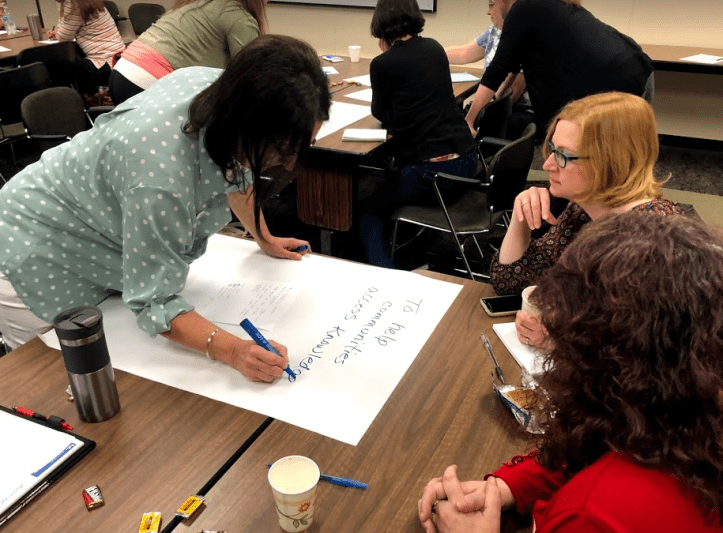
This week, we’re joined by Pennsylvania public librarian Justin Hoenke, who attended an Island session with colleagues from across the western part of his state in June 2019. The activity was embedded in a day-long event focussed on strategic & scenario planning for public libraries and their communities.
This interactive training activity helps participants to explore strategy, innovation, and the messy business of working with communities. We’ve spent the last two years perfecting Library Island with university staff, health workers, museum professionals, students, and, yes, librarians.
Something this weekend reminded me of the time I was too lazy to transcribe the builder’s order for materials and just scanned the plank he’d been writing on, so I could email it to the merchants.
Later, I was talking to my friend David, who teaches at a university. These days, student papers are submitted and marked electronically. That won’t surprise you, I’m sure, but what impressed me was that David delivers his marks and feedback as audio files which the students can then listen to when they get their grades.
The students have responded positively to the audio feedback, and David finds it more efficient, too. He reads the paper once, then goes back through it dictating into his phone. Not only does he get the work done in less time, but it helps him to highlight the reading experience to his students: “By the time I get to this point in the essay, I’m lost, because you haven’t established your argument on the preceding pages.”
Another friend who works in a senior academic role refuses to give book reports in written form; instead, he will mark out two hours of his time and take editors and publishers through his comments orally, over the phone. It saves time, means he can work from his notes, and enables them to question him or seek clarification as they go.
Earlier this month, I was leading an event for the Royal Dutch Library of the Netherlands exploring the future of our relationship to the written word. We pondered how new technologies and their social impact might affect this relationship, including developments in machine recognition of text and speech.
“If voice recognition and machine transcription were perfect,” we asked, “what would we gain? What would we lose?”
One of the first responses was immediate and positive. “No one would ever have to take minutes in a meeting again.”
We then started to explore issues around archiving and preservation, disability and accessibility, and division between technological ‘haves’ and ‘have-nots’.
Such explorations formed the basis of our event’s opening activity, which encouraged participants to challenge their thinking about the future, rather than resting on the assumptions of the past. It’s part of an ongoing project at the library to develop a space which explores the Netherlands’ relationship to the written word.
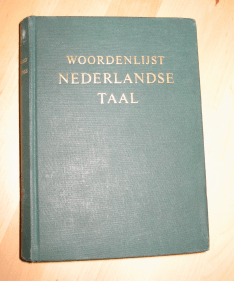
The 1954 “Groene Boekje” guide to the Dutch language. Image by Wikipedia, used under a CC BY-SA 3.0 licence.
This is particularly interesting in a Dutch context, because the Dutch language is regulated by an international treaty which seeks to maintain consistency between use in the Netherlands, Belgium, and Suriname.
All of this dispute, debate, and linguistic politics provided rich pickings for a group of Dutch culture and information professionals trying to imagine a library space devoted to the future of the written word in the heart of Den Haag.
This slideshow requires JavaScript.
From speech recognition to linguistic treaties, graffiti and doodles, hate speech and ‘fake news’, the value of fan fiction, battles over privacy, piracy, and copyright, and the political power of the written word, there’s so much to be discussed when we imagine the future of reading and writing.
Courtesy of the Spanish Ministry of Culture & Sport, plus the Ubik Tabakalera library in San Sebastian, I’ll be joining librarians, architects, culture professionals, and other stakeholders in the future of public libraries for a one-day workshop exploring challenges & opportunities in community collaboration.
What does it mean for these institutions to join forces with organisations, institutions, businesses, non-profit entities, users and potential users, when designing & delivering the services of the future?
How might libraries serve as spaces of collective creation & learning, and how would this service relate to their traditional mission and brand?
How could awareness of the wider transactional and contextual environment affect the way libraries define and negotiate their own future?
I’ll be joined by librarians from across southern Europe to explore these issues in an open, participatory, multidisciplinary format. In addition, our host venue is Ubik Tabakalera, one of the most fascinating public libraries in Europe, headed by the fiercely impressive Arantza Mariskal.
Spanish speakers who love their library and want to help shape its future should join us in the Basque Country on 30th May for a day of discussion and debate.
We can’t predict the future, yet we do it all the time. We have to: there are objectives to be set and met, projects to be devised and delivered, holidays to be booked, birthdays to celebrate, mouths to be fed, children to raise, dreams to be fulfilled.
Sometimes people and organisations anticipate the future based on what has gone before – but then we risk being blindsided by social and sectoral changes, financial crises, political upsets, natural disasters, and complex systemic challenges.
So, how do we prepare for futures characterised by turbulence and uncertainty?
What methods help information professionals to develop foresight, insight, and awareness that will support decisions made for their communities, teams, and institutions?
This June, visit the University of Toronto’s iSchool – “Learning to Plan on Library Island” – to develop skills and awareness which will help you to deal effectively with potential threats, opportunities, and challenges.
This two-day event will feature speakers including Peter Morville, author of Planning for Everything; Stephen Abram of Lighthouse Consulting; and Rebecca Jones & Jane Dysart of Dysart & Jones. I’ll also be there to offer insights gathered from information professionals working with institutions, communities, and businesses around the world.
Experienced consultants and leaders in the information profession will share planning tips, tricks, and methodologies. Participants will explore and experiment with new ways to develop their strategy, vision, and mission, including sessions of the Library Island play-based activity.
It’ll be provocative, inspiring, practical, challenging, and fun. Visit http://www.thefutureoflibraries.org to see more about this June’s University of Toronto iSchool – we’d love to see you there.